
Less Brampton, more Haliburton
A cottage in Highlands East · Assessed August 2026 · Planted September 2026
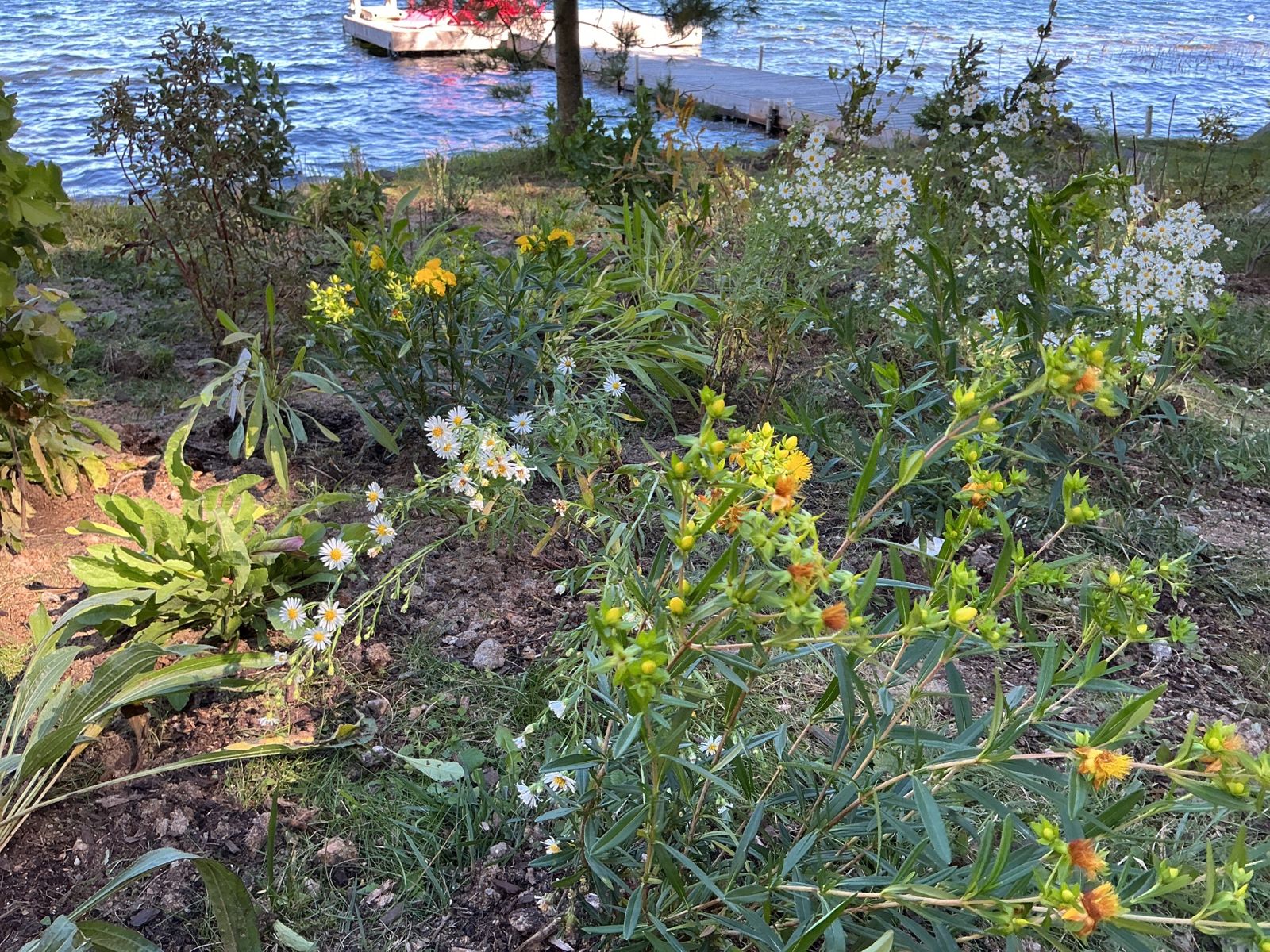
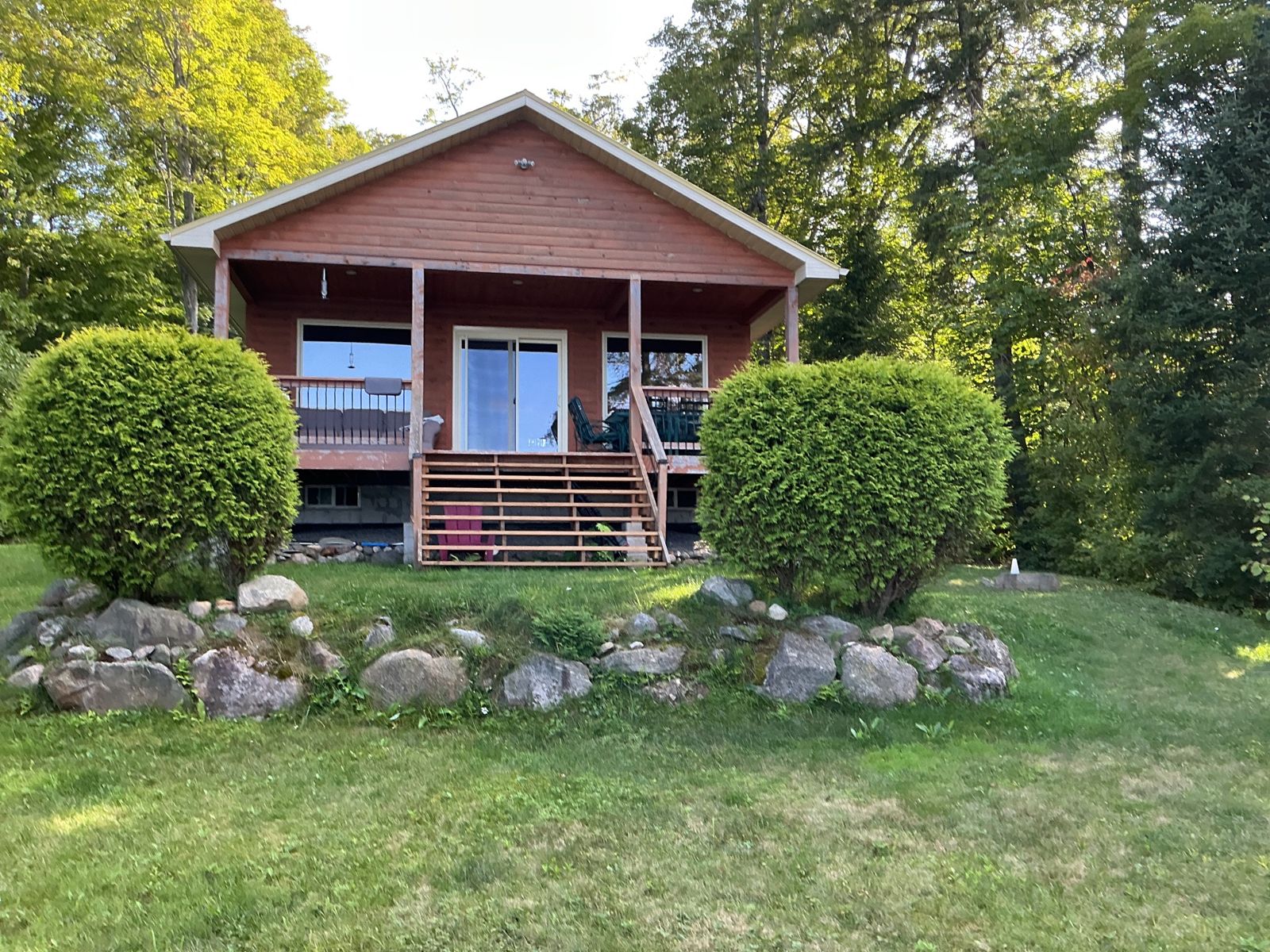
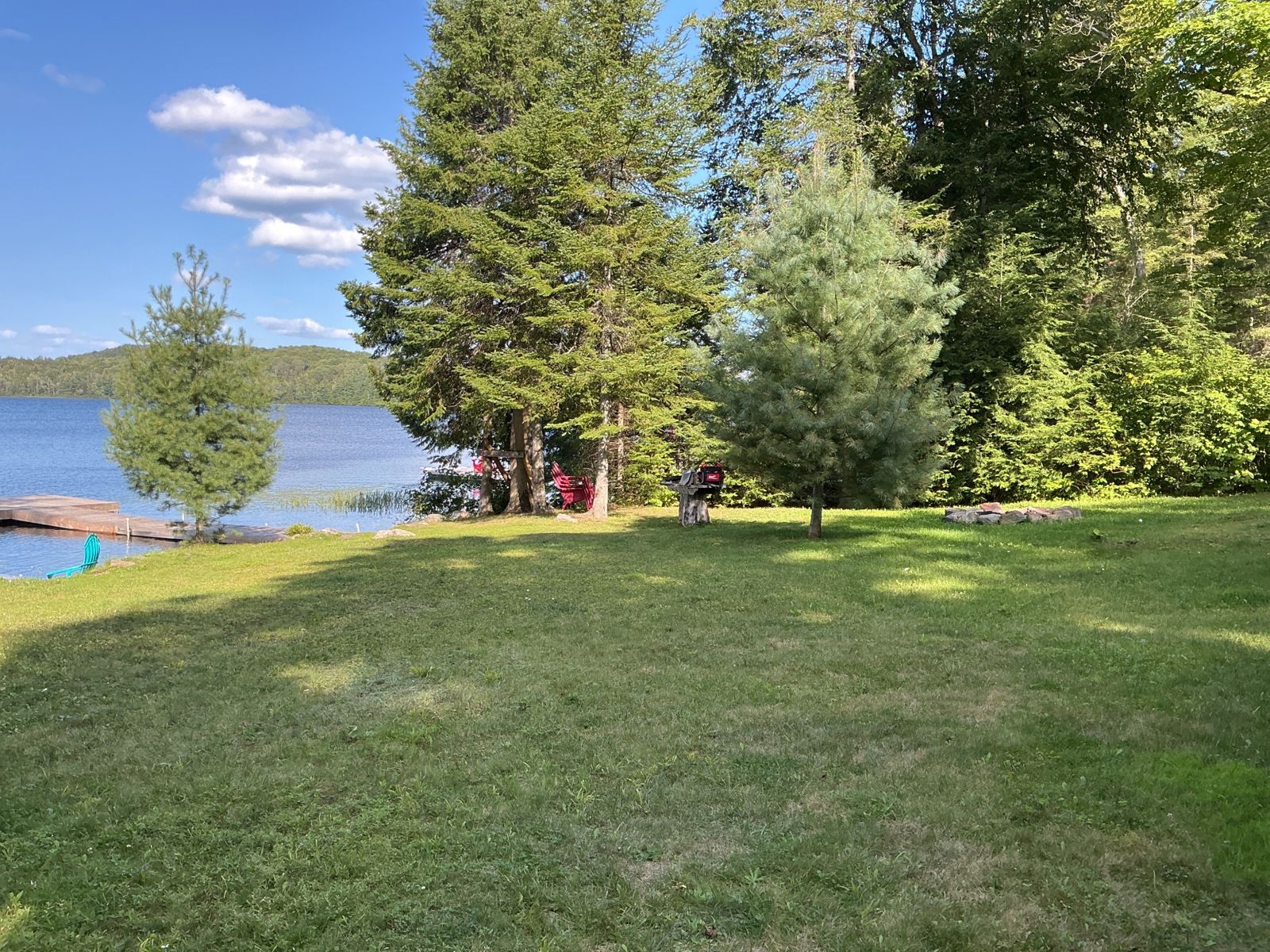
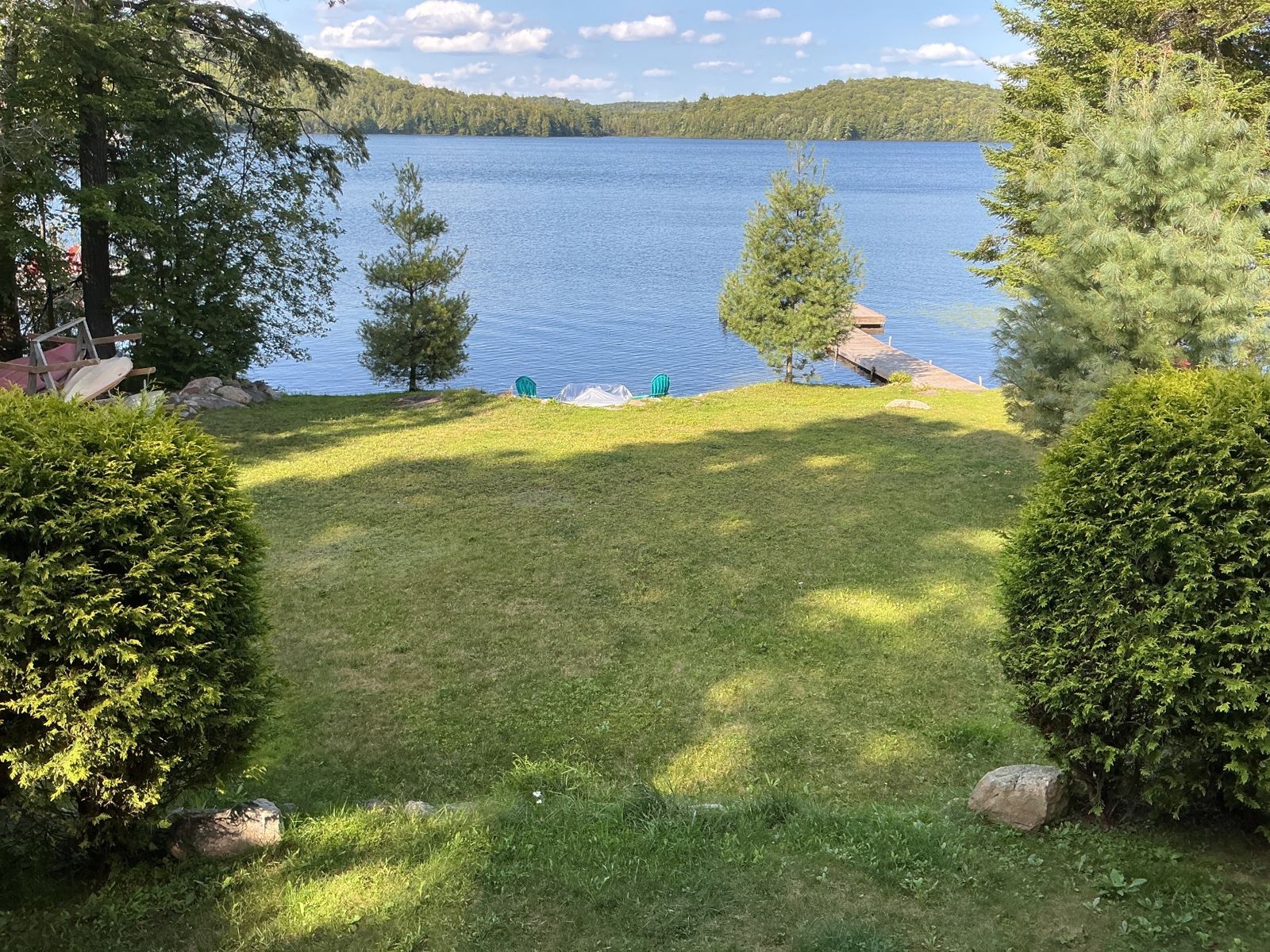
The cottage came with a landscape that could have been anywhere in the GTA. Clipped cedars flanked the front steps. A straight line of trees and shrubs marked the property boundary. And about 3,800 square feet of mown grass ran unbroken from the cottage to the water.
The owners’ brief was short: less Brampton, more Haliburton County. They were happy to stop mowing. They wanted native shrubs and wildflowers in quantity. And they wanted the shoreline thickened up, partly for the health of the lake and partly because geese were walking out of the water and onto the lawn.
They also live in Toronto. They asked from the start for help looking after the planting in its first years, and that shaped the design as much as anything about the site. A garden that needs someone on hand every week was never going to work here.
Five areas, one soil
We mapped the property as five areas: the shoreline, the edge of the woods, the open lawn, a low stone wall near the cottage, and a small wet pocket at one end of the shore. They differ in how much sun they get, how wet they are and what they are used for. The soil turned out to be much the same everywhere.
That soil is thin, sandy and very low in nutrients. Read the usual way, it’s a poor result, and a garden centre would tell you to add compost and fertiliser. For this project it was close to ideal.
Fertility decides which plants win. On rich ground, the fast, aggressive growers take over, and in this county those are mostly the plants you’d spend every summer pulling out. On thin ground they struggle, and slower, tougher native plants hold their place. That is what lets a planting like this look after itself with no one around.
So nothing was added. No compost, no topsoil, no fertiliser, no lime. There was a second reason too. This soil holds almost nothing, so anything added would wash through, and on this property whatever washes through ends up in the lake.
Keeping the grass
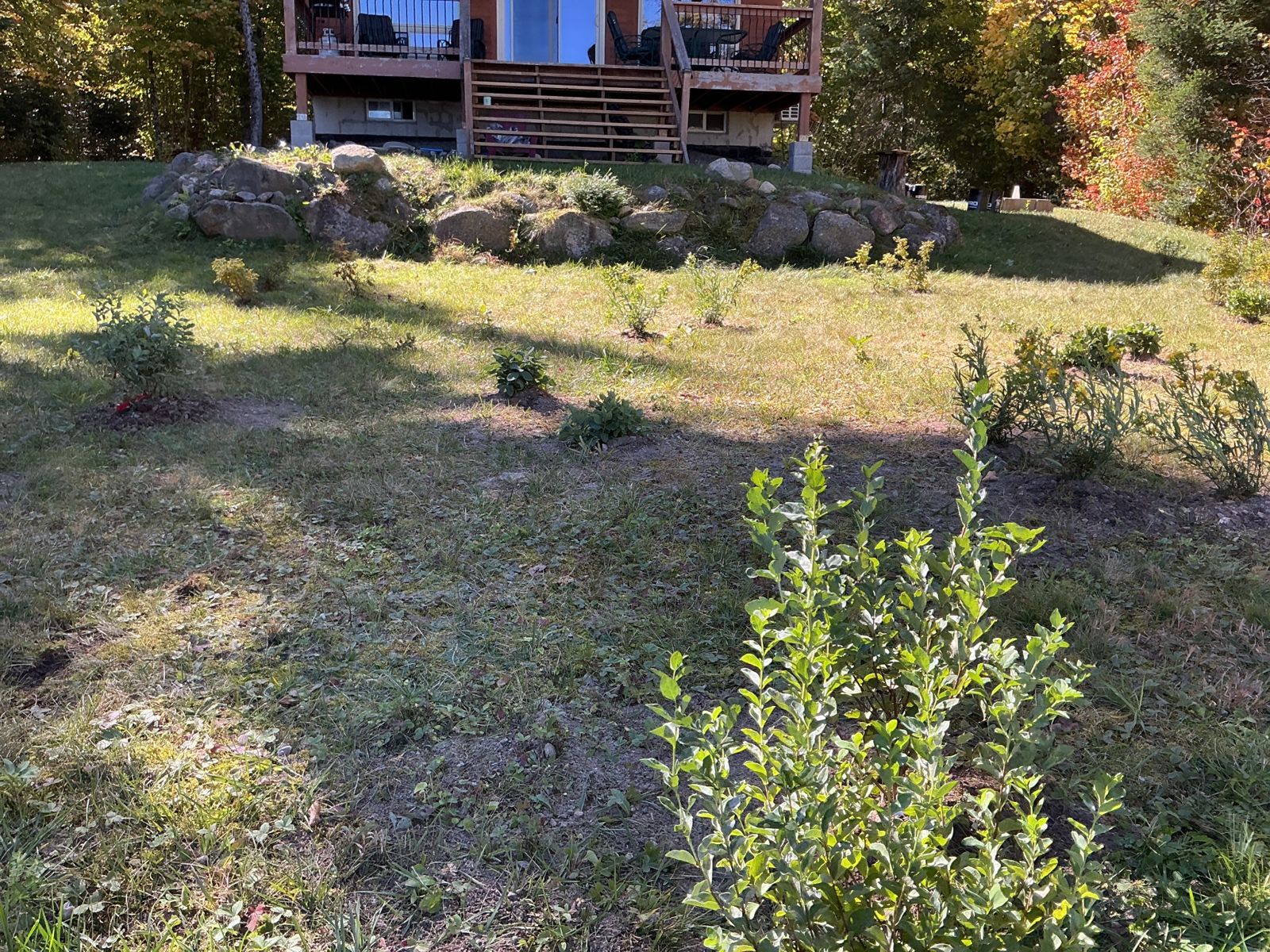
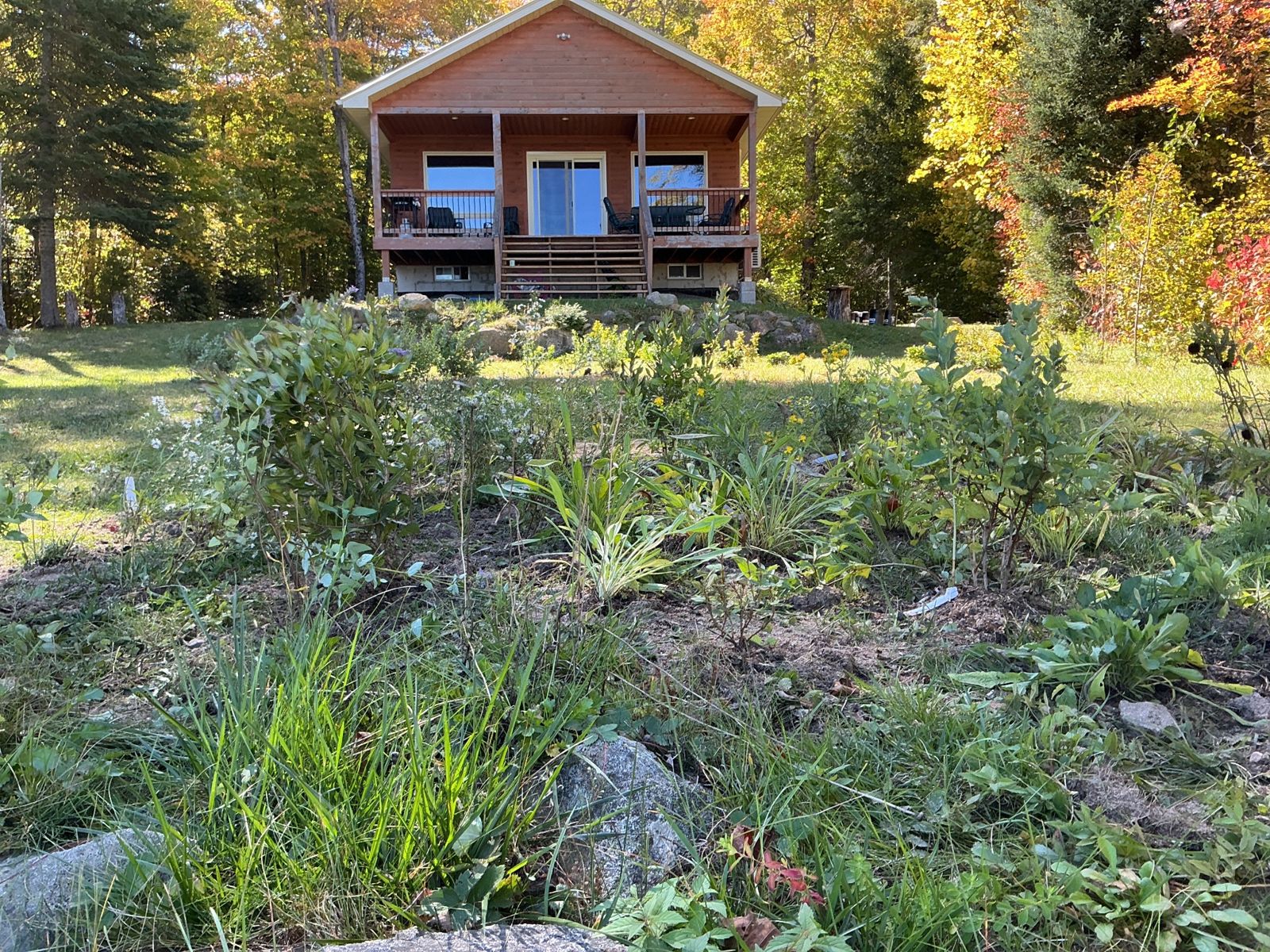
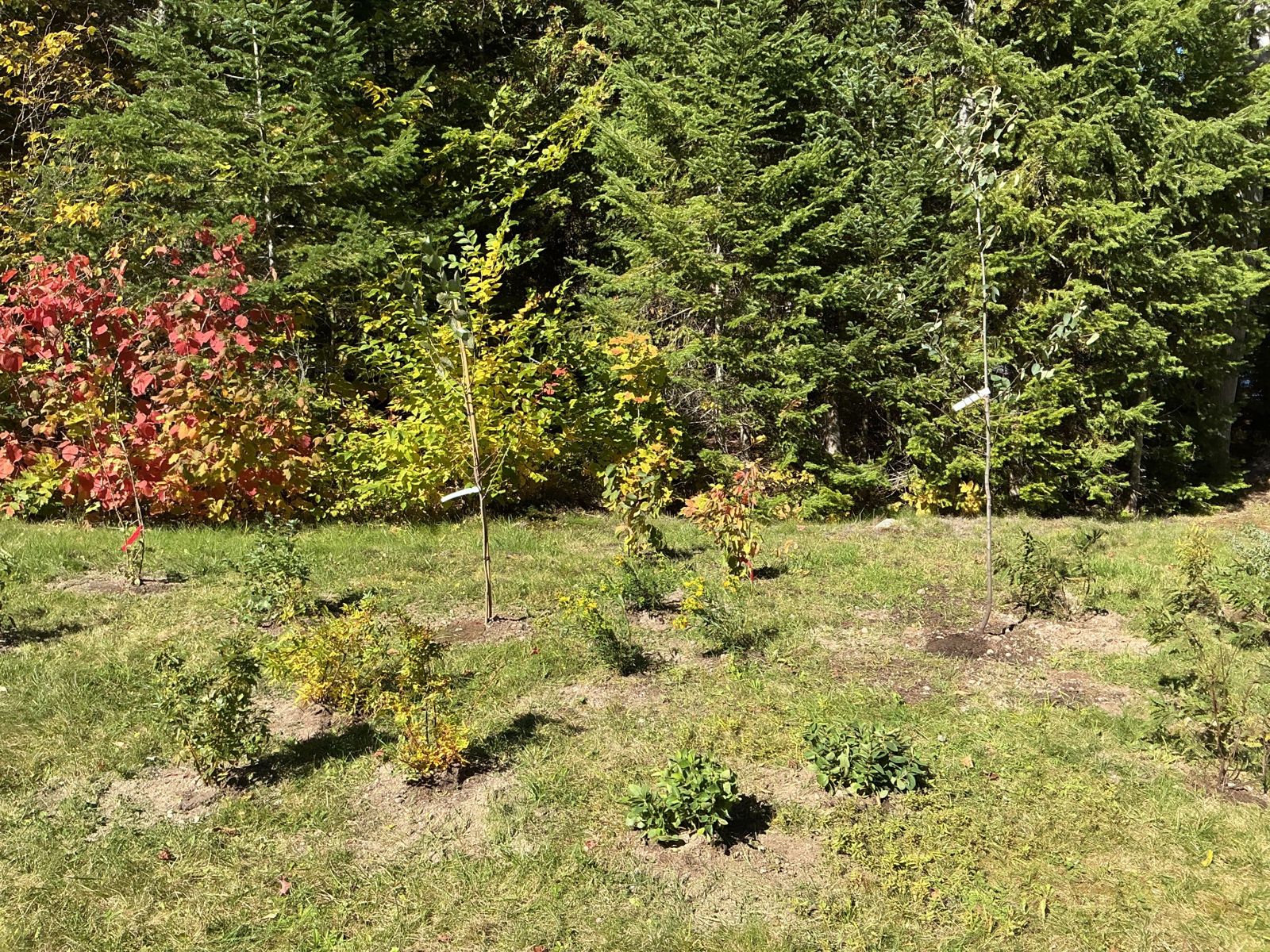
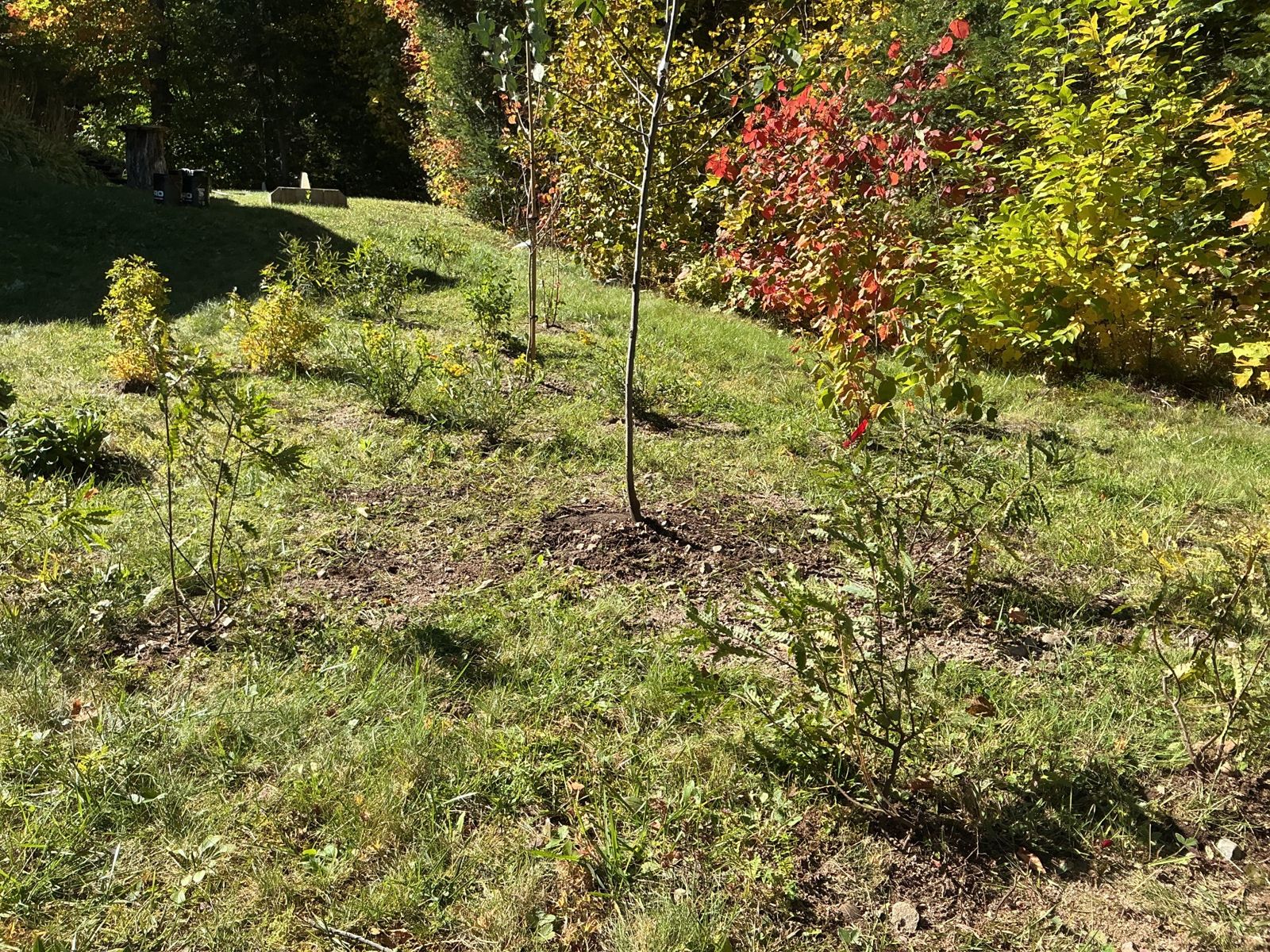
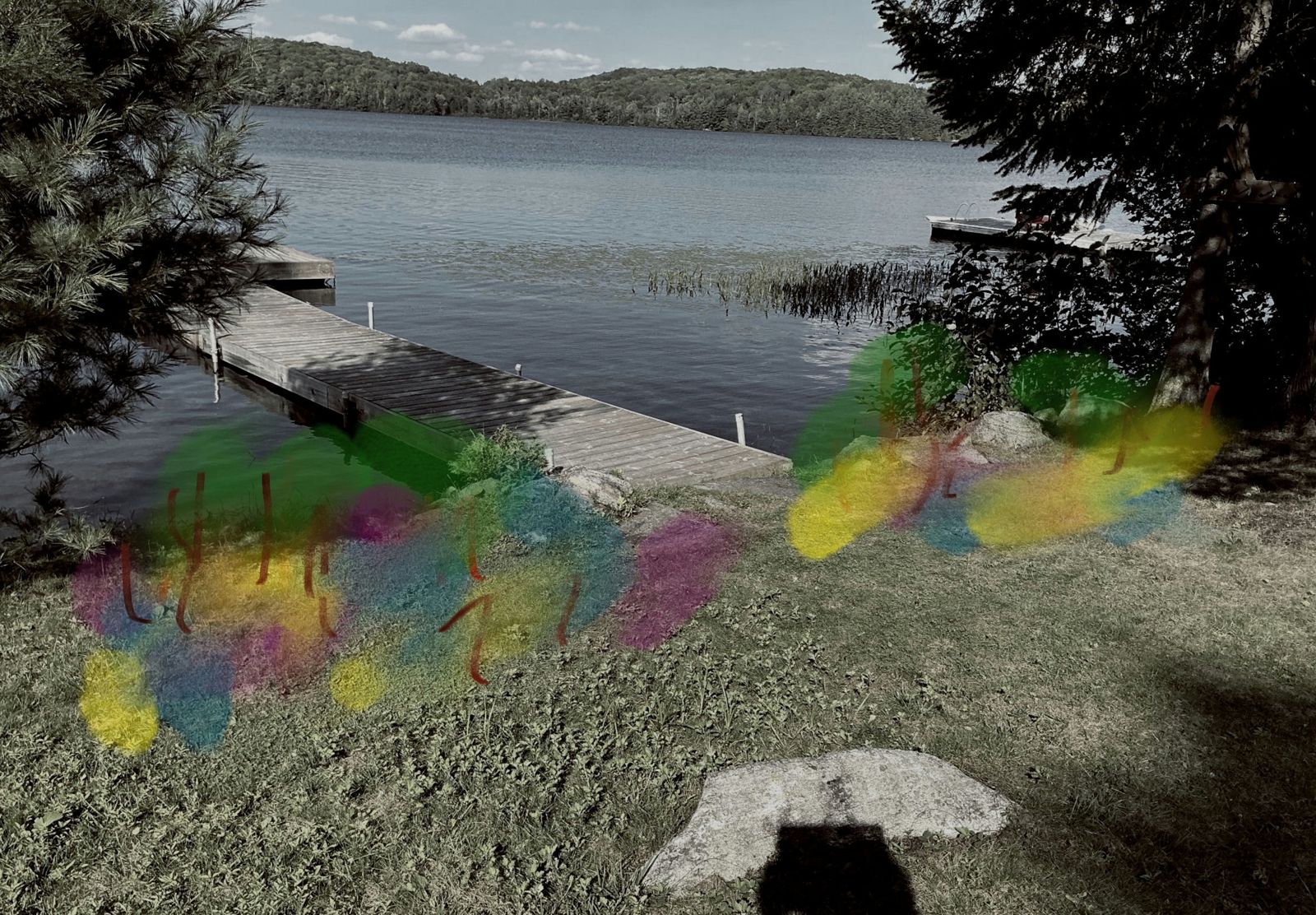
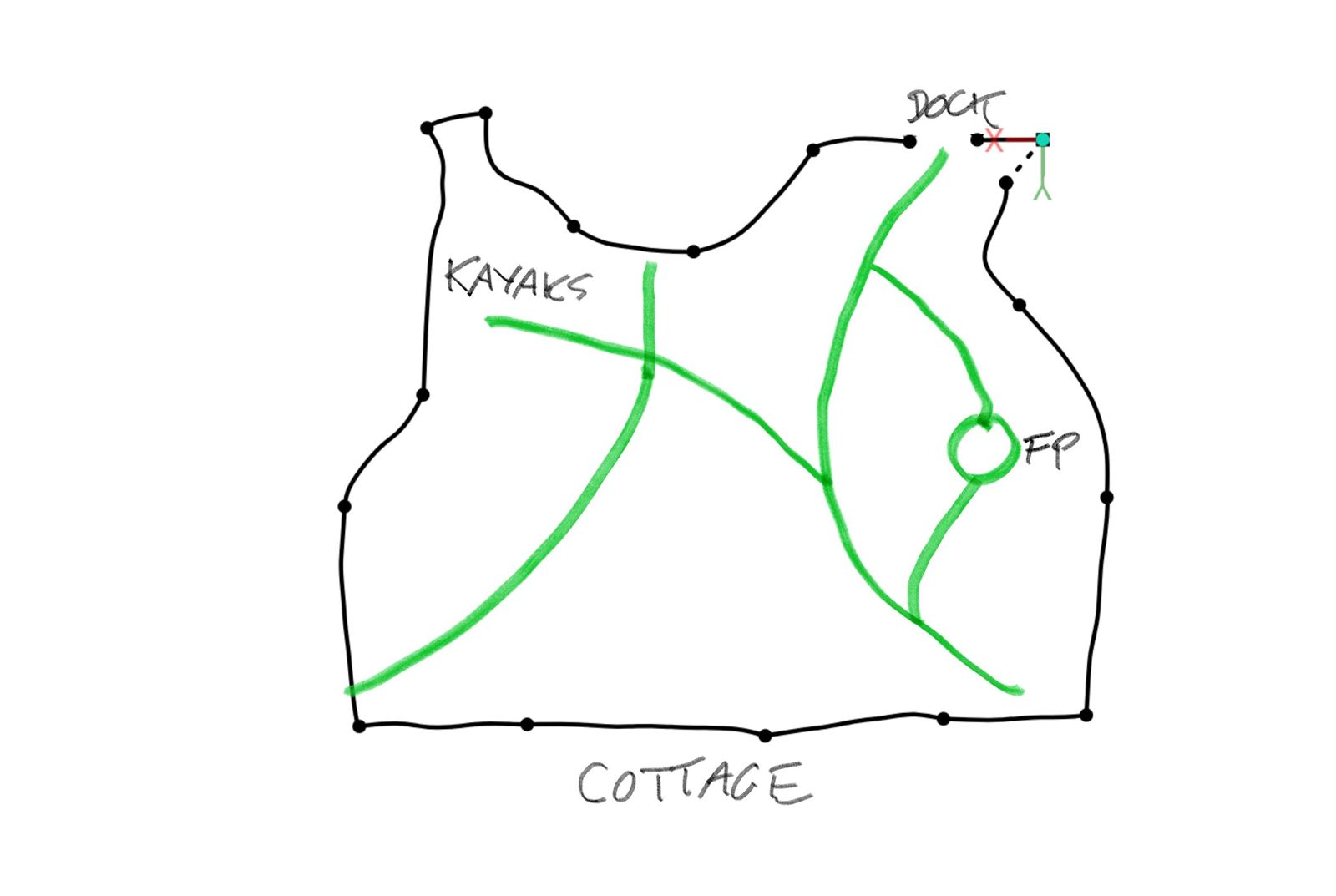
The biggest decision was what to do with the lawn. Tearing it out and replanting 3,800 square feet would have been expensive. Instead, the mowing stops and the grass grows. Twenty shrubs go in among it, in small groups, with mown paths through to the lake and across the property.
This does several things at once. It starts turning a large area back toward something wilder without a large budget, because the money goes into shrubs and not into clearing ground. The poor soil means no single plant is likely to take over the long grass. And it can be undone: if the owner doesn’t like it, the mower comes back out. You can’t say that about a lawn that’s been stripped.
The trade-off is honest enough. For the first few years the lawn will look like long grass with shrubs in it, not a finished garden.
The shoreline
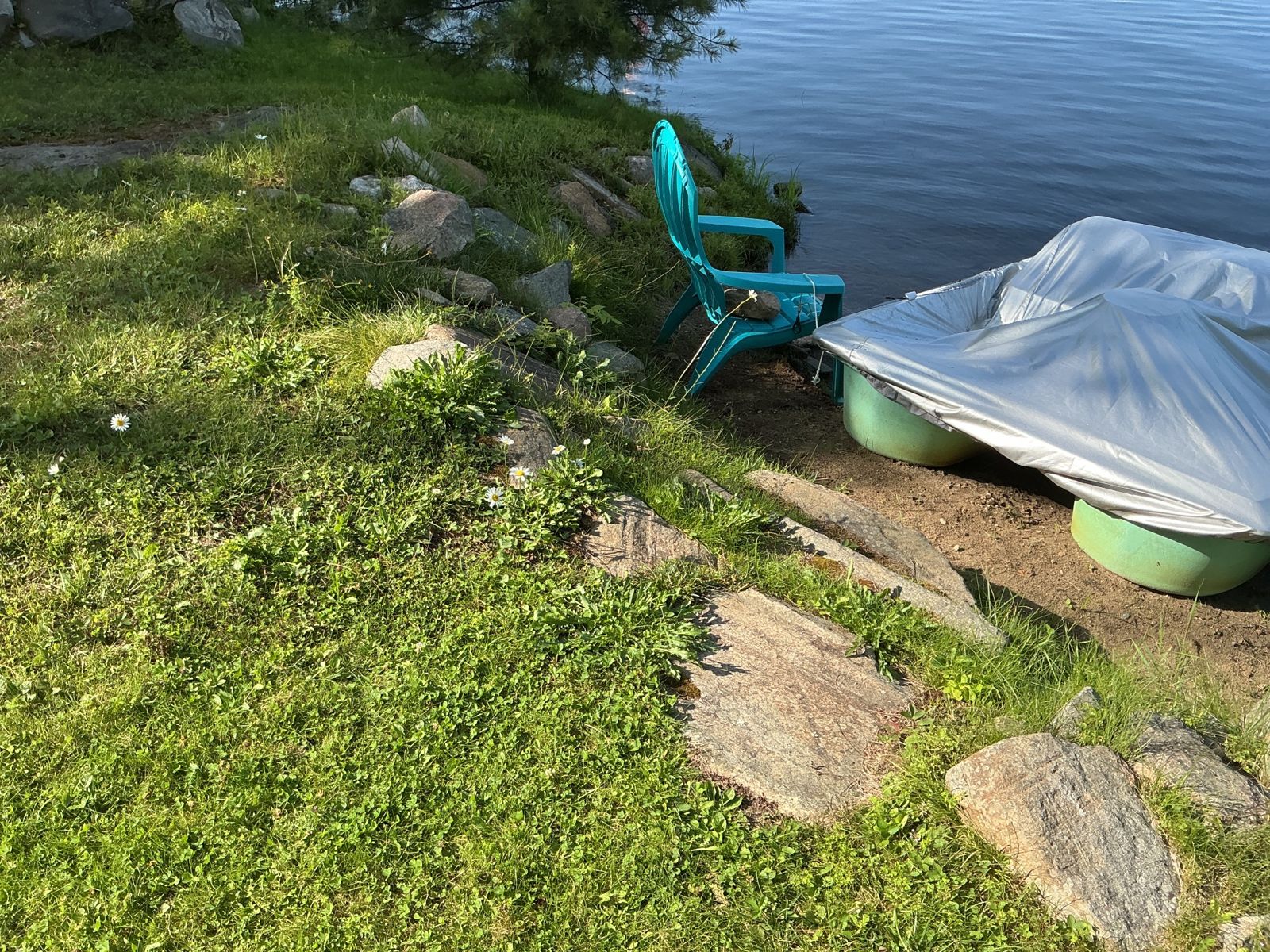
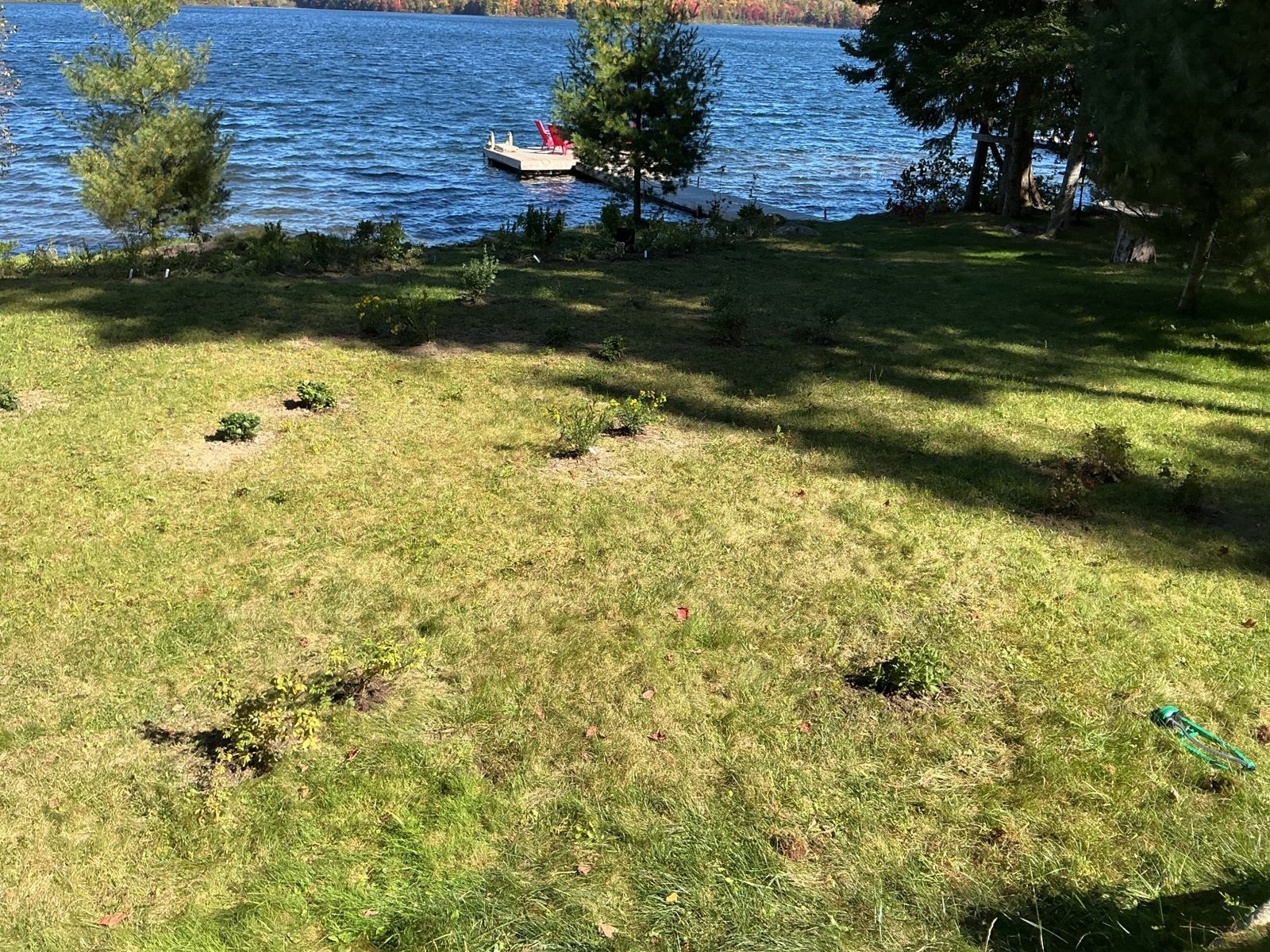
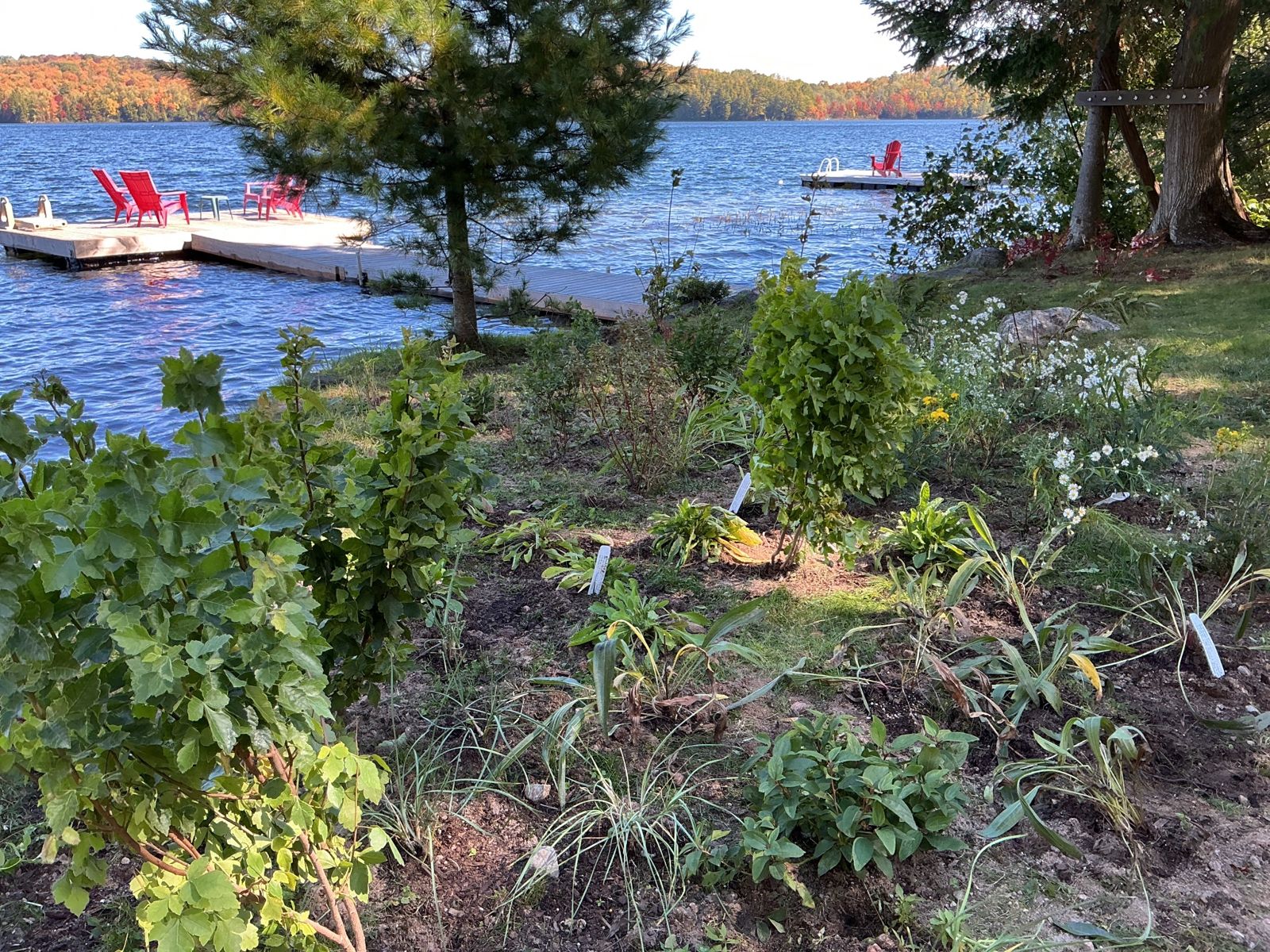
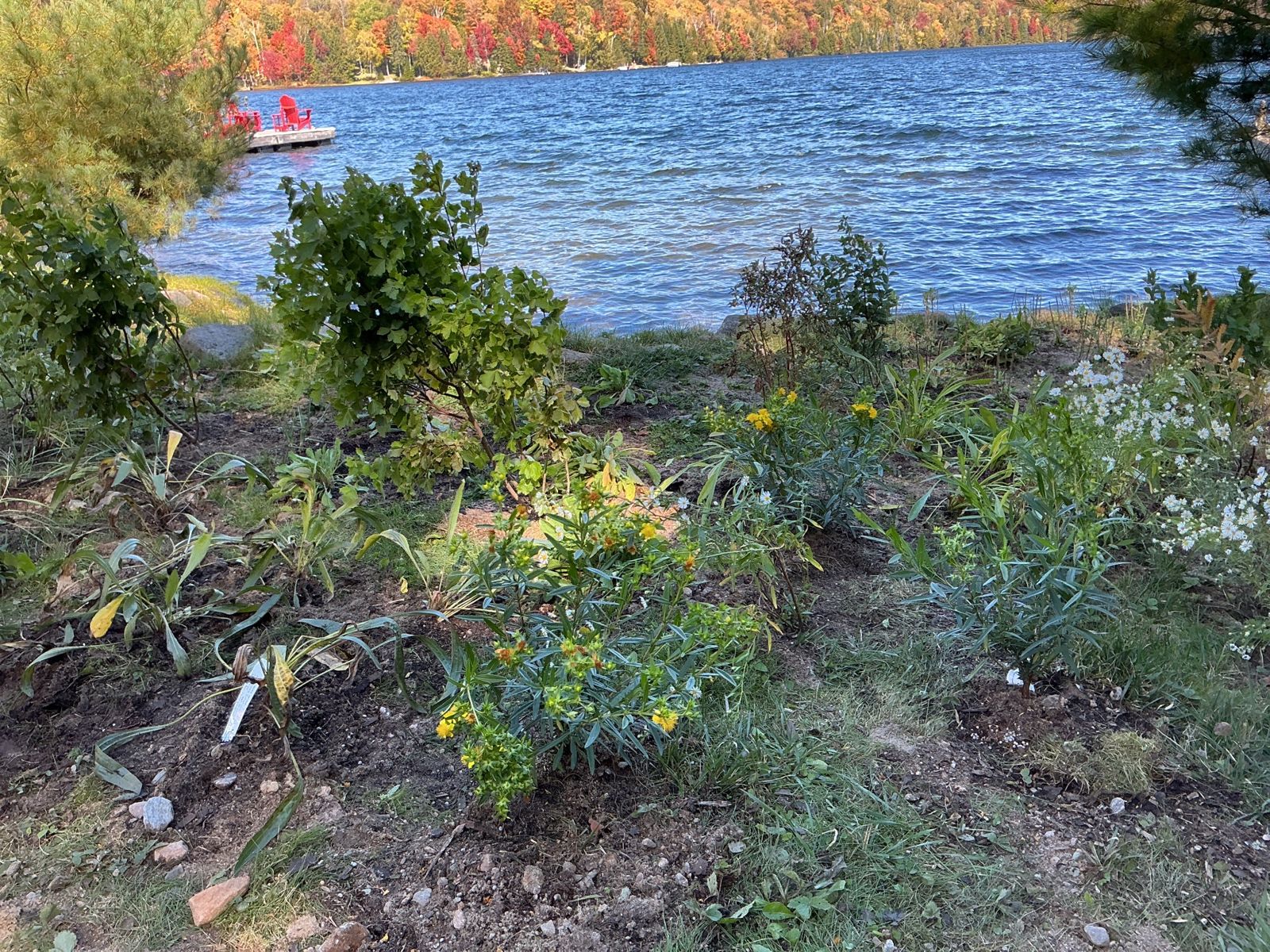
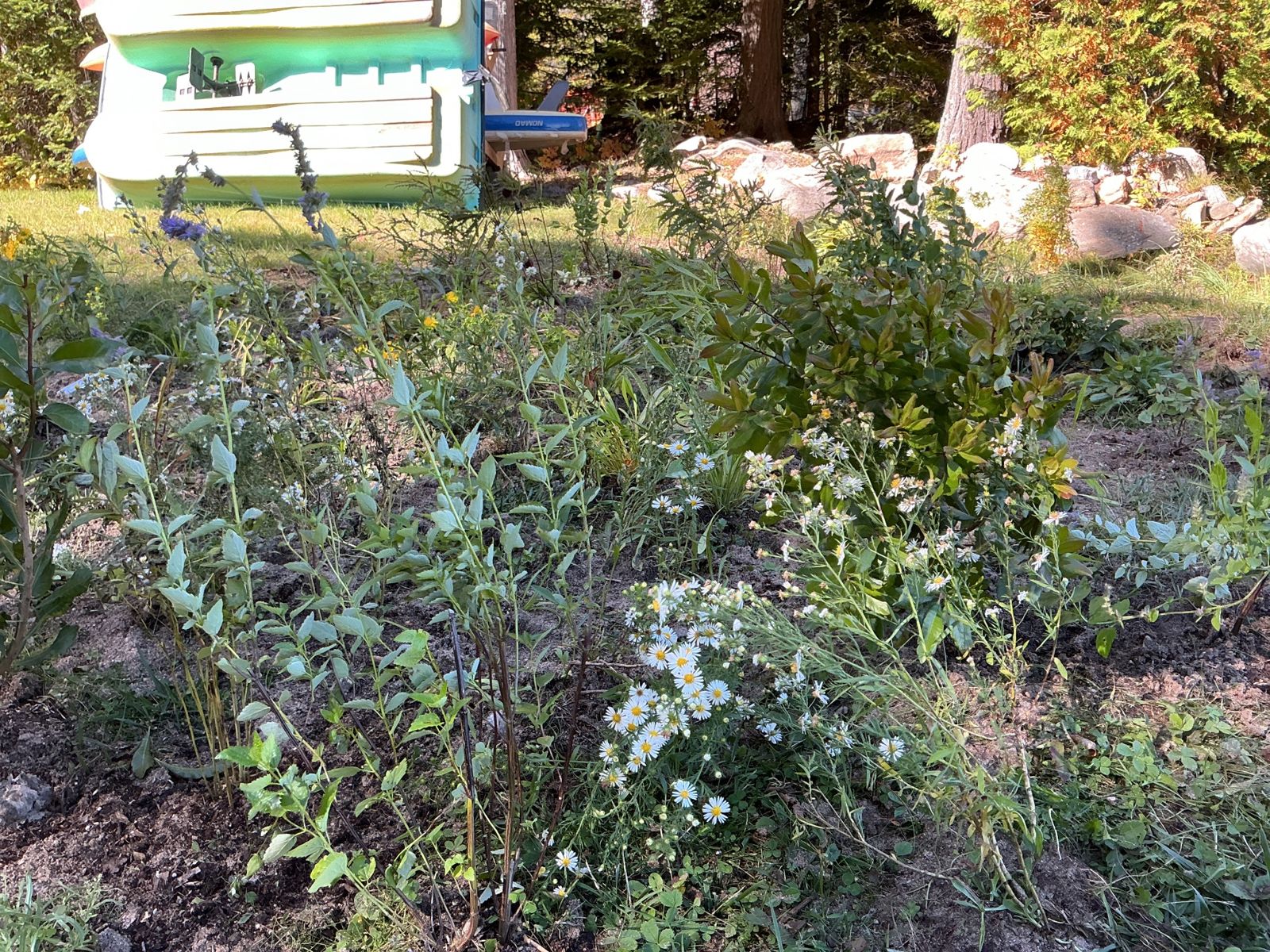
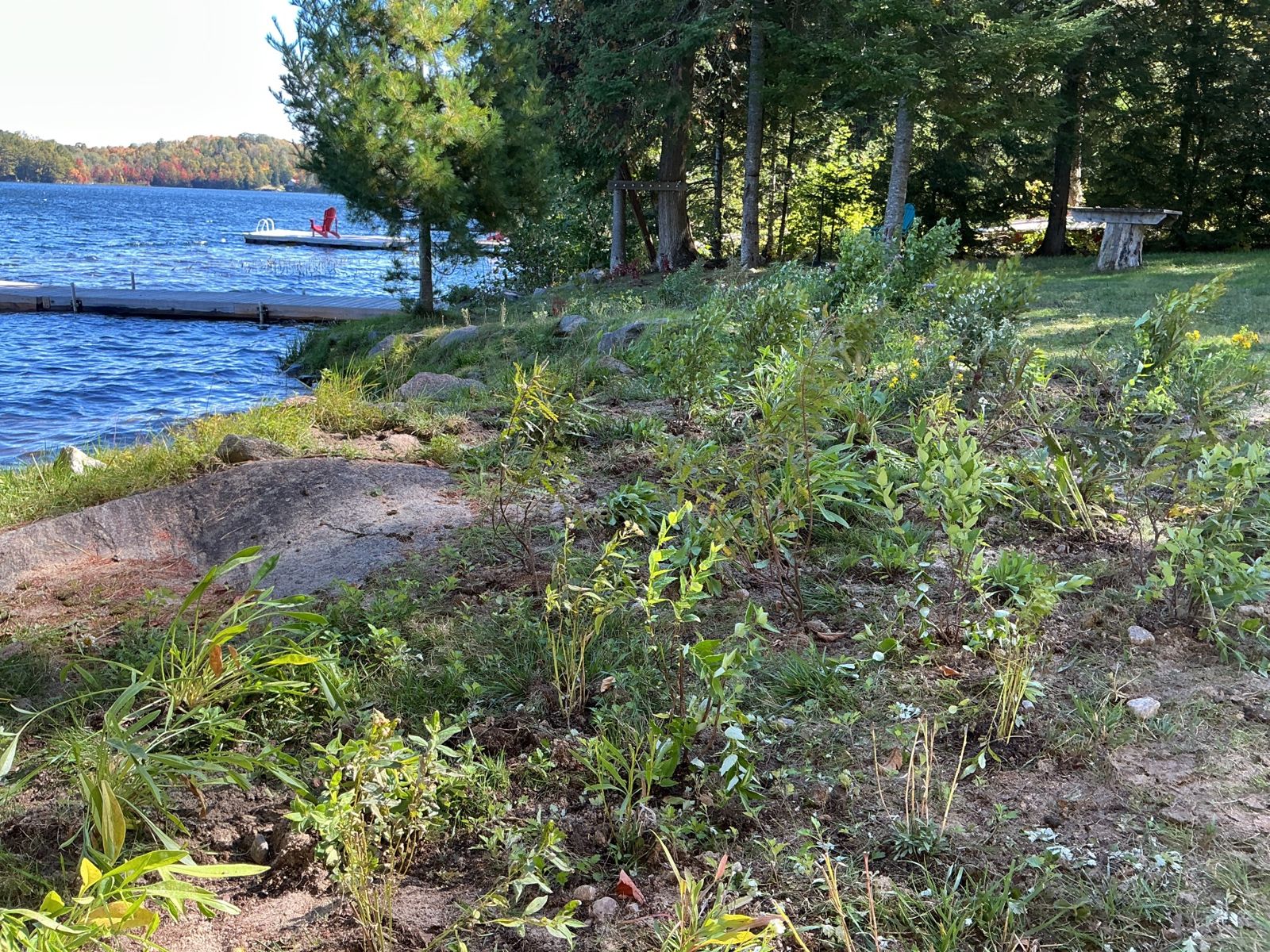
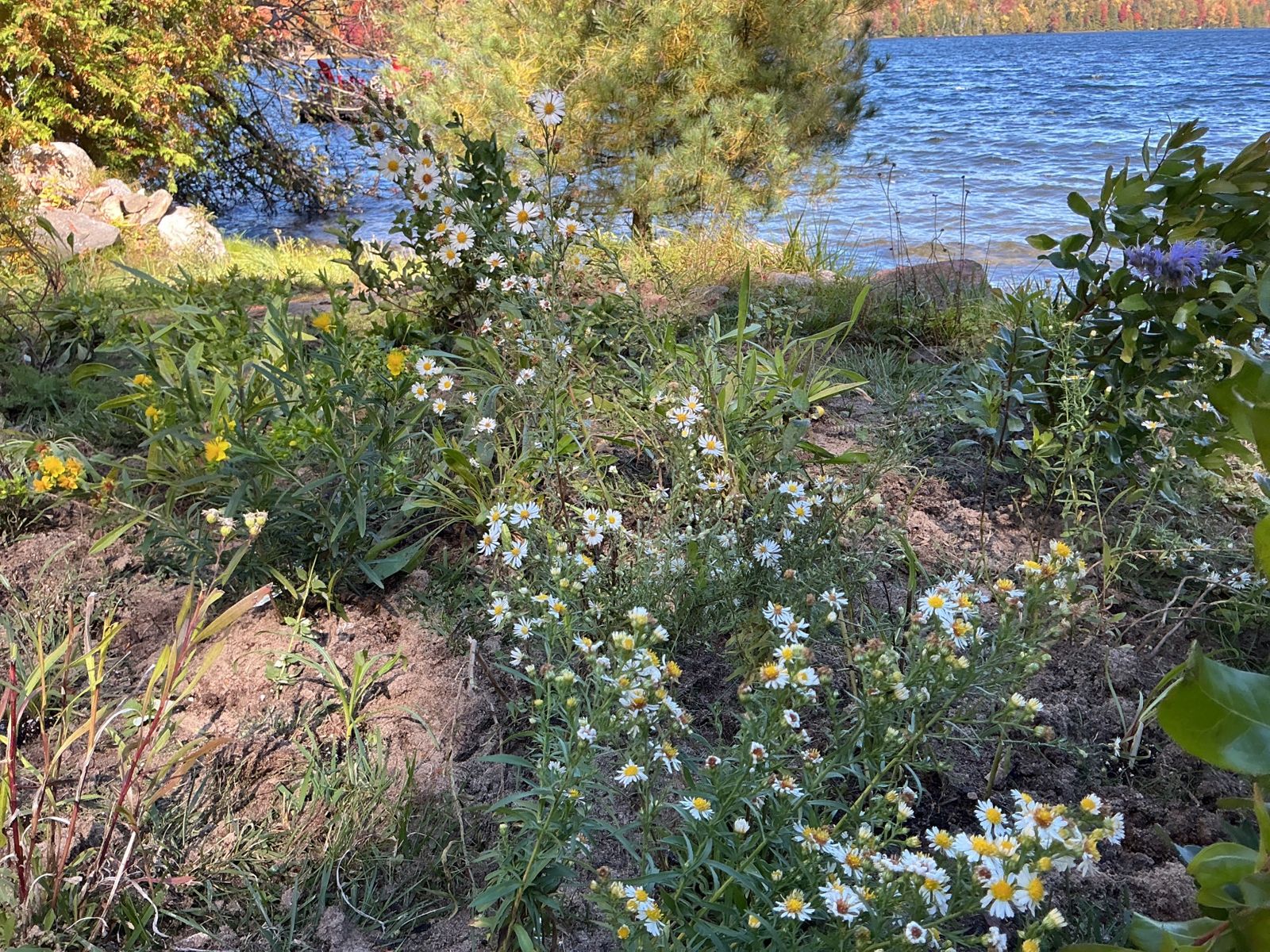
Most of the planting went here: 306 plants of 24 species in a strip about 60 feet long and seven feet deep. It’s the closest spacing on the property, because this strip is under the most pressure. Geese come ashore here, and the ground is compacted.
Taller shrubs such as northern bayberry and highbush cranberry go where height matters for keeping geese on the water. Wild roses form a low, thorny thicket, which is a goose deterrent made of plants. Sweet fern spreads sideways into low colonies and closes the gaps between everything else. Among the shrubs are wildflowers chosen to bloom in sequence from June into October: coreopsis, then anise hyssop, coneflower and nodding onion, then blazingstar, goldenrods and asters to finish the year. Paths to the dock and swimming beach stay open.
The edge of the woods
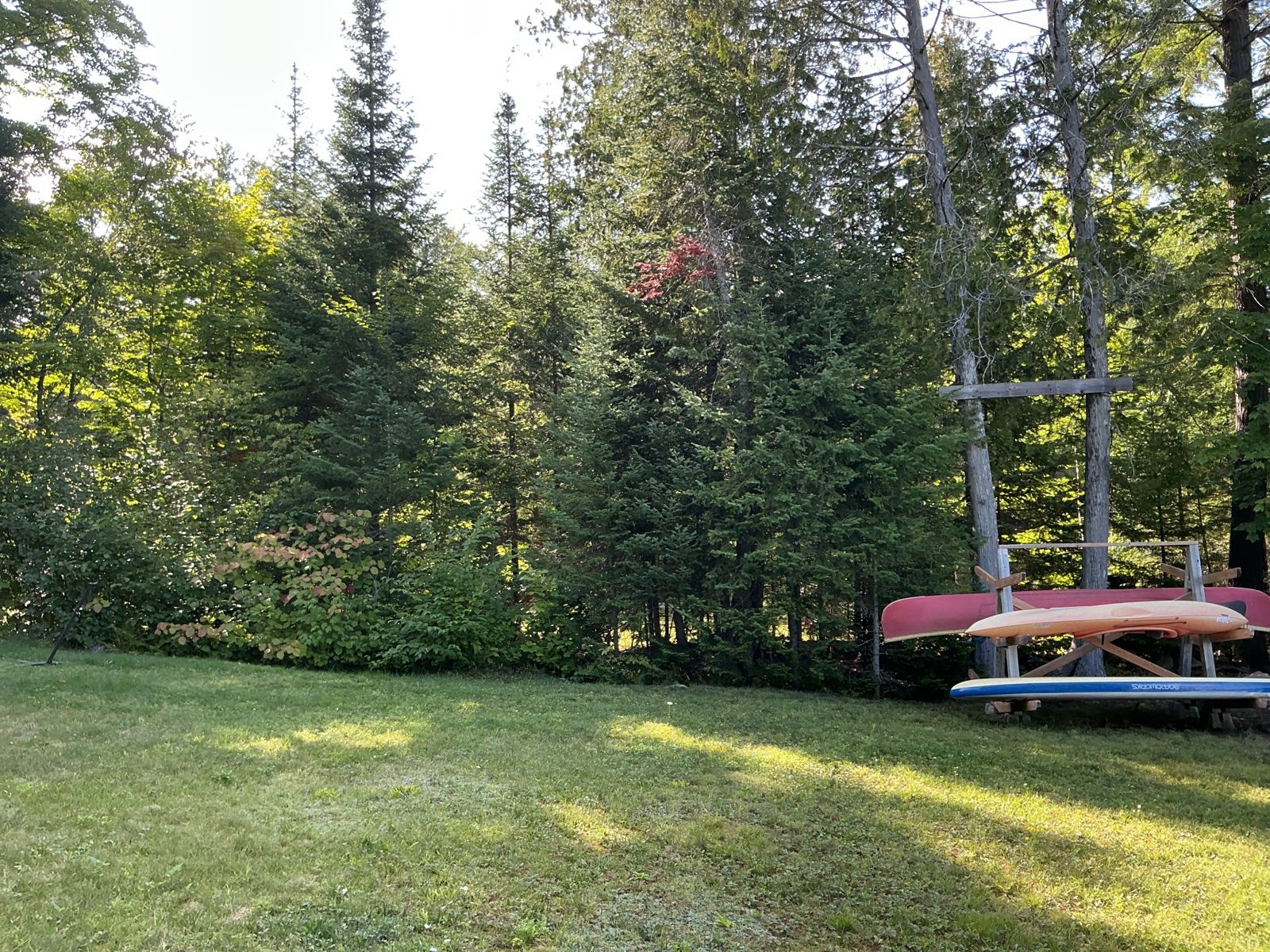
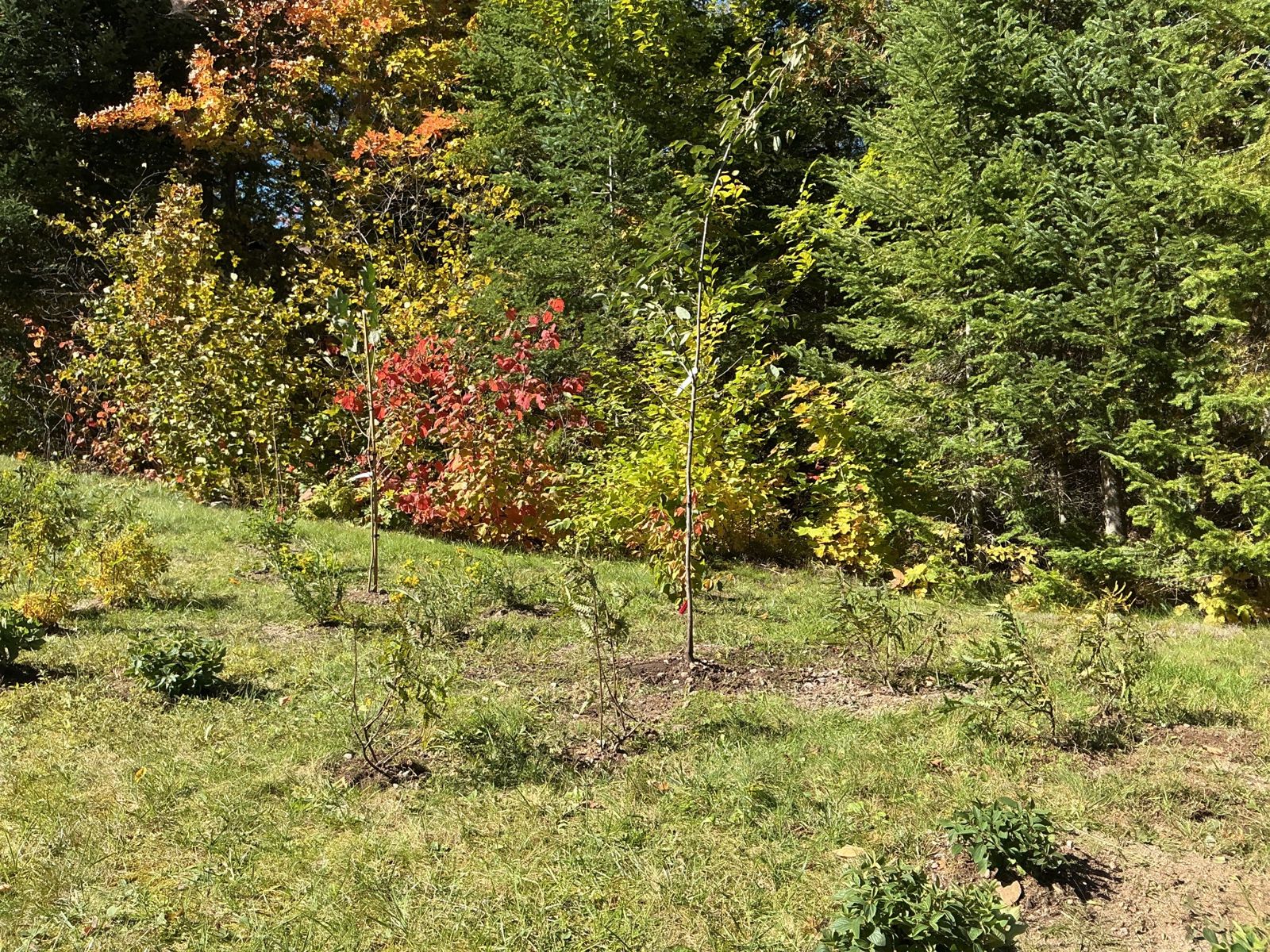
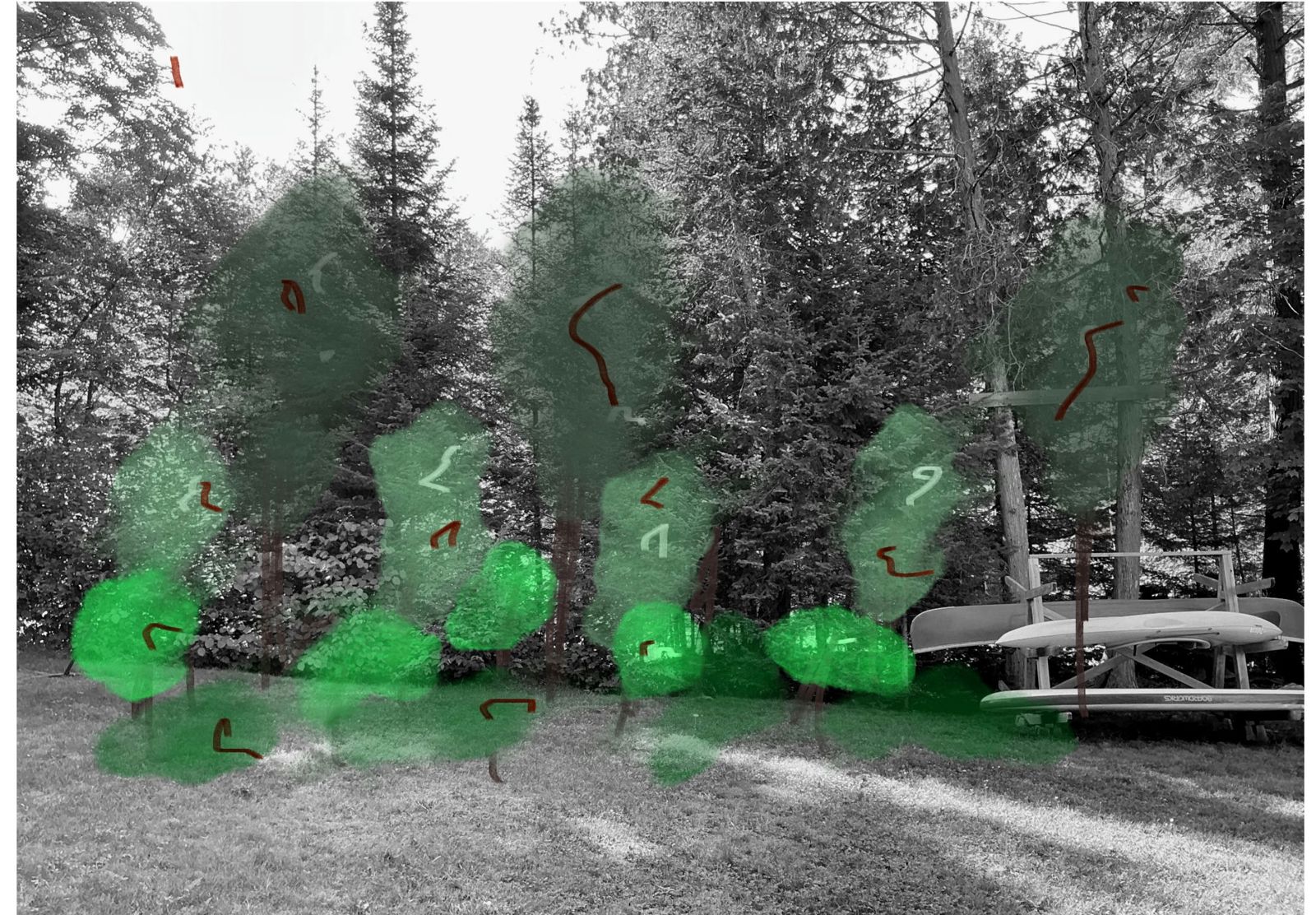
Where the lawn met the forest, there was a hard, straight line. That line, more than anything, made the property read as a suburban lot. The fix was to blur it.
Two small trees, a serviceberry and a nannyberry, will eventually reach 15 to 25 feet. Hazelnut and chokeberry fill the middle. Low shrubs sit at the front. They were planted in an irregular line that pushes in and out of the lawn, so the edge will read as a forest thinning out into a clearing.
The rock wall
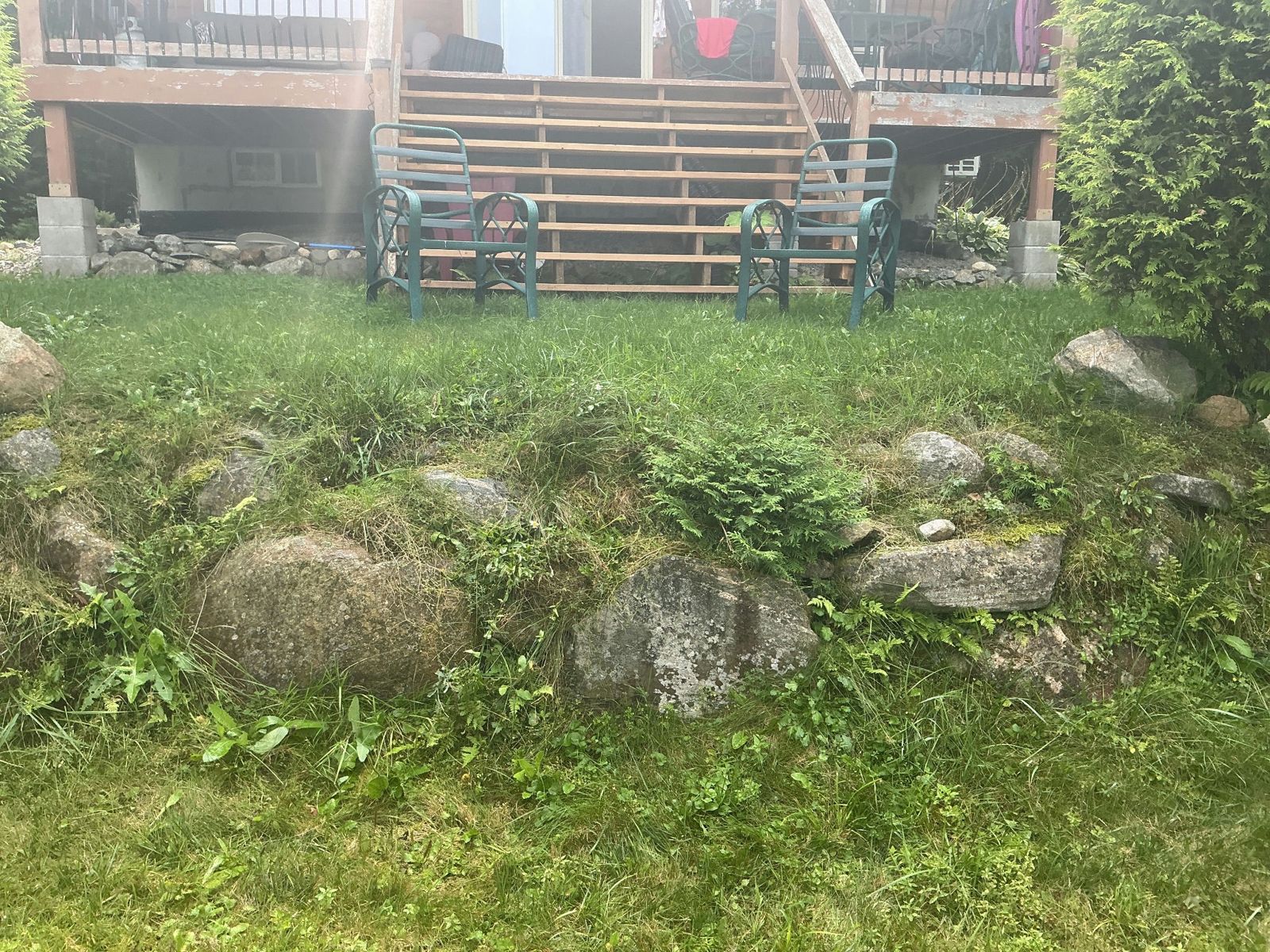
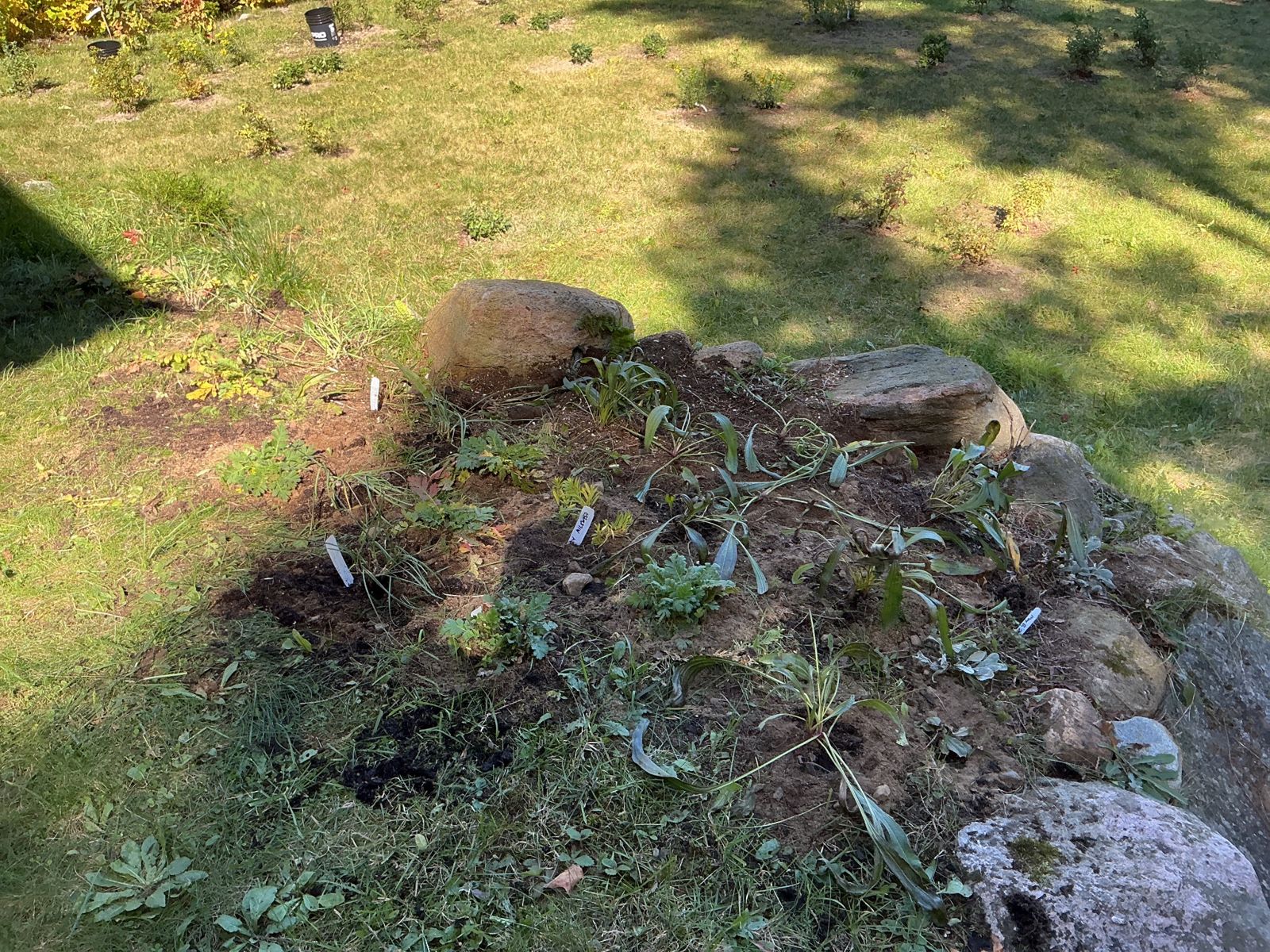
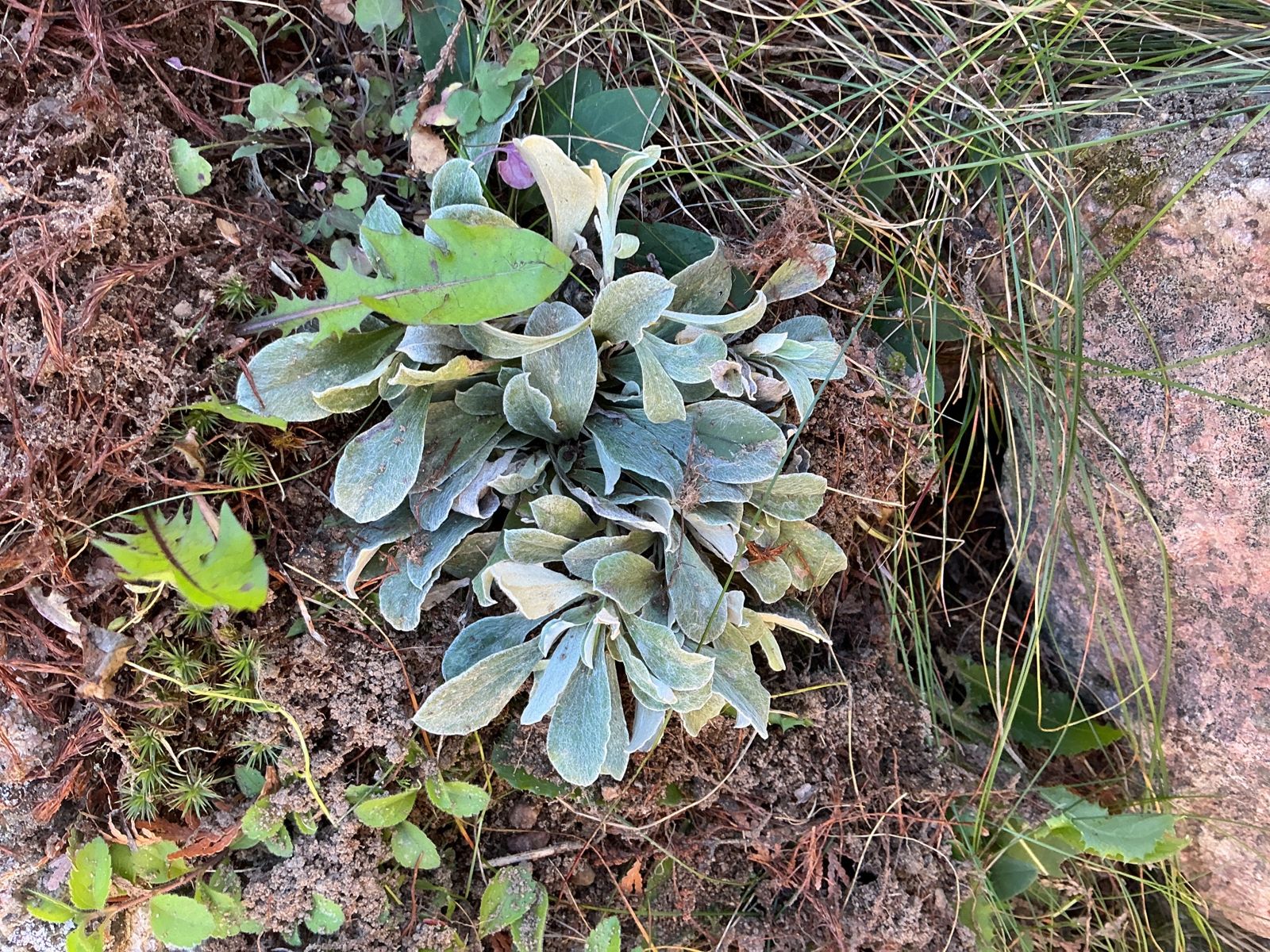
A low stone wall near the cottage had soil only in the gaps between stones. We didn’t rebuild it. Instead, plants were tucked into the pockets that were already there: harebel and silver mats of pussytoes that stay green all winter. At the top of the wall is the beginnings of a poillinator garden: pale purple coneflower, prairie smoke, nodding onion and one specimen butterfly milkweed. These are plants that carry their own water and food reserves in bulbs, corms and deep taproots, which is what it takes to live in difficult conditions.
What’s still to come
The planting went in over several days at the end of September: 461 plants, 29 species. One small area is still waiting. The wet pocket at the west end of the shore is meant for white turtlehead, and the nursery couldn’t supply it. It will be planted next spring if stock is available.
The method in detail
This section is for designers, students and anyone who wants the reasoning. It covers the soil test, how it set the plant strategy, and why each area was planted the way it was.
Site conditions
| Area | Size | Conditions |
|---|---|---|
| Lawn | ~3,800 sq ft (nearer 3,100 managed) | Full sun, sandy loam, gentle slope to the lake |
| Shoreline | ~475 sq ft (60 ft × ~7 ft) | Full sun, compacted, dry at the east end under a cedar, goose pressure |
| Woodland edge | ~200 sq ft (50 ft × ~4 ft) | Sun about 9 to 3, compacted, a straight line against the forest |
| Rock wall | ~50 sq ft less the stone | South-facing, full sun, soil only in pockets between stones |
| Wet pocket | ~20 sq ft | Inundated at the edge, about two hours of afternoon sun, silty |
The cottage faces north, but the canopy over the lawn is open enough that it reads as full sun. Two sight lines mattered: from the deck out to the lake, and from the dock back up. Both cross the lawn.
Twenty-four plants were identified before design. The lawn already held natives: wild strawberry, self-heal, Robin’s plantain, daisy fleabane and a sedge. With them were orange and mouse-ear hawkweed, ox-eye daisy and common St John’s-wort, the usual colonisers of thin, unfed, long-mown turf. On the shoreline, sensitive fern and northern bugleweed showed parts of the strip run wetter than the general moisture reading, and coltsfoot pointed to compacted, disturbed mineral soil. The vegetation and the soil test agreed with each other.
Soil test
One sample, taken in the lawn and applied across the property. A&L Canada, sampled 21 August 2026.
| Parameter | Value | Reading |
|---|---|---|
| Texture | Sandy loam | Fast-draining; holds little water |
| pH | 6.0 (buffer 6.9) | Normal for the Shield; not limiting |
| Organic matter | 1.5% | Severe band (under 3%) |
| CEC | 4.4 meq/100g | Very low; the decisive number |
| ENR | 27 lb/ac | Well under the 50 lb/ac line for severe limitation |
| Potassium | 25 ppm (1.5% sat.) | Very low; below the 2% line |
| Phosphorus (Bray-P1) | 13 ppm | Low |
| Magnesium | 54 ppm (10.2% sat.) | Adequate in absolute terms |
| Ca:Mg | 5.9:1 | Unremarkable |
| Aluminium | 0.6% sat. | No issue |
From soil to plant strategy
Ecologists sort plants by how they hold ground. Competitors grow fast and take everything where resources are plentiful. Stress-tolerators grow slowly and persist where they’re scarce. Ruderals move in quickly after disturbance and don’t last. This is Grime’s CSR framework, and soil fertility is the main thing that decides which strategy a site favours.
Here, nitrogen is the primary signal, and it is severe. ENR of 27 and organic matter of 1.5% both sit in the lowest band. Potassium below 2% saturation adds to the stress. Magnesium looks marginal on saturation alone, but 54 ppm sits inside the lab’s own adequate range and the Ca:Mg ratio is nowhere near a concern, so it was treated as a non-issue.
The result is S-dominant on every area. The palette was screened for stress-tolerators, potassium-efficient species and drought-tolerant root systems. Habitat analogues were sand barrens, dry rocky outcrops, poor woodland and dry sandy shoreline. Of the 29 species planted, 15 are stress-tolerators, 13 sit between stress-tolerator and competitor, and one is a generalist. There are no pure competitors, because on ground this lean a competitor has nothing to win.
The amendment decision
The lab recommended 165 lb/ac of nitrogen and 1.2 tons/acre of lime. Both were declined. The nitrogen figure is calibrated for flower gardens and would undo the selection pressure the design depends on. The lime figure follows arithmetically from buffer pH; at 6.0, with aluminium at 0.6% saturation, there’s no case for it.
Potassium was the harder call. Below 2% saturation normally gets attention even in a low-input design, because K deficiency affects disease resistance and water regulation during establishment. It wasn’t corrected because of the CEC. At 4.4 there is almost no exchange surface for a soluble amendment to bind to, and effective capacity at field pH is lower still. A potassium product would largely leave with the next rain, into a lake about ten feet away. Leaving potassium alone can be revisited later if it proves wrong. A fertility spike can’t be taken back.
Two physical interventions were allowed, and neither adds fertility. Compacted ground on the shoreline and woodland edge was loosened at planting positions only; blanket decompaction on a slope at the water’s edge would invite erosion and open the seed bank. And every new plant gets first-season water, by finger test and not on a schedule.
What the phosphorus says about history
Nitrate leaches out of soil within a few years. Phosphate binds and stays for decades. So an old fertilised lawn usually shows low nitrogen with medium or high phosphorus. Here both were low, which suggests this lawn was never fed. That changes the kind of weed pressure to expect. There’s no store of old fertiliser to feed a flush of rich-ground weeds after disturbance, and the weeds that do seed in are poor-ground plants, which are slower and easier to keep up with.
The existing grass is the matrix
Naturalistic plantings typically give 50 to 70% of their area to a matrix layer, a dense ground-covering community of grasses and sedges. This one has no planted matrix outside the rock wall, and no planted grasses. The existing turf already covers the ground, so it was kept and left to grow.
How the lawn comes out of mowing matters more to the first two years than anything in the soil test. A mown lawn holds a quantity of nitrogen in living grass. Killing it in place with herbicide or a tarp returns that nitrogen over the following season or two, which is the fertility spike the whole plan is built to avoid, and a soil test taken beforehand can’t see it coming. Letting the grass grow, and carrying cuttings off when it is cut, exports the nitrogen instead.
Nitrogen-fixing shrubs
Four of the shrubs fix their own nitrogen: New Jersey tea, sweet fern, northern bayberry and buffaloberry. That’s how a woody frame establishes here with nothing added. The nitrogen goes to the plant that fixed it and doesn’t enrich the surrounding ground, so the site stays lean.
Palettes by area
Shoreline (306 plants, 24 species). Tall structure: northern bayberry (5–10 ft) and highbush cranberry (8–12 ft, a facultative wetland species, placed at the damper end). Thorny mid-height thicket: smooth rose and pasture rose. Gap-closers: sweet fern and fragrant sumac, both rhizomatous. Bush honeysuckle takes the poorest light under the cedar. Low front: New Jersey tea, Kalm’s St John’s-wort, snowberry and buffaloberry. Forbs in sequence: lanceleaf coreopsis; anise hyssop, pale purple coneflower, nodding onion and upland white goldenrod; rough blazingstar and grey goldenrod; heath aster and New England aster. Clustered mountain mint and New England aster want more moisture, so they went to the moister locations. One lowbush blueberry is a trial: it tolerates pH 6.0 only at the limit, so it was placed under the white pine, where litter may lower the pH beneath it.
Woodland edge (32 plants, 10 species). Upper storey: shadblow serviceberry and nannyberry. Back: black chokeberry. Middle: American hazelnut and snowberry. Front: New Jersey tea, Kalm’s St John’s-wort and pasture rose, with sweet fern in groups. One buffaloberry, for silver foliage against the dark forest.
Lawn (20 plants, 4 species). New Jersey tea, Kalm’s St John’s-wort, smooth rose and snowberry, planted in twos and threes. Kalm’s holds a clear rounded shape, which reads as intentional in long grass. The rose and snowberry sucker into masses whose hips and berries carry the lawn through winter.
Rock wall (103 plants, 9 species). Shallow rooting is the governing stress, so nearly everything carries its own reserves: bulb (nodding onion), taproot (prairie smoke, butterfly milkweed, pale purple coneflower). Harebell is a rock-crevice plant in the wild. Thirty-two plantain-leaved pussytoes form the only planted matrix on the property, running along the seams.
Wet pocket (planned: 5 white turtlehead). An obligate wetland plant for the one spot that stays wet. Not yet planted.
Repetition ties the areas together. New Jersey tea, Kalm’s St John’s-wort and snowberry appear in the lawn, the shoreline and the woodland edge. Sweet fern, twenty plants in all, is on both the shoreline and the woodland edge. Five forbs link the shoreline and the rock wall.
What was left out
- No planted matrix outside the rock wall, and no planted grasses.
- No pure competitors. Canada goldenrod, the standard coloniser of disturbed ground in this county, is on the watch list. Grey and upland white goldenrod, both small and well-behaved, are planted instead.
- No amendments, including the lab’s nitrogen and lime recommendations.
- No kill-in-place lawn conversion.
- No blanket decompaction.
Stewardship and what to watch
Most of the property is stewarded leave-in-place: what’s cut stays where it falls, and leaf fall is left. Two areas differ. On the rock wall, organic matter is removed to keep the pockets lean. On the lawn, cuttings are carried off, which is the one ongoing task that actively lowers fertility.
The watch list is short. Coltsfoot on the shoreline is shaded out, not pulled, because every broken rhizome makes a new plant. Possible mugwort near the water is monitored. In the lawn, ox-eye daisy is tolerated and common St John’s-wort is watched, taking care not to confuse it with the Kalm’s St John’s-wort that was planted. Mullein on the wall is pulled as a first-year rosette.
Two things could change the trajectory. If geese keep coming ashore, their droppings will add nitrogen and phosphorus to the one area whose planting case rests on low fertility; a re-test in three years is worth doing if the shoreline looks unexpectedly vigorous or weedy. And the wet pocket’s soil is the least certain number on the record, because the field reading (dark, high organic matter) contradicts the lab sample, which came from the lawn.