
Can’t live, if living is without you
It’s the trout lilies that tell me spring is here.
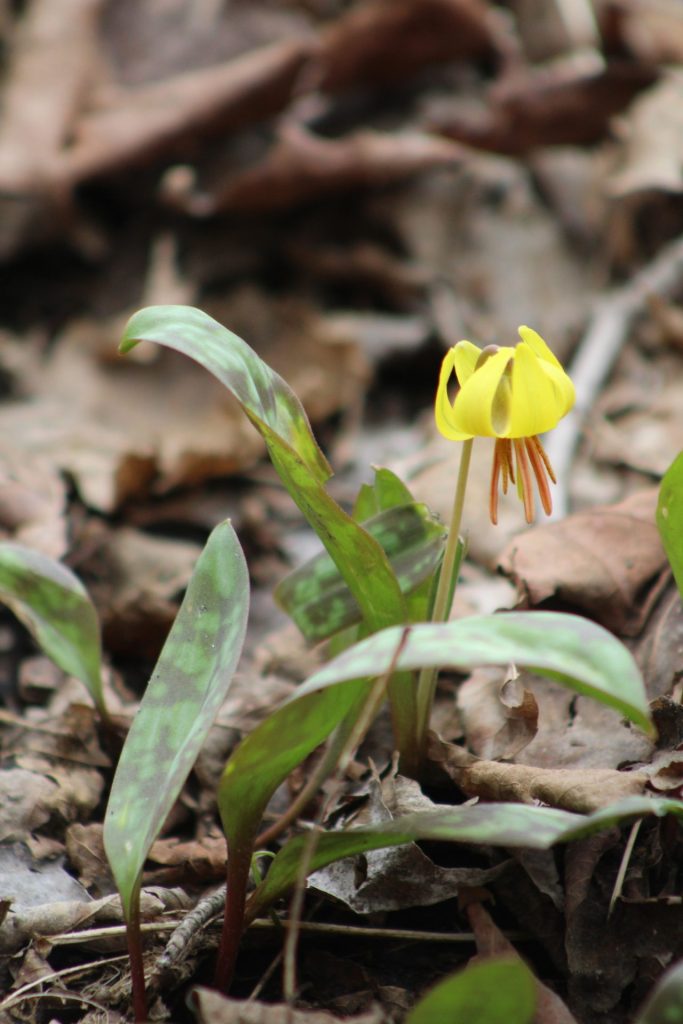
Not long after the snow melts I notice their dark green leaves with brown spots. Which is how trout lilies get their name.
And shortly after that, some of these plants produce brave yellow flowers.
Trout lilies spread thanks to ants. Before bees and butterflies are around, ants are busy. Maybe you noticed them in your kitchen this spring? The trout lily wraps its seed in a fat-rich packet, which the ant takes to its nest to feed its larvae.
The ants then chuck the seed in the colony’s waste dump, which is rich in nitrogen. The perfect place for a new trout lily to grow.
It’s like the trout lily pays the ant in food to spread its seed.
Stems and bees
The dead stems of mountain mint, aster and milkweed are still standing at my Lucas House garden in Haliburton, even as the new growth is starting to show.
During the season, mother bees bore their way into the stems, lay eggs and leave a ball of pollen and nectar for the emerging larvae, which then spend a cozy winter in the stem’s cavity. They’ll emerge when the weather gets consistently warm.
Small carpenter bees are suited to boring into stems. And stems are suited to providing nests for carpenter bees. The bees have a creche and the plants have pollinators for next summer.
Columbines and hummingbirds
I heard my first hummingbird last week. It’s a sign of the times that I thought it was a drone. But then it hovered past me.
Perhaps it was on its way to some wild columbine. I planted a bunch of this on my property a few years ago and it’s starting to spread.
Columbine’s draw is its bright red flowers. These open up just in time for the hummingbirds’ arrival, and they’re adapted so hummingbirds can insert their beaks and lap up the nectar. Everything about columbine says “I’m for hummingbirds”: the bright red colour, the tubular shape, the length of the flower and the way it curves.
The hummingbird gets fed after a long journey north and the columbine gets pollinated. Over time, flower and bird have got closer to each other, more precisely matched. A stronger partnership.
Milkweeds and monarchs
I picked up some swamp milkweed from Haliburton Micromeadows on the weekend. They were year-old plants and the stems were emerging, just as they are back at my HQ.
The monarch butterflies aren’t here yet but when they arrive, the milkweed will be ready.
Those butterflies aren’t the same ones that were here last year – they’re two or three generations on from that.
When they get here, I will see eggs, caterpillars, chrysalises, and adult butterflies on the milkweeds through the summer.
Milkweed is poisonous to most animals: it produces a toxin that stops the heart. That deters herbivores from eating the juicy leaves.
But the monarch has adapted to the poison and uses the toxicity to its advantage because it now becomes poisonous, too. Its bright orange colour is a warning to other creatures – I’m dangerous, don’t eat me!
Milkweed and monarch are in an arms race. The milkweed gets more poisonous and the monarch adapts to it and gets more poisonous, too. Both get safer.
And both are locked in a relationship that’s lasted millions of years.