
Drag Lake Meadow
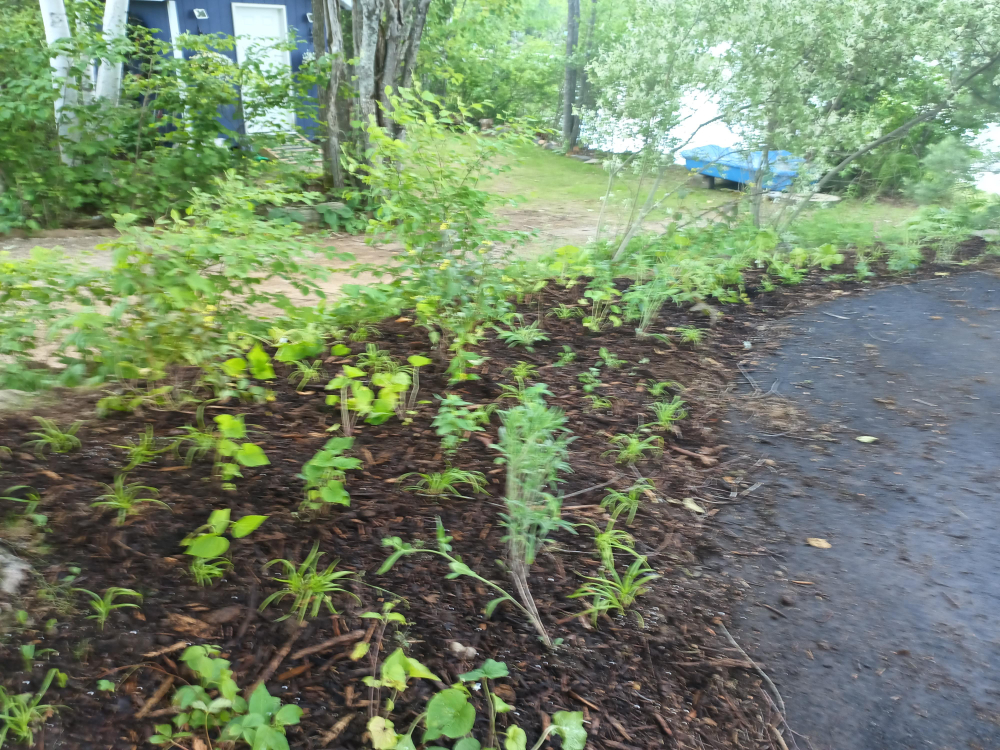
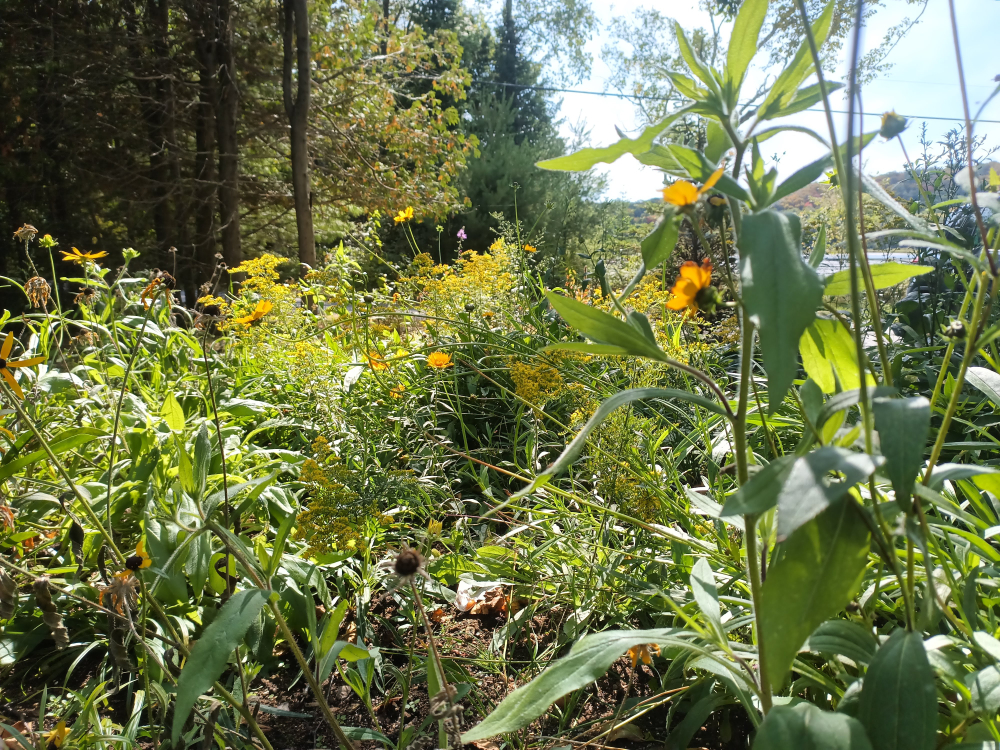
A native plant meadow on a part-sun septic system leach bed, along with a shaded driveway border and shoreline plantings. Installed July 2025.
Plant Selection and Layout Methodology
Project Overview
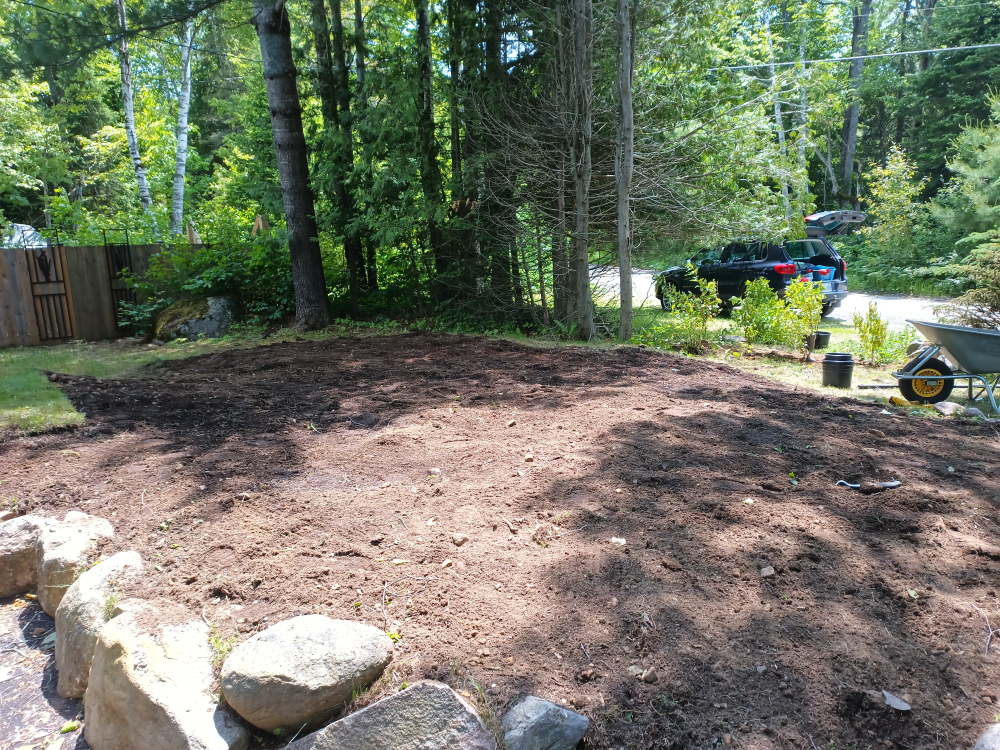
A cottage property on Drag Lake required transformation of several distinct areas into naturalistic plantings. The primary challenge was a 472 sq ft raised septic bed visible from multiple sightlines—front door, driveway, parking area, and road approach. Secondary areas included a 200 sq ft driveway border and a 100 sq ft road screening zone. The site presented typical Haliburton conditions: mixed light exposure, deer pressure, and the need to work with rather than against existing woodland character. The clients wanted more interest and flowers while respecting the native flora already present.
Site Analysis Summary
Light Conditions
The septic bed receives approximately six hours of sun daily, with morning exposure transitioning to midday shade from an established white pine, then additional afternoon sun. This part-sun regime with dappled intervals creates conditions suitable for meadow species adapted to woodland edges rather than full prairie exposure.
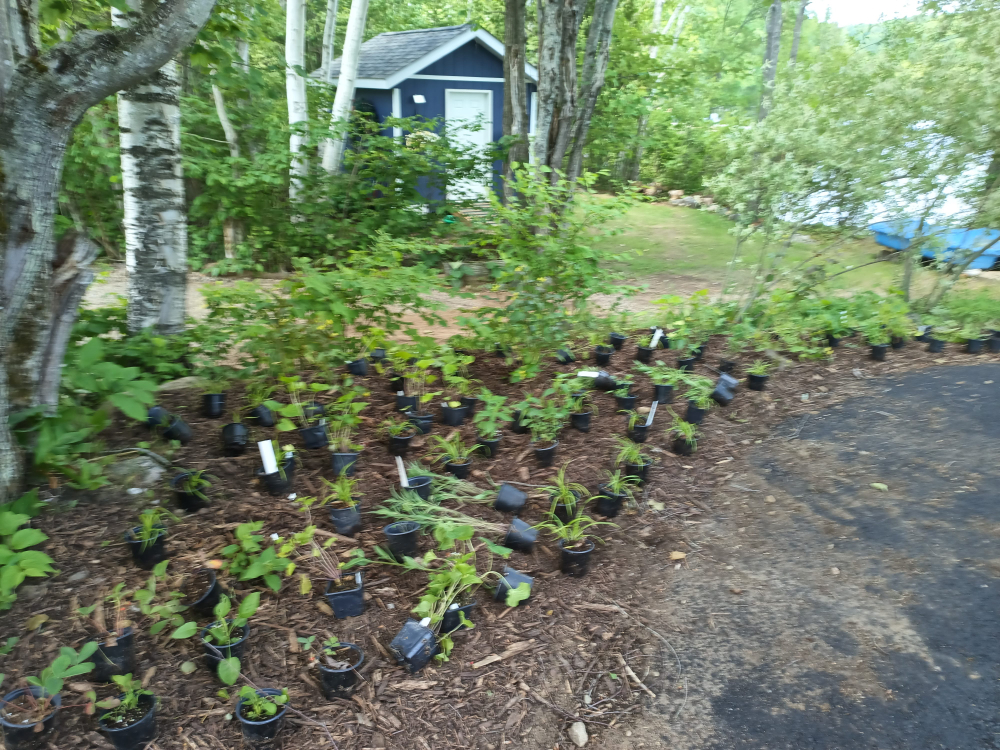
The driveway area offers part-sun including midday exposure until 2-3 PM, followed by dappled shade. The road screening zone sits in part-shade with less direct sun due to overhead tree coverage from hemlock, pine, and spruce.
Soil Observations
The septic bed presented better conditions than typically found over leach fields. The soil is dark and loamy with adequate moisture retention—evidence of reasonable organic matter content and biological activity. Moisture readings varied across the bed: neutral in shaded portions, dry near the driveway edge, and notably drier near existing cedars where vegetation had struggled to establish.
Near the driveway, conditions shift to sandy clay with considerable rubble and stones from previous construction. Digging is difficult and shallow. The road screening zone presents rocky substrate, particularly from the road toward the driveway, with moisture ranging from moist-drained near the road to dry.
Existing Vegetation Evidence
The septic bed already supported native species including wild columbine, wild strawberry, wild geranium, various sedges, and evening primrose. This existing community told a clear story: the site can support stress-tolerant natives without amendment. The presence of goutweed indicated some disturbance history requiring management, but the native presence confirmed the soil's capacity to grow what we intended to plant.
Soil Interpretation and CSR Determination
Reading the Site
The dark, loamy septic soil with its established native community indicated moderate organic matter but limited available nitrogen—the natives present were stress-tolerators, not aggressive competitors. The variable moisture regime across the bed, from drier edges to more consistent moisture in shaded areas, suggested a site that would favour plants adapted to periodic stress rather than consistent abundance.
The existing vegetation community provided the clearest CSR signal: wild strawberry, columbine, and geranium are all stress-tolerant species that succeed in moderate-to-low fertility conditions. Their presence alongside sedges—classic S-strategists—indicated the soil chemistry favours stress-tolerance over competitive dominance.
Strategy Determination
The site conditions pointed toward an S-dominant matrix with SC-strategy support species. The reasoning:
Low apparent nitrogen: The native community composition—stress-tolerators rather than aggressive colonizers—indicated nitrogen limitation. This is desirable for naturalistic planting: low nitrogen means reduced weed germination and selection pressure favouring the species we intend to establish.
Variable moisture creating stress gradients: The dry zones near cedars and driveway edge would require genuine drought tolerance, while moister areas could support species with moderate water demands. This gradient allows for community zonation within the single planting area.
Sandy clay in adjacent areas: The driveway border's poor, construction-disturbed soil reinforced the need for stress-tolerant selections capable of establishing in difficult conditions.
Amendment Decision
Following naturalistic planting principles, no amendments were applied. The existing native vegetation demonstrated the soil's capacity to support appropriate species. Adding fertility would have undermined the stress-selection advantage and created competitive pressure favouring weeds over the intended community.
Design Strategy
Constraint Integration
The design needed to address multiple simultaneous requirements:
Septic infrastructure: Root systems must remain shallow enough to avoid damaging the leach field. This eliminated deep-rooted shrubs and perennials from the septic bed itself while allowing them in adjacent screening areas.
Deer pressure: Evidence of herbivory throughout the property required either deer-resistant species or mature specimens capable of withstanding browse. For shrub screening, more mature plants were specified to improve establishment odds against deer.
Multiple viewing angles: The septic bed functions as a prominent landscape feature visible from house, driveway, and road. The planting needed to perform from all angles rather than having a single "front."
Matrix and Vignette Approach
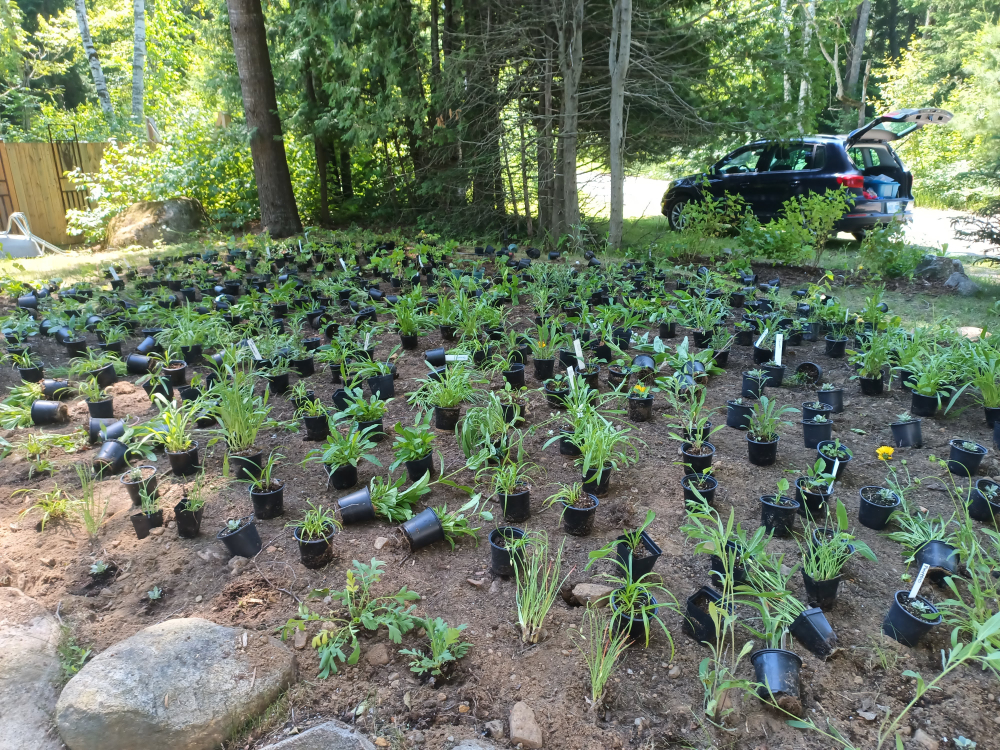
The design employed a strong matrix/groundcover layer covering 60-70% of the septic area, with 30-40% coverage of taller flowering plants providing seasonal interest. This ratio ensures weed suppression through groundcover dominance while creating the flower display the clients requested.
Plant Community Structure
Septic Bed: Matrix Layer (269 plants)
Wood/Rosy Sedge (Carex rosea) forms the primary matrix at 189 plants—the backbone of the planting. Selection rationale:
- CSR profile: S-strategist, stress-tolerant
- Root system: Shallow fibrous roots, safe over septic
- Light tolerance: Adapts to the variable sun/shade conditions
- Behaviour: Forms interconnected colonies that suppress weeds while allowing companion emergence
- Sociability: Appropriate for matrix use at high density
Supporting groundcover species create textural interest within the matrix:
| Species | Quantity | Role |
|---|---|---|
| Plantain-leaved Pussytoes | 24 | Silver rosettes, early bloom, extremely shallow-rooted |
| Canada Violet | 19 | White flowers, spreads to fill gaps, bridges matrix to vignettes |
| Prairie Smoke | 14 | Distinctive feathery seedheads, strong S-strategist |
| Eastern Teaberry | 14 | Evergreen patches, late-season interest, acid-tolerant |
| Common Blue Violet | 9 | Purple accent within groundcover layer |
This combination provides year-round texture: sedge structure, silver pussytoes rosettes, violet foliage, and teaberry's evergreen presence through winter.
Septic Bed: Vignette Layer (279 plants)
The flowering layer creates the visual interest the clients specifically requested. Species were selected for sequential bloom, deer resistance, and shallow root systems.
Early Season (Late Spring)
- Canadian Columbine (24): Red and yellow flowers, already present on site, hummingbird attraction
- Early Meadowrue (24): Delicate blue-green foliage, subtle flowers, fine texture contrast
Mid-Season (Summer)
- Lanceleaf Coreopsis (28): Yellow, long-blooming, drought-tolerant
- Foxglove Beardtongue (28): White spires, reliable performer
- Nodding Onion (28): Pink globes, excellent deer resistance, interesting form
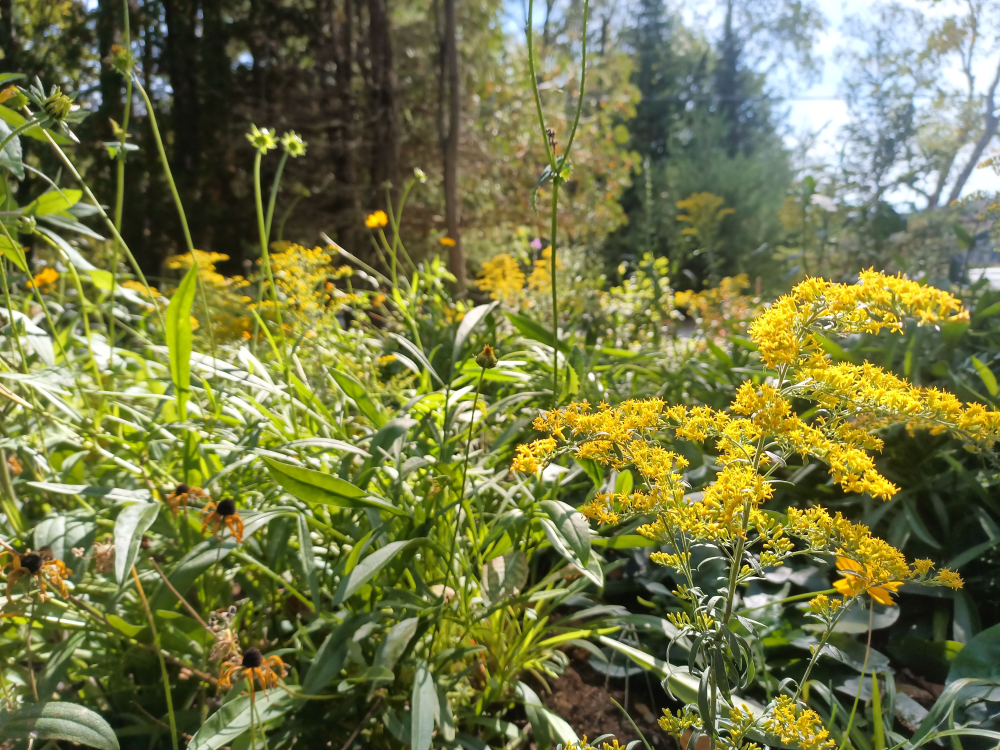
- Black-eyed Susan (28): Classic yellow, fills mid-summer gap
- Pale Spiked Lobelia (24): Pale blue spires, pollinator value
Late Season (Late Summer to Fall)
- Cylindrical Blazingstar (24): Purple spires, strong vertical element
- Heart-leaved Aster (24): Pale blue, reliable fall bloom
- Azure Aster (24): Lavender, extends bloom into October
- Gray Goldenrod (24): Yellow, complements aster colours
This sequence ensures continuous bloom from May through October, with peak display during summer months.
Driveway Border (162 plants)
The driveway planting employs similar species to create visual connection with the septic bed while adapting to harsher conditions—sandy clay, construction rubble, and exposure to snow plow damage.
Matrix: Wood/Rosy Sedge (36) with Wild Strawberry (24), Canada Violet (24), and Prairie Smoke (6).
Vignettes: Black-eyed Susan (12), Azure Aster (12), Gray Goldenrod (12), Foxglove Beardtongue (12), Wild Bergamot (12), and Canadian Columbine (6). These are the toughest performers from the septic palette, selected for their proven tolerance of difficult conditions.
Structure: Bush Honeysuckle (6) provides low shrub framework without creating snow-plow targets. Its arching habit survives burial and regenerates readily.
Road Screening (16 plants)
The rocky, part-shade conditions between septic bed and road required shrubs capable of establishing in thin, stony soil while providing screening over time.
| Species | Quantity | Function |
|---|---|---|
| Grey Dogwood | 4 | Multi-stemmed screening, white fruit clusters, tolerates poor soil |
| Ninebark | 4 | Dense branching, bark interest, extremely adaptable |
| Shadblow Serviceberry | 2 | Taller anchor specimens, spring bloom, fall colour |
| Fragrant Sumac | 2 | Low spreading, aromatic foliage deters deer, fall colour |
| Black Chokeberry | 2 | Dense habit, dark fruit, tolerates wet or dry |
| Highbush Cranberry | 2 | Screening height, red fruit display |
More mature specimens were specified for this area to improve odds against deer herbivory. The combination provides layered screening heights from 2-6 feet (sumac) through 6-10 feet (dogwood, ninebark, chokeberry) to 12-15+ feet (serviceberry, cranberry).
What Was Excluded
Several species from initial consideration didn't make the final design:
Narrowleaf Mountain Mint: Excellent pollinator value but aggressive spreading potential made it unsuitable for the contained septic area where sedge matrix dominance was priority.
Rough Blazingstar: Replaced by Cylindrical Blazingstar, which performs more reliably in part-sun conditions.
New England Aster: Considered for late colour but grows taller than appropriate for the septic bed's viewline requirements. Heart-leaved and Azure Aster provide similar colour at more moderate heights.
Pearly Everlasting: Interesting texture but less reliable establishment than Pussytoes, which serves the same silver-foliage function.
Pale Purple Coneflower: Classic meadow species but requires more consistent sun than the site provides. Black-eyed Susan fills the mid-summer gap more reliably.
Spatial Organization
Septic Bed Zonation
The natural moisture gradient across the septic bed informed plant distribution:
Drier edge (near driveway and cedars): Higher concentration of Prairie Smoke, Pussytoes, and Gray Goldenrod—species tolerant of periodic drought stress.
Central mound: Core matrix of Rosy Sedge with distributed vignette species. Foxglove Beardtongue and Black-eyed Susan concentrated here where conditions are most consistent.
Shaded portions: Canada Violet, Early Meadowrue, and Heart-leaved Aster—species tolerating lower light. Teaberry patches in deeper shade areas.
Textural Balance
The design achieves approximately:
- 50% fine texture (sedge matrix, delicate perennial foliage)
- 30% medium texture (violets, moderate-sized perennials)
- 20% bold texture (Blazingstar spires, Black-eyed Susan flower heads, Beardtongue stalks)
This ratio ensures the meadow reads as cohesive rather than chaotic while providing sufficient bold elements to create focal points and seasonal drama.
Unifying Elements
Species repetition across areas: Rosy Sedge, Canada Violet, Black-eyed Susan, and Azure Aster appear in both septic and driveway areas, creating visual connection between distinct plantings.
Colour palette: Yellow (Coreopsis, Black-eyed Susan, Goldenrod), white (Beardtongue, Boneset, Violet), purple-blue (Asters, Lobelia, Blazingstar), and pink (Onion, Prairie Smoke) create coherent seasonal combinations.
Structural rhythm: Vertical elements (Blazingstar, Beardtongue, Lobelia) distributed throughout prevent the matrix from reading as flat. These punctuation points draw the eye and create depth.
Expected Development
Year One (2025): Establishment
Coverage expected to reach 50-65% by fall. The septic bed's better soil will establish faster than the driveway border. Sedge matrix requires attention to ensure weeds don't outcompete plugs during establishment—the goutweed present needs management. Watering during dry periods critical for first-year survival.
Year Two: Infill and Competition
Coverage increases to 75-85% as sedge matrix fills gaps. Self-seeding from Columbine, Black-eyed Susan, and Violets begins contributing volunteers. First significant bloom display from vignette layer. Screening shrubs showing growth but not yet providing substantial screening.
Years Three to Five: Maturation
By year three, the planting functions as established community requiring seasonal maintenance rather than intensive intervention. Matrix achieves weed-suppressing density. Vignette species reach mature size and full bloom potential. Screening shrubs begin providing intended privacy function.
Long-Term Trajectory
The S-dominant community should remain stable with minimal inputs. Annual tasks include:
- Spring cleanup of previous year's growth
- Goutweed monitoring and removal
- Periodic thinning of aggressive self-seeders (Black-eyed Susan may need reduction after year 4-5)
- Shrub pruning as needed for form
The design anticipates some species movement and natural editing. Exact plant placement will shift as the community finds its equilibrium—this is expected and desirable.
Summary
- Site observation revealed loamy soil with established stress-tolerant native community, variable moisture, and mixed light conditions
- This indicated S-strategy dominance as appropriate approach—the existing plants confirmed what the soil could support
- Site constraints added shallow root requirement over septic, deer resistance, multiple viewing angles, sequential bloom for client interest
- CSR + constraints filtered to a palette of stress-tolerant, shallow-rooted, deer-resistant meadow species with extended bloom sequence
- Design challenge was creating continuous flower interest while maintaining matrix dominance for weed suppression
- Solution was layered community: dense sedge matrix with distributed vignette species providing spring-through-fall colour, connected across areas through repeated species
- Result: A design that enhances existing site character rather than imposing foreign aesthetic, requiring low inputs after establishment
Get updates by email
Fill out the form to get updates about Grounded and native plant gardening.