
How much of a pond is beaver?
When does a tree end and the forest begin? How much of a pond is beaver? What percentage of me is me?
These are the things I think about in the shower. No wonder my propane bill is so high.
They are, however, important questions about how the world is made – and they directly affect how we landscape around our homes and cottages. I’ll try to explain.
We’re talking about the fundamental units of life here, and what my hot-water ponderings are teaching me is that it’s not as simple as “a tree”, “a beaver”, and “a human.”
Look at that sugar maple by your cottage. Its influence extends far beyond its trunk and branches. Its roots feed fungal networks that connect to other trees. Its leaf litter builds the soil that other plants grow in. Its canopy creates the shade and moisture conditions that determine what lives beneath it. You could say the tree is making the forest.
But you could also say the forest is making the tree. It would struggle to survive without those same fungal networks – nutrients go both ways. It would be hungry without decomposers breaking down leaves into food.
So where does the tree end and the forest begin?
Look at the beaver in the local wetland. Its dam makes the pond, which changes the water level, which creates wetland edges where new plants can live, which builds fish habitat. You could say the landscape is beaver in wood, water, and mud because the whole thing is a creation of the rodent’s compulsion to build dams.
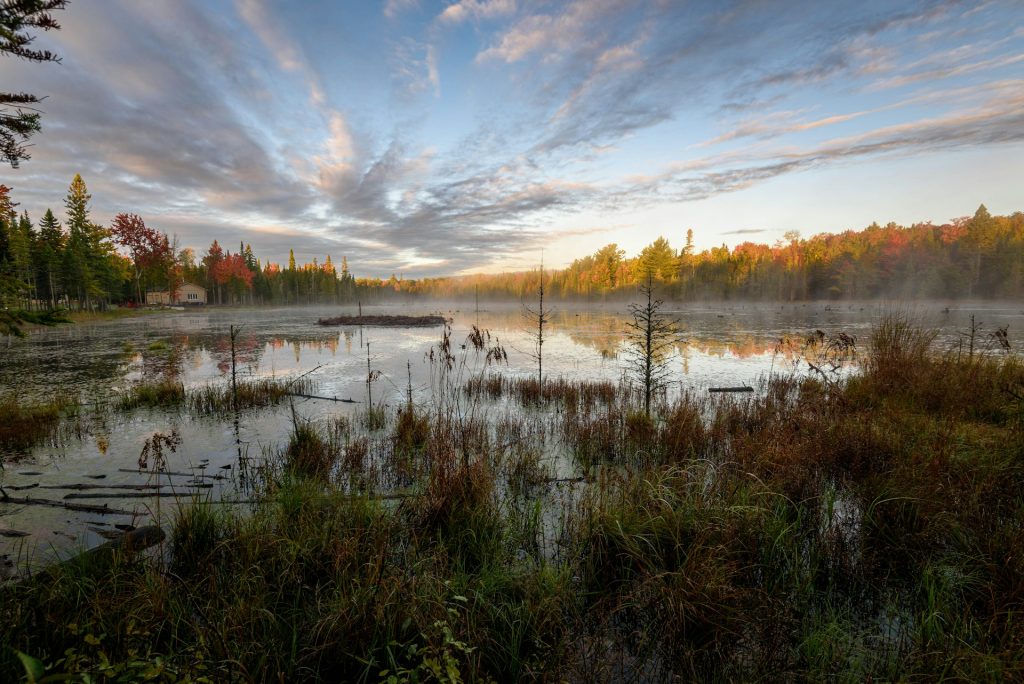
The beaver is pond, too. It needs the trees it fells, the water flow it redirects, the food and shelter the pond provides. Break the dam and the beaver needs to get busy rebuilding it.
Now look at yourself. You host trillions of microorganisms that would not exist without a home in your gut. There are as many bacterial cells in your body as there are human cells. So how much of you is you?
It’s not a one-way street, either. Those gut bacteria break down foods and provide vitamins. The mitochondria in your cells that produce your energy were once separate bacteria. Perhaps the thing that powers you is not… you?
Which all brings me back to landscaping.
We’re taught to look at the plants as separate units. We go to the nursery and buy “a rose” or “a ninebark” or “a geranium.” We’re led to believe that each plant functions alone, as an island. Sometimes it seems that choosing plants is like choosing furniture for a new home. You’ve got a blank canvas and you need to fill it with chairs, a table, lamps, beds.
It’s clear to me, however, that creating a landscape is nothing like furnishing a room. At least if we want it to function well.
That’s why I design gardens and shorelines to make communities, working with what is already there and adding to the rich web of relationships in the landscape.
Those sedges on a slope have roots that are holding the soil together, providing the conditions for other plants to grow. Those irises by the shoreline are filtering run-off from your driveway, keeping the lake clean and providing conditions fish thrive in. Those goldenrods you chose for fall colour are helping pollinators build reserves for winter.
All of these plants need the soil created by other plants. They need the pollinators fed by other plants.
Everything is everything else. The grasses are sparrows and the coneflowers are bees. The soil is birch and the butterflies are milkweeds.
And us? We are all of those things, too. Which is why when we create landscapes that fit in with the world, we fit in with the world, too. And that, it seems to me, is a nice way to live.