
Your land isn’t messy, it’s getting going
A few years ago I planted an ecological garden slap bang in the middle of Haliburton, next to the post office, across from the town hall, by the intersection visitors hesitate at because they don’t understand it… You get the picture. The garden at Lucas House got noticed.
Someone said to me the other day that the garden looked messy in that first year.
To be fair, it was sparse. The plants were small and there were big gaps between them. If you didn’t know, you might think it was failing. It was certainly not a TV show “reveal”.
But one person’s messy is another person’s establishing. So I pushed back on my critic: an ecological garden develops variety – grasses next to perennials, ground that is covered and stops weeds growing.
Instant gardens less so. You could say they’re brittle. Those big, beautiful plants don’t yet have roots that are integrated into the soil. They’re not yet part of the landscape. They are pictures placed on the land rather than inhabitants of it.
The tidiness myth
We tend to think tidy means healthy. A tidy house is a clean house lived in by a healthy person. Piles of books gathering dust and toys scattered on the floor less so. We feel that a sense of neglect must filter through to all parts of our lives.
A neat lawn is the sign that someone is on top of their domestic affairs. If their lawn is that neat, their bathroom must be Lysoled to a shine and the shampoos lined up just right.
This feels like common sense – that neatness is next to godliness – but it’s something we’ve learned. It’s not a law of nature.
A neat, trimmed lawn is a monoculture that offers little to the rest of nature. Those weekly cuts mean the grass never forms deep roots so struggles to help combat erosion. You miss the welcome sight of a new flower first thing in the morning. It never sets seed. It’s a carpet and not much more.
Those stems that are cut down each fall to put the garden to bed make overwintering insects homeless. That means there will be fewer insects to pollinate the plants next summer, and fewer chances to see butterflies and bees in your garden. When the stems are left, the landscape has height that survives the blanket of snow, providing a brown vertical spike against the white.
Cues to care
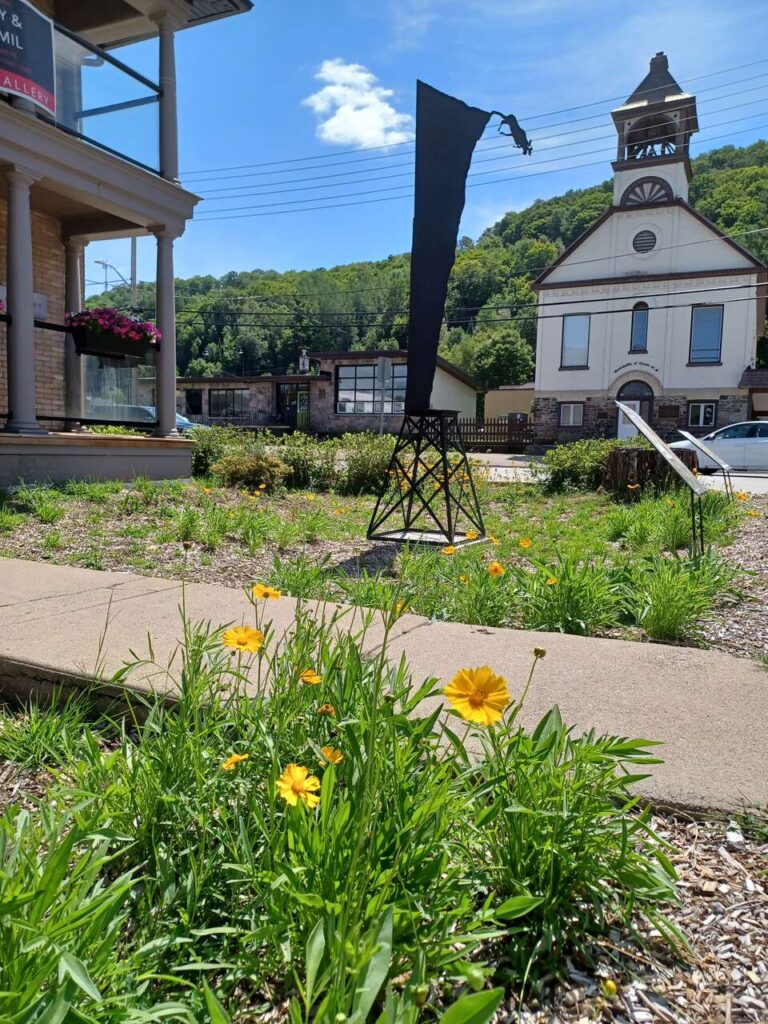
This doesn’t mean we go to the other extreme. Raw nature can look chaotic… and chaotic isn’t a good look in front yards. People complain your plants bring down the tone of the neighbourhood, even lower house prices.
That’s why I use “cues to care”, which show the landscape is deliberate. I have paths running through Lucas House, an edge of mulch by the sidewalk to keep plants off the path. There’s a bench. Even a metal sculpture of a moose.
I might be careful about placing tall plants too near the front so they don’t block views to the rest of the garden. Or I might add some Serviceberry or Pagoda Dogwood trees that take the eye to the White Pine by the lake.
The messiness of life
After the first year, the garden at Lucas House started to fill in. It was much less sparse the second year and dense the third. So dense that plants were packed in together, some sharing the same space of sky – one low, the other high.
It’s still not the neatness of lawn and mulch. From a distance, it’s hard to tell where one plant ends and the other begins.
But get closer to the garden in early August and notice the butterflies and bees, all living their lives amid the stems and leaves. To them, it’s not messy, it’s home.