
Moist Shoreline
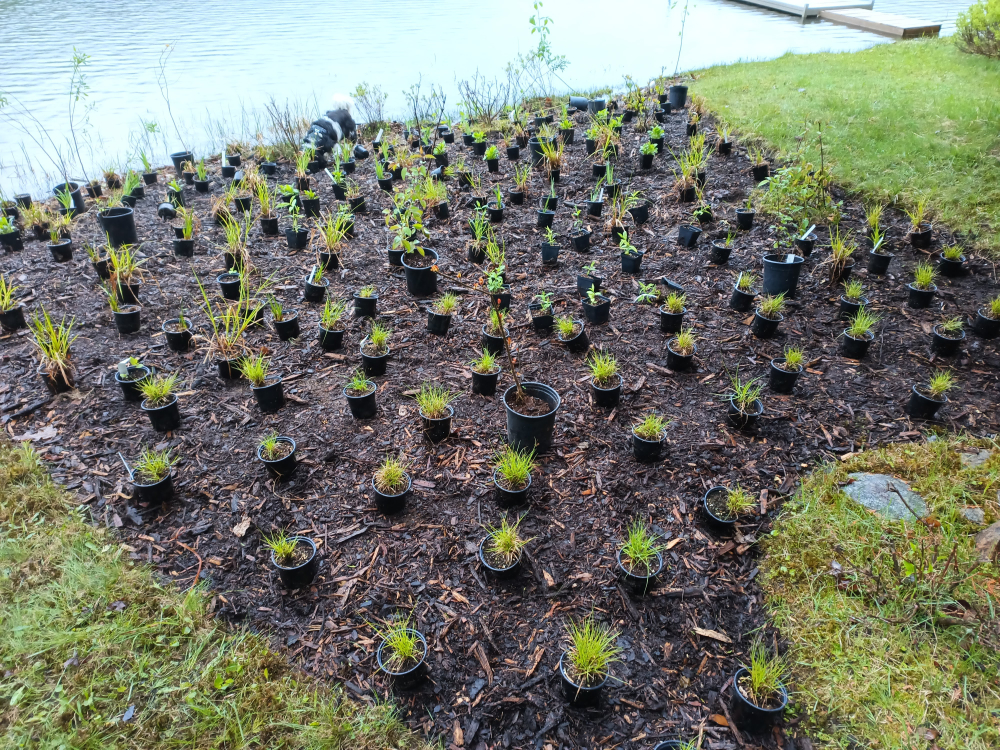
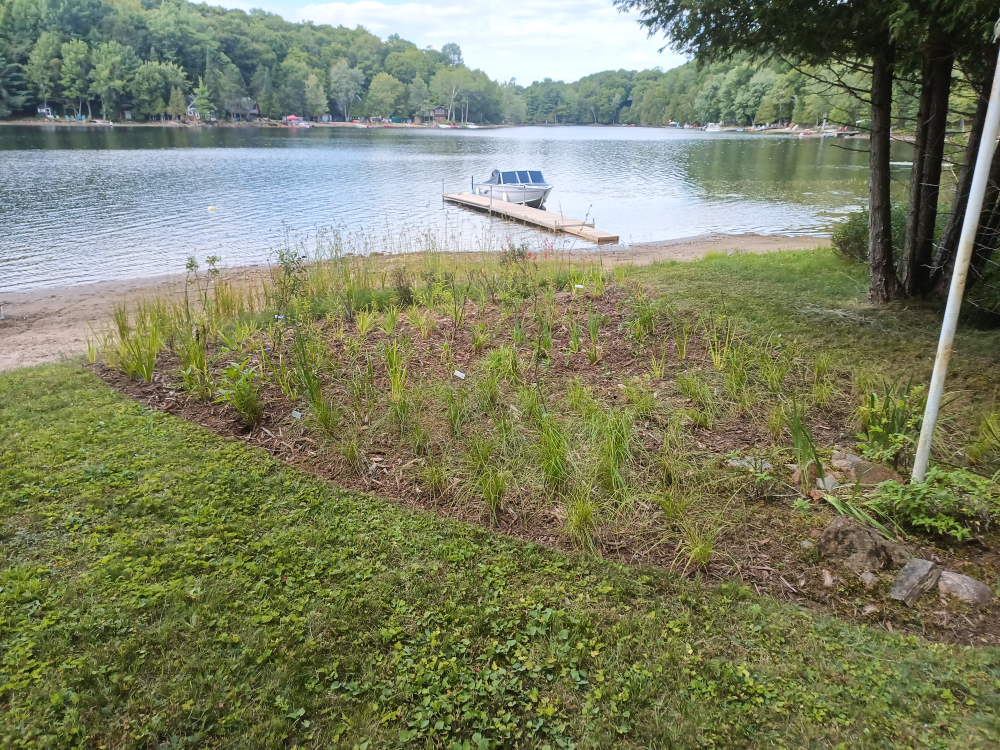
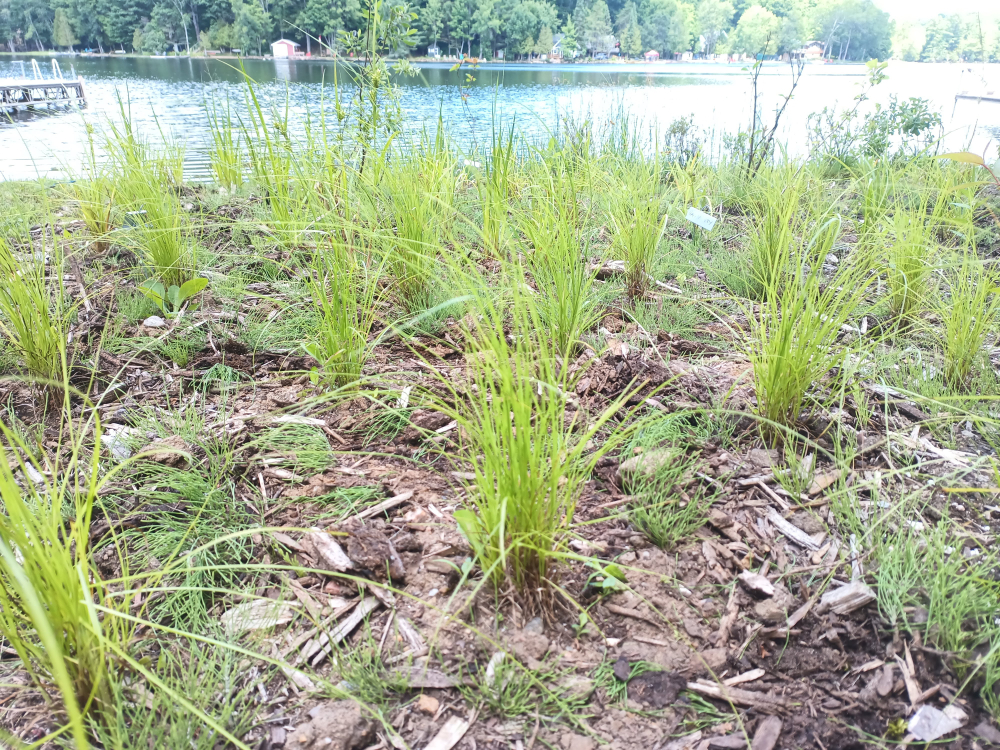
We replaced part of a lawn with a bed of moisture-loving shoreline plants. Installed July 2025.
Plant Selection and Layout Methodology
Project Overview
A cottage property on Horseshoe Lake required conversion of a sloping lawn area to naturalistic shoreline planting. The site presented multiple design challenges: an active goose problem, a slope running from lawn down to water's edge, and the need to balance ecological restoration with practical access and aesthetics. The design goal was to create a functional native plant community that would increase biodiversity, contribute to lake health through improved shoreline filtration, and create physical barriers to discourage goose grazing while maintaining the property's usability.
Site Analysis Summary
Light and Exposure
The planting area receives sun to part-shade conditions, with the shoreline edge experiencing more direct light exposure due to the open water. The site's south-facing aspect on a Canadian Shield lake provides adequate light for most wetland and facultative species. Neighbouring mature trees create filtered shade conditions in portions of the upper slope.
Moisture Gradient
The defining characteristic of this site is its natural moisture gradient—wet at the shoreline, transitioning to moist conditions upslope. This gradient became the primary organizing principle for plant selection and placement. Rather than treating the slope as a single planting zone, the design reads the site's hydrology and positions plants according to their natural affinity for specific moisture regimes. The presence of moss in portions of the original lawn confirmed consistently moist conditions even in the upper areas.
Functional Requirements
The client identified goose deterrence as a primary concern. Geese prefer easy sight lines to water and unobstructed access between grazing areas and escape routes. The design addresses this through strategic shrub placement along the shoreline—not as a solid barrier, but as visual and physical interruptions that make the site less attractive to grazing waterfowl. The client wished to maintain lawn access for family use, so the planting concentrates in one section rather than creating a continuous buffer strip.
Design Strategy: Wetland Indicator Status
Reading the Moisture Gradient
The design relied on observable site conditions and the established framework of Wetland Indicator Status (WIS). This classification system categorizes plants according to their probability of occurring in wetland versus upland conditions, providing a reliable basis for matching plants to position along a moisture gradient.
The WIS categories relevant to this site:
| Category | Placement Logic |
|---|---|
| Obligate Wetland (OBL) | Positioned at shoreline edge; these species require consistently wet or saturated conditions |
| Facultative Wetland (FACW) | Positioned mid-slope; these species usually occur in wetlands but can tolerate occasional drier conditions |
| Facultative (FAC) | Positioned upper slope; these species occur equally in wetland and non-wetland areas |
This approach lets the site's natural hydrology dictate plant placement rather than imposing arbitrary design zones.
Plant Community Structure
The planting is organized in three functional layers: a groundcover matrix to stabilize soil and suppress weeds, a seasonal forb layer for wildlife value and visual interest, and a structural shrub layer for year-round presence and goose deterrence.
Groundcover Layer: The Three-Sedge System
The groundcover relies on three sedge species, each positioned according to its moisture preference. This creates visual unity (all are fine-textured graminoids with similar colour) while allowing ecological precision in placement.
| Species | Position | WIS | Character |
|---|---|---|---|
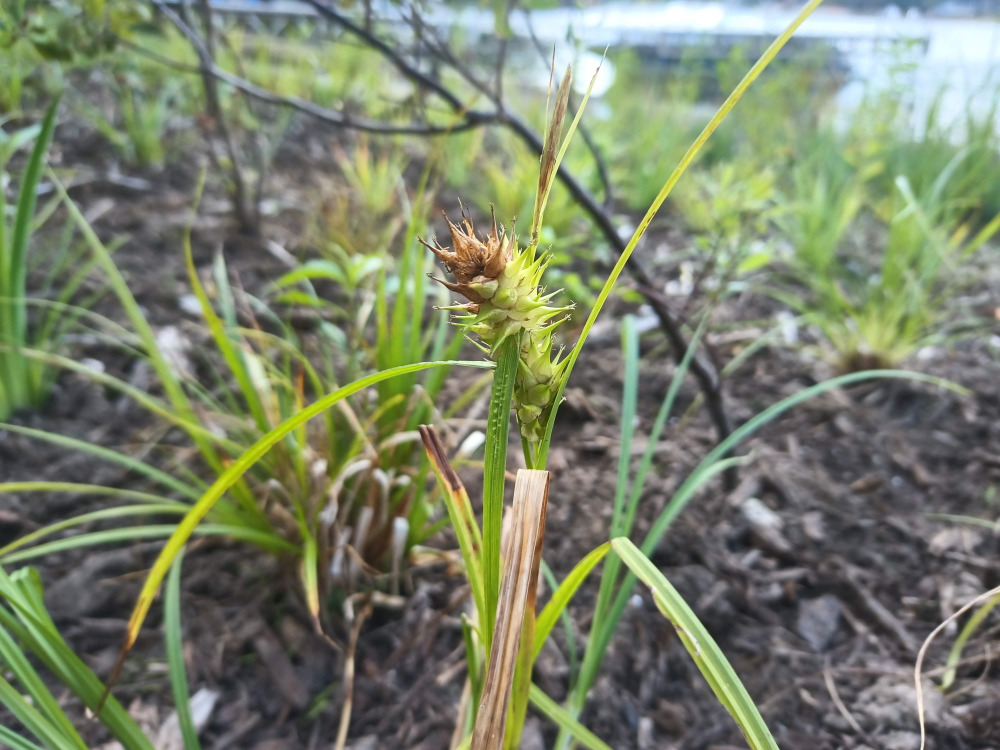
| Carex pseudocyperus (Cyperus-like Sedge) | Shoreline edge | OBL | Architectural bristly seed heads; bold texture |
| Carex vulpinoidea (Fox Sedge) | Mid-slope | FACW-OBL | Dense clumps; fox-tail seed heads |
| Carex sparganioides (Bur-reed Sedge) | Upper slope | FAC-FACW | Large arching clumps; tolerates drier conditions |
All three sedges establish through rhizomatous spread, eventually knitting together to form continuous groundcover that suppresses weeds and stabilizes the slope. Their placement follows a moisture logic that allows each species to thrive without irrigation or amendment.
Seasonal Forb Layer
The forb layer provides seasonal colour and wildlife value. These species were selected for both their ecological contributions and their visual impact during cottage season (late spring through early fall).
| Species | Bloom | Colour | Primary Value |
|---|---|---|---|
| Asclepias incarnata (Swamp Milkweed) | Mid-summer | Pink to mauve | Monarch host plant; premier pollinator nectar |
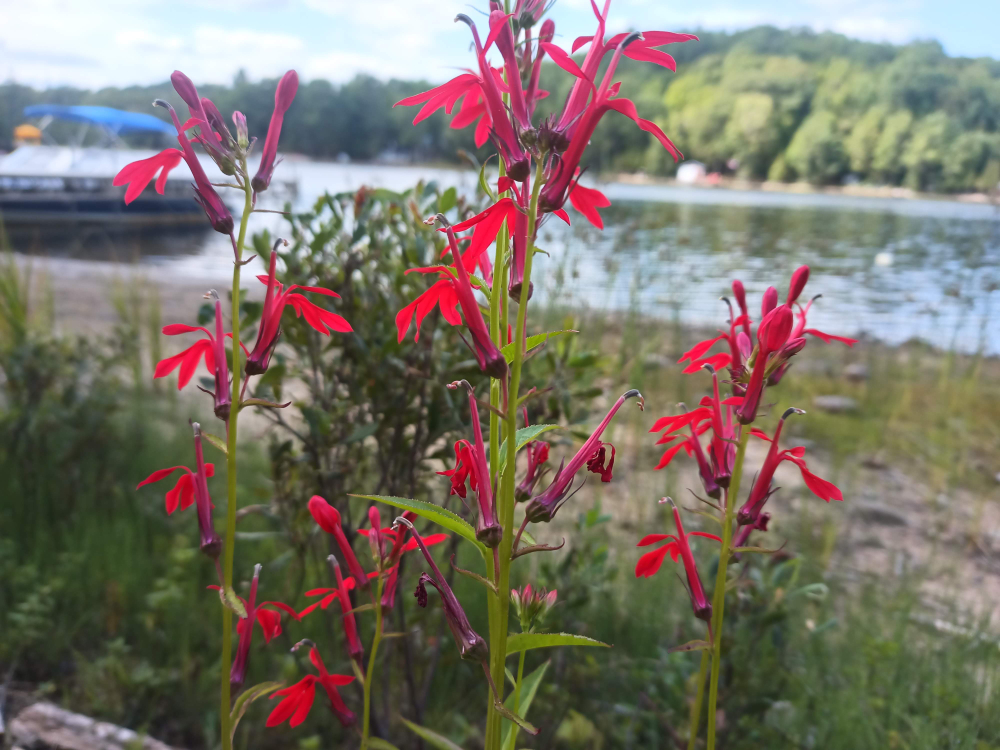
| Lobelia cardinalis (Cardinal Flower) | Mid-late summer | Brilliant red | Premier hummingbird plant; visual anchor |
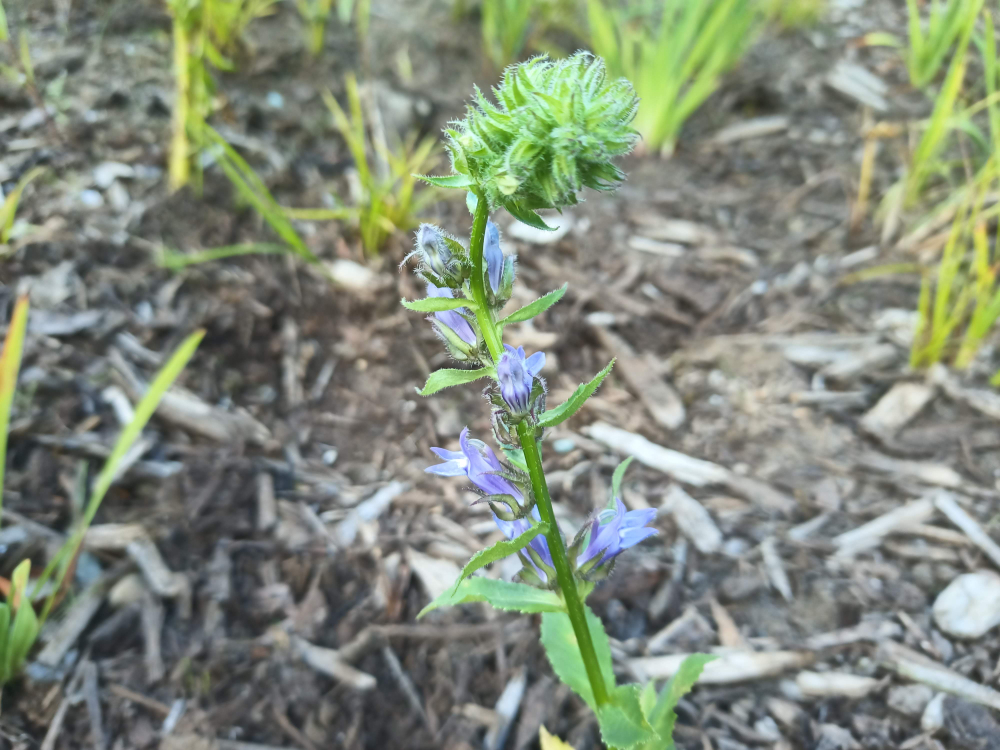
| Lobelia siphilitica (Great Blue Lobelia) | Late summer–fall | Bright blue | Hummingbirds and native bees; extends bloom season |
| Chelone glabra (White Turtlehead) | Late summer–fall | White to pink | Baltimore Checkerspot host; bumblebee nectar; deer resistant |
| Acorus americanus (American Sweet Flag) | Early–mid summer | Green-brown | Shoreline stabilization; wildlife cover; aromatic foliage |
The bloom sequence provides continuous colour from mid-summer through fall. The two Lobelias—one red, one blue—create complementary focal points, while Swamp Milkweed and Turtlehead extend the pollinator value. Cardinal Flower and Great Blue Lobelia are short-lived perennials (2–4 years) that maintain populations through self-seeding, creating dynamic but predictable populations over time.
Structural Shrub Layer
The shrub layer provides year-round structure, winter interest, and the physical barriers needed for goose deterrence.
| Species | Mature Size | Placement | Function |
|---|---|---|---|
| Cornus sericea (Red Osier Dogwood) | 1.5–2.5 m | Far corner (×3) | Screening; winter red stems; 30+ bird species eat berries; thicket formation |
| Cephalanthus occidentalis (Buttonbush) | 1–3 m | Shoreline | Goose barrier; tolerates flooding; distinctive spherical flowers; butterfly nectar |
| Myrica gale (Sweet Gale) | 1–2 m | Shoreline | Goose barrier; nitrogen-fixing; aromatic foliage; tolerates flooding |
| Ilex verticillata (Winterberry) | 2–4 m | Mid-slope | Winter red berries; 20+ bird species; year-round structure; very long-lived (40+ years) |
The Red Osier Dogwood cluster in the far corner serves a dual purpose: creating a dense thicket that partially screens the neighbour's dock while balancing similar plants visible in the adjacent property. The bright red winter stems provide year-round interest when viewed from the cottage.
What Was Excluded and Why
Several species were considered but not included in the final design:
Continuous shoreline buffer strip: Research indicates a continuous dense planting along the entire shoreline provides superior goose deterrence—geese require clear sight lines to water as an escape route. However, the client prioritized maintaining family beach access and lawn area. The design represents a compromise: sufficient shrub density to discourage grazing in the planted area while accepting that geese may continue using other portions of the property.
Aggressive spreaders: Several otherwise suitable species were excluded due to their potential to dominate the planting. In this relatively small area, vigorous rhizomatous spread could quickly eliminate the designed diversity.
Spring ephemerals: The client's seasonal occupancy (late spring through summer) means early spring interest goes unseen. The design prioritizes bloom during the residency period.
Spatial Organization
Moisture Zones
The design creates three implicit zones based on distance from water rather than arbitrary boundaries. Obligate wetland plants occupy the water's edge. Facultative wetland species dominate the mid-slope. The upper portions, still moist but not saturated, accommodate facultative species tolerant of occasional drier conditions. This zonation is functional rather than decorative—it positions each species where it will thrive without supplemental irrigation.
Shrub Placement Strategy
The shrub layer serves both aesthetic and functional purposes. The Red Osier Dogwood thicket in the far corner provides screening and winter interest while echoing the neighbour's similar plantings. Lower shrubs along the shoreline (Buttonbush, Sweet Gale) create physical barriers to goose access without completely blocking lake views. This layered approach maintains the open feel the client desired while addressing the goose problem within the planted area.
Unifying Elements
Despite the variety of species, several elements create coherence. The sedge groundcover, though comprising three species, reads as a unified matrix of similar colour and texture. The predominant bloom palette centres on pink, red, blue, and white—avoiding the visual chaos of random colour mixing. The structural shrubs all share tolerance for wet conditions and similar growth habits, creating a consistent framework.
Expected Development
Year One: Establishment
The first year focuses on root establishment rather than impressive above-ground growth. The sedge matrix will appear sparse, and perennials may show limited bloom. This is normal and healthy behaviour. The site's natural moisture and the mulch layer applied at installation should minimize watering needs—supplemental irrigation only if an extended dry period occurs. Weeding should focus on removing perennial weeds and tree seedlings; annual weeds can simply be prevented from flowering.
Years Two and Three: Community Formation
Growth accelerates as root systems establish. The sedge groundcover begins filling gaps, and perennials reach full bloom potential. Self-seeding from the Lobelias and Milkweed may produce volunteers that can be edited or encouraged depending on desired effect. The shrubs begin developing their characteristic forms—the Red Osier Dogwood thicket becomes denser, and the shoreline shrubs create effective goose barriers.
Long-Term: Mature Community
By year four and beyond, the planting functions as a self-sustaining plant community. The sedge matrix provides complete ground coverage, naturally suppressing weeds. The shrub layer reaches mature size, providing reliable structure and goose deterrence. Maintenance drops to minimal intervention—occasional editing of aggressive spreaders, selective cutting back in spring, and periodic assessment of community balance. The design should require 2–5 minutes per square metre annually, compared to 15–20 minutes for conventional landscapes.
Summary
- Site observation revealed a natural moisture gradient from shoreline to upper slope
- This gradient indicated Wetland Indicator Status as the primary organizing principle for plant selection
- Client goals added goose deterrence, seasonal interest, and biodiversity as design requirements
- The moisture gradient + functional goals filtered to a palette of native wetland species positioned by their natural moisture affinity
- Design challenge was creating visual coherence while serving multiple functions
- Solution was a three-layer system: sedge groundcover for stability, forbs for seasonal interest and wildlife, shrubs for structure and goose barriers
- Result: A design that works with site hydrology rather than against it, requiring minimal long-term inputs while providing ecological and aesthetic value
Get updates by email
Fill out the form to get updates about Grounded and native plant gardening.