
Shoreline Vista Landscape
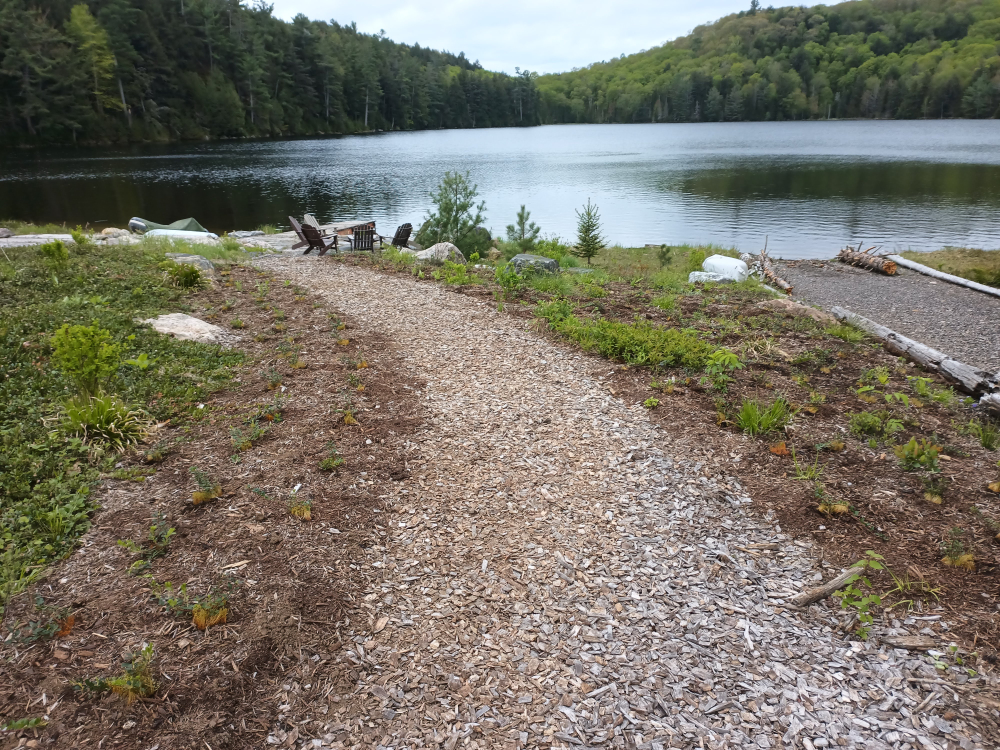
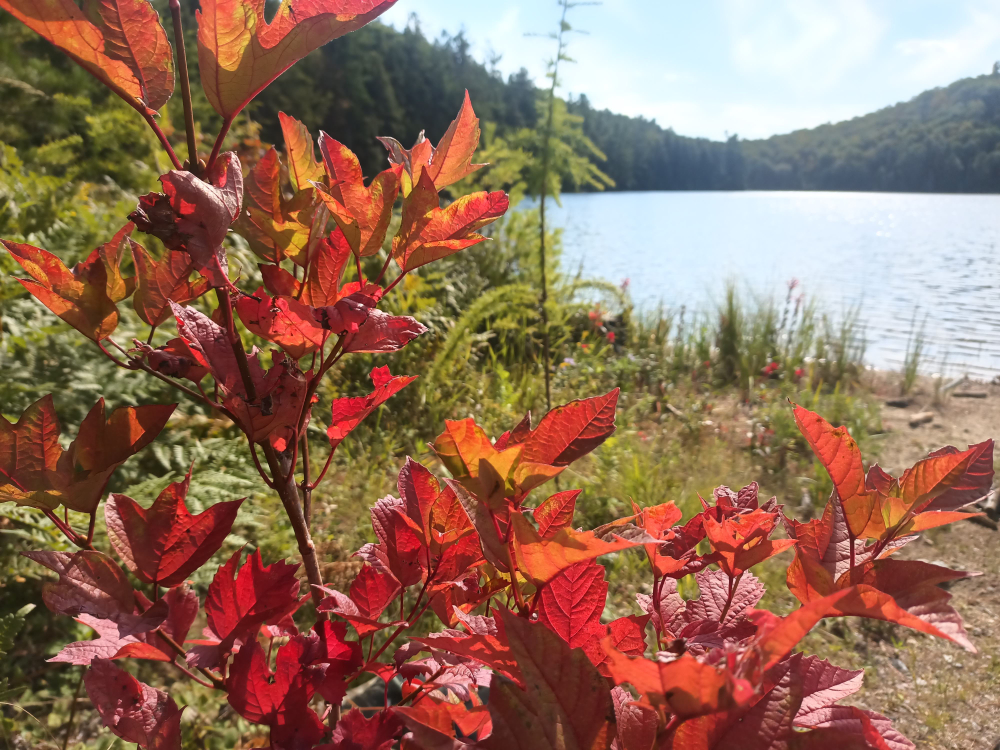
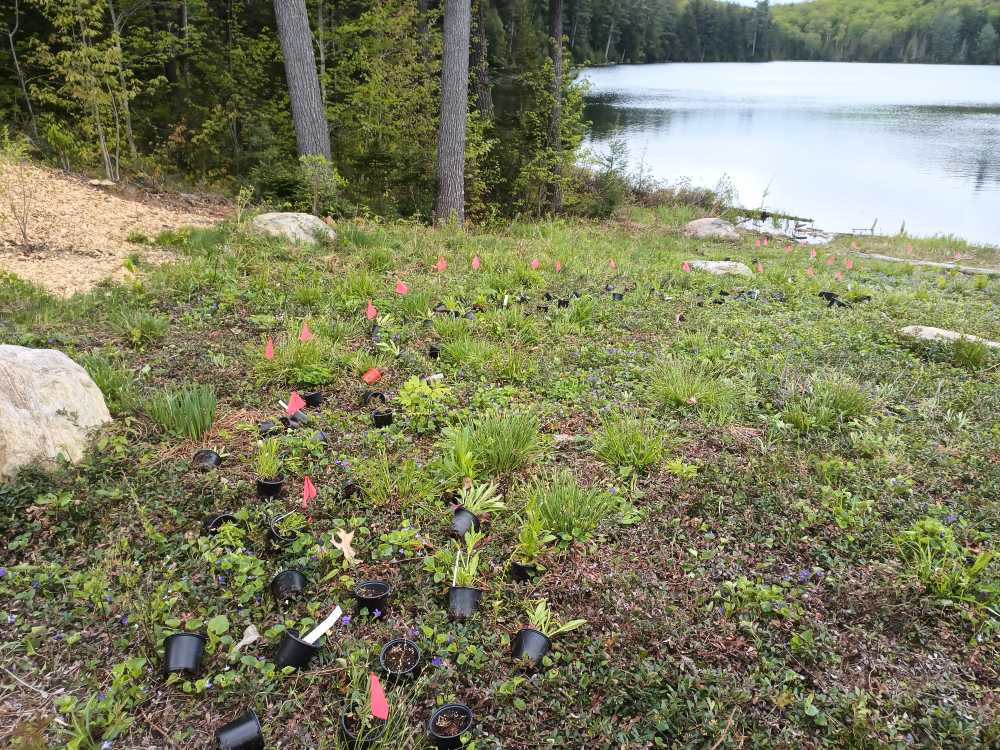
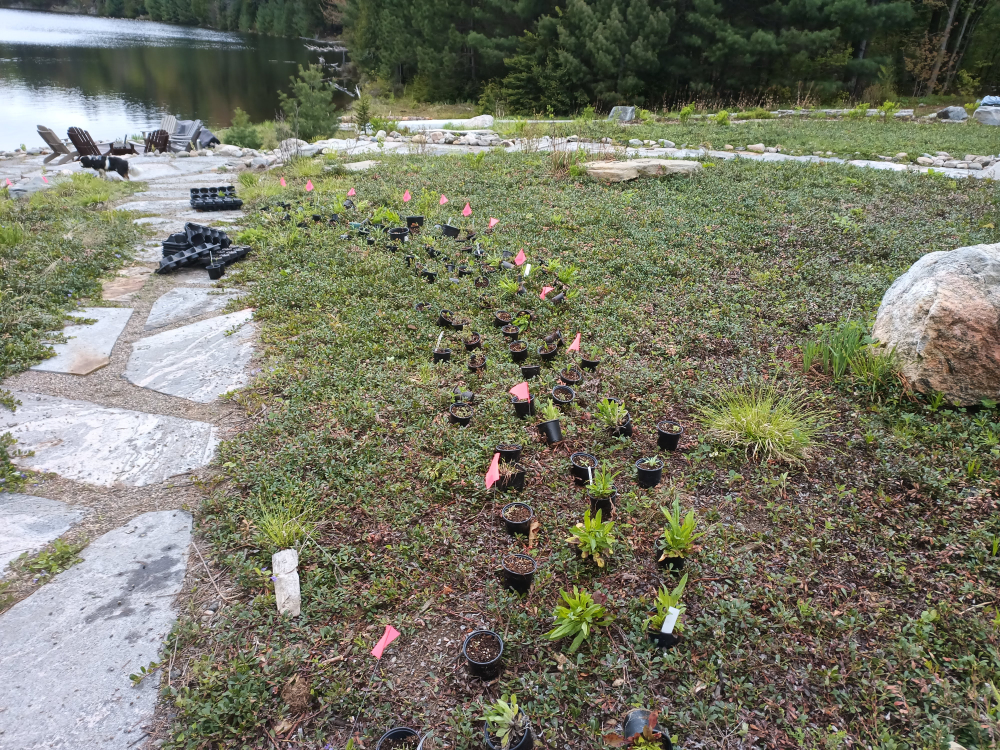
A reclaimed sand pit was rehabilitated by our client. He wanted to add some native plant colour to the landscape, so we added curving bands of perennials and woodland-edge shrubs. Installed June 2025.
Plant Selection and Layout Methodology
Project Overview
A 5,000 sq ft former sandpit required transformation into a naturalistic landscape that would remain stable without progressing toward forest. The site sloped gently toward the lake, surrounded on two sides by mature forest, and featured an established groundcover of bearberry (Arctostaphylos uva-ursi) that the client had installed a few years earlier. The design challenge was to work with this existing condition rather than replace it, creating a visually compelling landscape that appears designed while remaining ecologically stable—what might be called "arrested succession."
Site Analysis Summary
Light and Microclimate
The main planting area receives full sun throughout the growing season, with the surrounding forest providing wind protection but not shade encroachment. The south-facing slope toward the lake creates a warm microclimate, and the sandy substrate drains rapidly after rain. These conditions—full sun, excellent drainage, warm exposure—favour stress-tolerant species adapted to dry, nutrient-poor environments.
Soil Conditions
The site's history as a sandpit and the thriving bearberry population tell a clear story. Sandy loam texture with low organic matter content, slightly acidic pH (typical of Canadian Shield soils), and minimal nutrient retention capacity. The bearberry's success confirms these conditions—it thrives in precisely the kind of nutrient-poor, acidic, well-drained soil that most garden plants would struggle in.
In conventional horticulture, this would be considered "problem" soil requiring amendment. For naturalistic planting, it's an advantage. Low fertility means reduced weed pressure and competitive exclusion of aggressive species, while the stress conditions favour plants adapted to these environments over opportunistic colonizers.
Existing Vegetation
The established bearberry groundcover occupying approximately 70% of the site represents a significant design asset. This evergreen mat-forming shrub has already solved the ground-layer problem, creating a stable, low-maintenance base that suppresses weeds and holds the sandy soil. Rather than removing or replacing this vegetation, the design works with it as the foundation.
Design Strategy
The Arrested Succession Concept
Left alone, this site would gradually transition from its current early-successional state toward forest, as woody species establish and shade out sun-loving plants. The design intervenes in this trajectory, creating a stable mid-successional community of grasses, forbs, and scattered shrubs that won't progress to climax forest. This requires selecting species that can persist without being outcompeted, while strategically placing woody elements that provide structure without casting excessive shade.
The approach embraces the site's disturbance history rather than erasing it. A restored sandpit can never become old-growth forest, but it can become a distinctive meadow-edge landscape with ecological value and visual interest that forest cannot provide.
Working with the Existing Matrix
The 70% bearberry coverage dictated a design strategy of interplanting rather than replacement. New plantings occupy the remaining 30% of area, emerging from and surrounded by the existing groundcover. This creates immediate visual coherence—the new plants appear as though they've grown up through the bearberry rather than been inserted into bare soil—and reduces establishment stress since the bearberry moderates soil temperature and moisture.
Band Design for Visual Impact
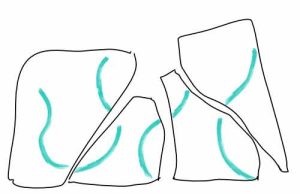
The perennials were planted in bands to create a coherence to the design.
The main garden area is organized as seven bold curved bands, each approximately 20 feet by 4-6 feet, sweeping across the slope to draw the eye toward the lake. This geometric approach creates visual drama while working with the natural flow of the terrain. Repetition within bands (single species or small groupings repeated throughout each band) creates coherence, while variation between bands creates interest. The effect is intentionally different from the naturalistic chaos of a wild meadow—more legible, more designed, while still using exclusively native species.
Plant Community Structure
Matrix and Groundcover Layer
Bearberry (Arctostaphylos uva-ursi) serves as the primary matrix, comprising 70% of ground coverage with 200 plants supplementing natural regeneration. This evergreen mat-former provides year-round structure, fall colour when leaves redden, and ecological function as a groundcover host to native pollinators. Its low profile (4-8 inches) allows taller plants to emerge dramatically above it.
Structural Grass Layer
Little Bluestem (Schizachyrium scoparium) forms the vertical spine of the design with 200 plants distributed across the bands. This warm-season grass reaches 2-3 feet in height, providing summer green that transitions through copper and bronze in fall before persisting through winter as architectural tan stems. Its bunch-forming habit allows companion plants to grow between clumps, and its stress tolerance matches the site conditions precisely.
The choice of Little Bluestem over other native grasses reflects both aesthetic and ecological reasoning. Switchgrass would be too tall and aggressive for this scale; Sideoats Grama too short; Big Bluestem too dominant. Little Bluestem provides the right scale and the four-season interest that makes it valuable in naturalistic design.
Perennial Forbs
The forb layer totals 900 plants across multiple species, selected for sequential bloom, stress tolerance, and pollinator value:
Early-season colour comes from Foxglove Beardtongue (100 plants) with purple-pink tubular flowers in early June, and Red Columbine (50 plants) providing red and yellow nodding flowers that attract hummingbirds.
Mid-summer interest peaks with Wild Bergamot (100 plants) in lavender-pink, Black-eyed Susan (100 plants) in yellow, Anise Hyssop (100 plants) in pale purple, Azure Blue Sage (100 plants) in true blue, and Pale Purple Coneflower (40 plants) in soft pink. This creates the most dramatic display during peak cottage season.
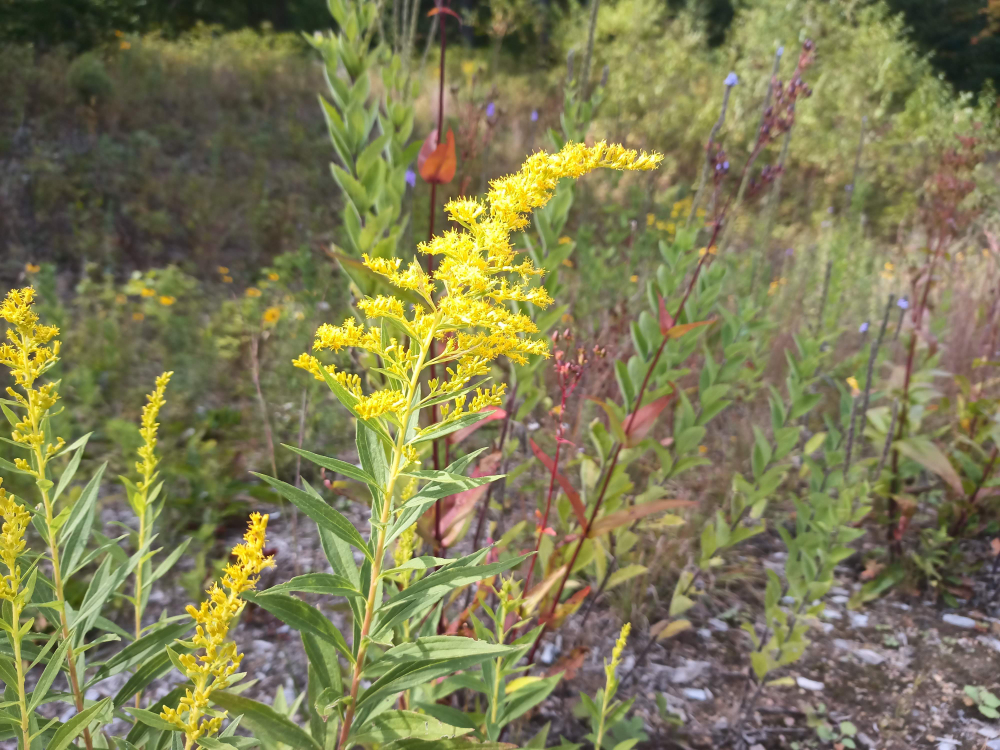
Late-season display features Gray Goldenrod (100 plants) in yellow and Azure Aster (100 plants) in blue, ensuring colour continues into fall while complementing the bronzing Little Bluestem.
Wetland Vignette
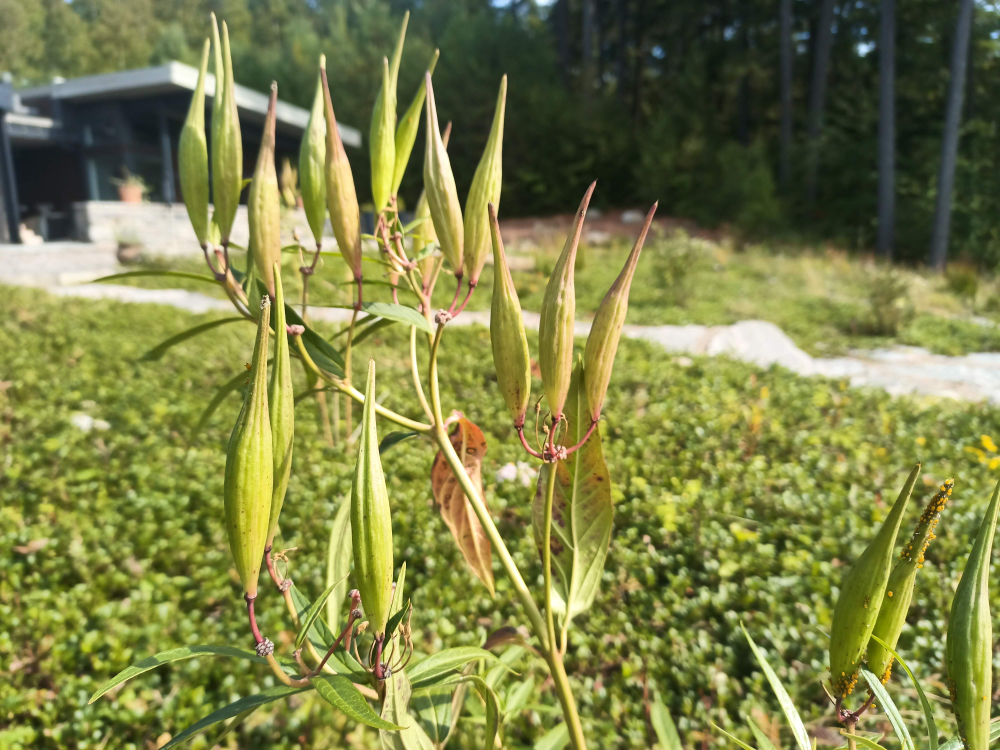
The shoreline area extends the band design into wetter conditions with moisture-adapted species: Harlequin Blueflag (20 plants), Cardinal Flower (20 plants), and Swamp Milkweed (20 plants). These provide vertical interest at the water's edge while managing the transition from dry upland to wet shoreline.
Shrub Structure
Two distinct shrub plantings serve different functions. Within the main garden area, New Jersey Tea (10 plants) and Meadowsweet (10 plants) provide woody structure without exceeding 3-4 feet, maintaining the open character while offering additional bloom interest. At the forest edge, 15 larger shrubs (Smooth Serviceberry, Grey Dogwood, Alternate-leaved Dogwood, Northern Bayberry, and others) create a graduated transition from open meadow to forest canopy, with height increasing toward the tree line.
Specimen Trees
Tamarack (5 specimens) provide the tallest vertical elements. The birches offer white bark contrast against the surrounding conifers, while the deciduous Tamarack provides fall gold before dropping needles—a conversation piece for visitors unfamiliar with deciduous conifers.
What Was Excluded
Several species that might seem appropriate were deliberately excluded. Big Bluestem and Switchgrass were rejected as too tall and competitive for the site scale. Showy Goldenrod was replaced with Gray Goldenrod to avoid the more aggressive spreading habit. Common Milkweed was excluded in favour of Swamp Milkweed to avoid its rhizomatous spread through the garden bands. Purple Coneflower was considered but replaced with the native Pale Purple Coneflower to maintain the regional palette. These exclusions reflect the arrested succession concept—plants that spread aggressively or grow too tall would destabilize the intended balance.
Spatial Organization
Three-Zone System
The design organizes 950 plants across three distinct zones: the Garden Area (seven bands on the main slope), the Forest Edge (graduated shrub planting transitioning to woods), and the Shoreline Wetland (moisture-adapted species at the water's edge). Each zone responds to its specific conditions—sun exposure, moisture availability, visual prominence—while the whole reads as a unified landscape.
Height and Colour Gradients
Plant height increases from the bearberry groundcover (4-8 inches) through the perennial bands (18-36 inches) to the forest edge shrubs (4-10 feet), creating depth and drawing the eye from foreground detail to background mass. Colour moves from cool blues and purples in the mid-ground bands to warm yellows and golds in late summer, with the Little Bluestem's bronze providing the unifying thread that connects all zones.
Repetition for Coherence
The design achieves coherence through bold repetition. The seven bands each contain significant quantities of single species (100-200 plants per species), creating drifts rather than scattered individuals. Little Bluestem appears throughout, serving as the universal connector. The bearberry matrix ties all zones together at ground level. This approach creates a landscape that reads as unified despite containing 29 different species.
Expected Development
Establishment Phase (Years 1-2)
First-year growth will be modest as plants establish root systems in the sandy soil. The bearberry matrix provides immediate visual interest while new plantings fill in. Watering during drought periods will be necessary, particularly for the shoreline species. By the end of year two, perennials should reach near-mature size with initial bloom displays, and the Little Bluestem will begin to show its characteristic form.
Maturation (Years 3-5)
The band structure will become fully legible as plants achieve mature height and spread. Self-seeding of short-lived species (Black-eyed Susan, Red Columbine) will begin filling gaps naturally. The shrub layer will provide increasing structure. By year five, the landscape should function as a self-maintaining community requiring only annual cutback of previous year's growth.
Long-term Stability
The arrested succession strategy should create a landscape that remains stable for decades with minimal intervention. The low-fertility soil prevents aggressive species from outcompeting the intended palette. The bearberry matrix suppresses weed establishment. Annual or biennial cutback of herbaceous material maintains the open character. Forest edge shrubs may require occasional pruning to prevent excessive shading of the main garden area. The goal is a landscape that looks increasingly naturalized while maintaining the designed structure.
Summary
- Site history indicated sandy, low-fertility, acidic conditions confirmed by existing bearberry success.
- Existing conditions suggested stress-tolerant species adapted to nutrient-poor, dry environments.
- 70% bearberry coverage dictated an interplanting strategy rather than wholesale replacement.
- Arrested succession concept filtered the palette to exclude aggressive spreaders and tall competitors.
- Band design organized 29 species across 950 plants into a legible, dramatic composition.
- Result: a landscape that works with site conditions rather than fighting them, requiring low inputs after establishment while providing year-round interest.
The methodology prioritizes matching plants to place over transforming place to suit plants. The "poor" soil and disturbance history aren't problems solved but conditions embraced.
Get updates by email
Fill out the form to get updates about Grounded and native plant gardening.