
River Erosion Landscape
Our clients wanted to ward off erosion from a fast-flowing river so we planted deep-rooted grasses, sedges and perennials to stabilize the bank.
Plant Selection and Layout Methodology
Project Overview
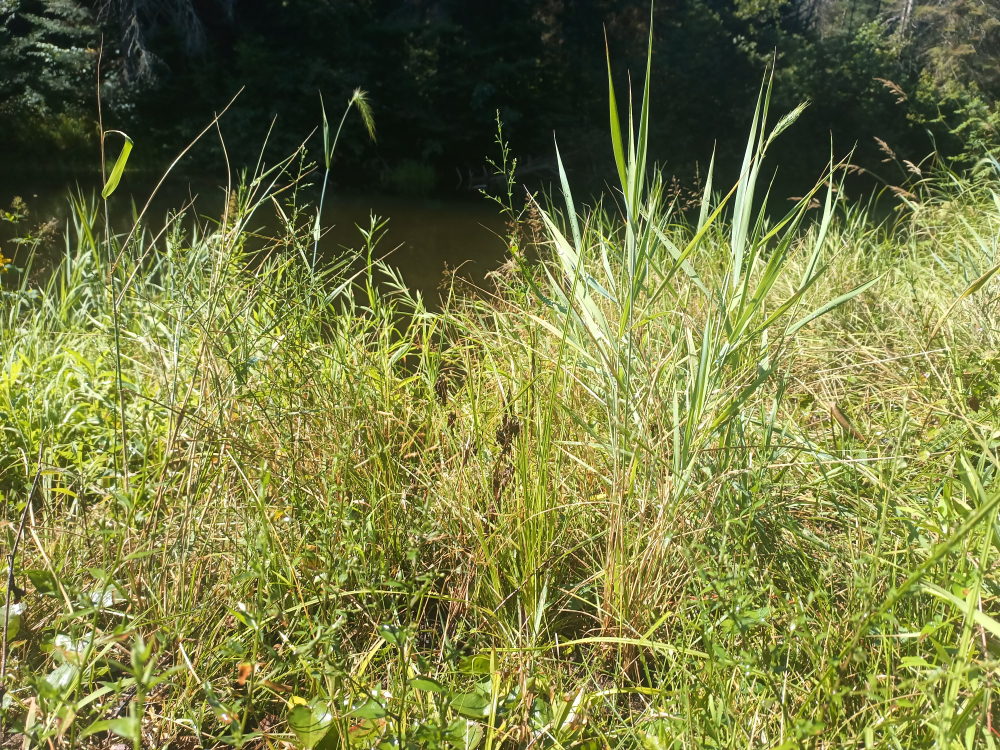
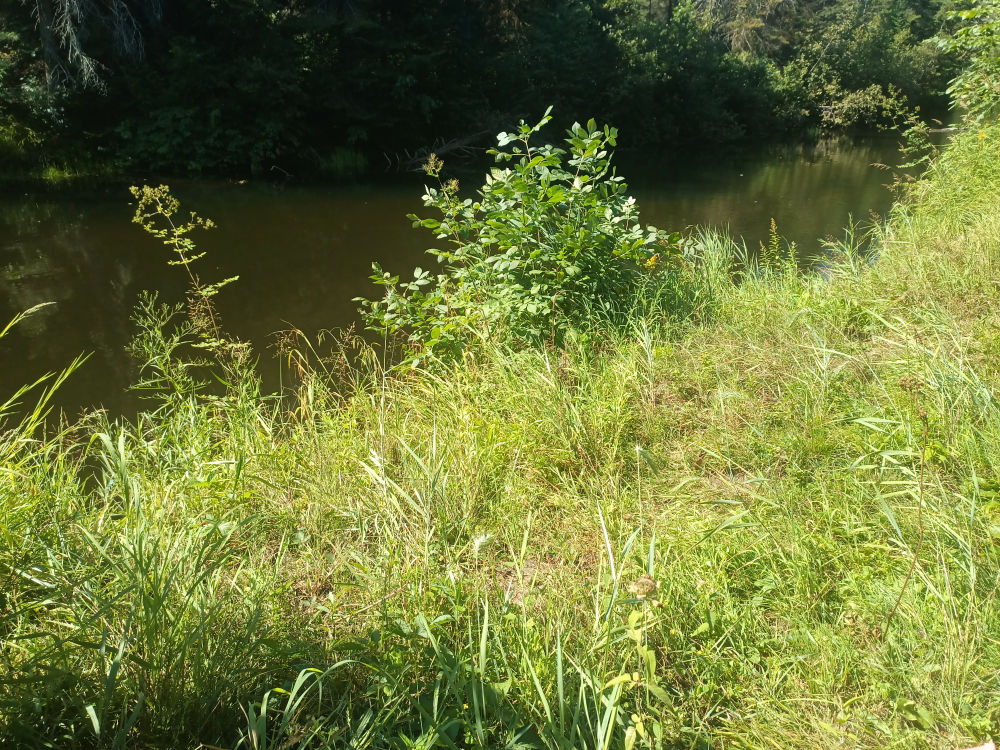
A 250 sq ft riverbank on the Irondale River required stabilization after vegetation removal triggered active erosion. The site presented compounding challenges: position on the outside of a river curve (where hydraulic force is strongest), sandy soil with minimal organic matter, full sun exposure, and a client requirement to maintain views from the cottage. The design needed to halt ongoing bank undermining while working within aesthetic constraints that ruled out conventional erosion solutions like riprap or dense shrub barriers.
Site Analysis Summary
Erosion Assessment
The erosion pattern proved more concerning than typical surface runoff damage. The bank was being undermined from beneath rather than eroded from above—water current cutting into the base of the bank, causing overhanging vegetation and exposed root systems. Fresh damage and unstable positioning of existing grass clumps indicated much of the visible erosion occurred within the current growing season. The river's hydraulics at outside curves naturally concentrate erosive force, making this a perpetually challenging location for bank stability.
The primary area spans approximately 50 feet of shoreline with a 5-foot minimum planting depth (expandable based on budget).
Light and Exposure
The area faces south with full sun throughout most of the day. This creates ideal conditions for sun-loving natives but contributes to the drier soil conditions that compound the sandy texture.
Soil Conditions
Field observation indicated very sandy texture with minimal organic matter in the cleared primary area. Organic content increased away from the eroded zone, suggesting two contributing factors: the clearing removed ongoing organic inputs from decomposing vegetation, and river movement naturally washes away or prevents organic debris accumulation.
The soil classification falls into moist but well-drained with a lean toward dry. Sandy texture dominates, particularly in the cleared area. This is poor soil by conventional standards but presents opportunity for stress-tolerant native plant communities.
Existing Vegetation Evidence
The adjacent vegetated area supports a diverse native plant community that provided direct evidence of what can establish in these conditions:
Ground Layer: Wild strawberry, sensitive fern, heartleaf asters, evening primrose, common blue violet, wild sarsaparilla, and wild columbine create diverse groundcover despite sandy conditions.
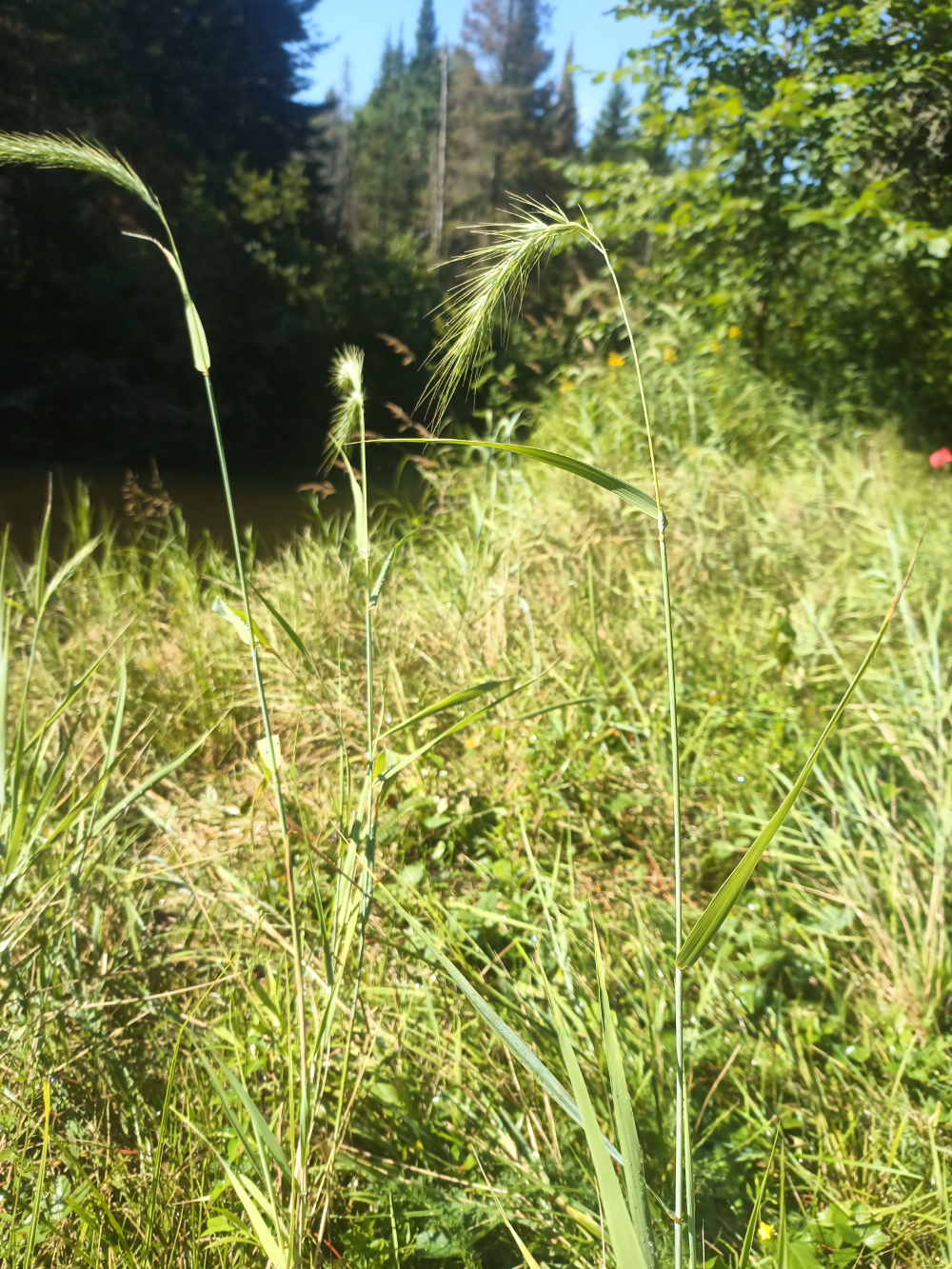
Grasses and Sedges: Existing wild sedges and grasses form much of the matrix, demonstrating adaptability to dry, sandy conditions and confirming potential for soil stabilization.
Canopy: White pine, spruce, and hemlock provide overstory with white pines positioned further from the shoreline—possibly indicating preference for less water-influenced conditions. Wild prunus contributes to the woody layer.
This existing community proved the site can support native diversity within appropriate species parameters.
Design Strategy
Constraint Integration
The design addressed multiple simultaneous constraints:
Active erosion: Required deep-rooted, spreading species capable of binding soil rapidly. The undermining pattern meant surface coverage alone was insufficient—root penetration depth became critical.
River curve hydraulics: The outside-curve position means ongoing hydraulic pressure regardless of planting. Any solution must assume continued stress rather than eliminate it.
View preservation: Client required maintaining sight lines from cottage to river. This eliminated dense shrub solutions and tall structural elements from the primary viewing corridor.
Sandy, low-fertility soil: Rather than amending soil (which would require ongoing fertility inputs and potentially favour weedy competitors), the design selected species adapted to stress conditions.
Seasonal timing: Client occupies property during cottage season. Bloom timing was weighted toward summer display, though fall grass colour became the primary seasonal feature.
Grass-Dominant Approach
The solution centred on native grasses as the primary functional and aesthetic element. Grasses provided:
- Deep root systems (Big Bluestem roots extend 8-15 feet) for erosion control
- Transparency for view preservation—tall but see-through
- Adaptation to sandy, dry, nutrient-poor conditions
- Fall colour and seedhead interest during shoulder season
- Low maintenance once established
This represents the naturalistic inversion: conventional landscaping would consider sandy, dry, nutrient-poor soil a problem requiring amendment. Here, these conditions favour stress-tolerant native grasses over aggressive competitors, reducing long-term weed pressure and maintenance.
Cool-Season / Warm-Season Balance
A mixed grass strategy addressed the establishment timeline concern:
Cool-season grasses (Canada Wild Rye, Slender Wheat Grass, Kalm's Brome) establish quickly and provide early coverage—critical for erosion control. They green up in early spring and may go dormant in summer heat.
Warm-season grasses (Big Bluestem, Little Bluestem, Indian Grass) establish slowly but persist for decades. They spend initial years developing root systems before substantial above-ground growth—the classic "sleep, creep, leap" pattern. These provide the long-term structural erosion control once established.
Canada Wild Rye was planted in large quantity (75 plants) specifically as a nurse crop: fast-establishing coverage while slower warm-season species develop roots.
Plant Community Structure
Matrix Layer: Grasses and Sedges (205 plants, 68%)
| Species | Quantity | Role |
|---|---|---|
| Canada Wild Rye | 75 | Quick establishment, early erosion control |
| Little Bluestem | 30 | Medium height, fall colour, drought tolerance |
| Muhlenberg's Sedge | 30 | Dry-site groundcover matrix |
| Slender Wheat Grass | 30 | Drought tolerance, sandy soil adaptation |
| Kalm's Brome | 30 | Cool-season variety, textural diversity |
| Indian Grass | 10 | Late summer golden panicles, deep roots |
Canada Wild Rye selection rationale: The site's active erosion demanded species capable of establishing within one growing season. Canada Wild Rye's quick establishment from plugs and moderate self-seeding maintains population even as individual plants (3-5 year lifespan) cycle out. The arching seed heads provide visual interest while the bunch-forming habit allows interplanting with slower species.
Little Bluestem selection rationale: Perhaps the best-adapted native grass for dry, sandy, nutrient-poor conditions. The fine-textured blue-green summer foliage and copper-orange fall colour provide year-round visual interest. Bunch-forming habit maintains clear boundaries. Roots establish slowly but persist 10+ years once mature.
Muhlenberg's Sedge selection rationale: Specifically adapted to sandy, dry conditions—one of few sedges that thrives where others struggle. Provides groundcover matrix that allows grasses to dominate above. Neat clumps expand gradually without aggressive spread.
Structural Layer: Big Bluestem (10 plants, 3%)
Big Bluestem was placed at edges of the primary planting area rather than throughout. This species grows 4-8 feet tall, potentially blocking views, so strategic placement frames rather than obscures the river. Root systems extending 8-15 feet provide the deepest erosion control anchor in the design.
The low quantity reflects both view concerns and establishment reality: Big Bluestem spends 2-3 years developing roots before significant above-ground growth. The design doesn't rely on this species for early erosion control but positions it for long-term bank stabilization.
Vignette Layer: Forbs (85 plants, 28%)
| Species | Quantity | Role |
|---|---|---|
| Wild Strawberry | 30 | Groundcover, runner spread, existing site species |
| Prairie Cinquefoil | 30 | White/cream summer flowers, dry site tolerance |
| Wild Bergamot | 25 | Pollinator value, lavender summer colour |
Wild Strawberry selection rationale: Already present on site, demonstrating established adaptation. Spreads by runners to fill gaps between grass clumps. Provides spring flowers and edible fruit. The lacey runner network allows coexistence rather than competition with other plants.
Prairie Cinquefoil selection rationale: Specifically adapted to dry, sandy, gravelly soils. Low-growing (30-60 cm) maintains view lines. White to cream flowers in mid-summer contribute to pollinator value without adding management complexity. Medium lifespan (4-6 years) but stable clumps maintain presence.
Wild Bergamot selection rationale: Superior pollinator value justified inclusion despite being medium-lived and potentially spreading. The aromatic foliage provides deer resistance (not a significant concern at this site but an added benefit). The lavender-pink flowers in mid to late summer provide the design's primary colour accent.
What Was Excluded
Taller forbs: Species like Joe-Pye Weed, New England Aster, or Ironweed would provide additional late-season colour but at heights (4-7 feet) that conflict with view preservation requirements.
Aggressive spreaders: Several prairie species with excellent erosion-control properties (e.g., some Solidago species) were excluded due to spreading habits that could dominate the small planting area.
Moisture-dependent species: Despite proximity to water, the sandy soil and raised bank position create dry conditions. Species requiring consistent moisture were inappropriate.
Additional flowering perennials: The extreme site conditions limited viable flowering options. The design prioritized functional erosion control with grasses while including flowering where conditions allowed. As noted in project documentation: "The extreme conditions do limit the number of flowering perennials we can successfully grow there."
Spatial Organization
Primary Area Strategy
The 50-foot shoreline length with 5-foot depth creates a linear planting bed. The design distributes plants to create:
Front (river) edge: Big Bluestem at edges for structural framing, with lower grasses (Little Bluestem, Canada Wild Rye) and sedge through the centre maintaining view transparency.
Middle zone: Forb vignettes (Bergamot, Cinquefoil) clustered in groups of approximately 5 plants, distributed rather than massed. These groupings are noted as placement targets for supplemental watering during establishment.
Back (cottage) edge: Transition to existing vegetation, with Wild Strawberry providing groundcover continuity.
Textural Balance
The design achieves approximately:
- 70% fine/medium texture (grasses, sedge)
- 30% medium/bold texture (forbs, structural grass)
This ratio reflects the functional priority of erosion control (grass root systems) over ornamental display (forbs). The fine grass texture maintains view transparency while the forb clusters create focal points that draw the eye without blocking sight lines.
Unifying Elements
Grass dominance: The shared grass character creates visual coherence across the primary area. Different species contribute varied heights and textures but the overall effect reads as "native meadow" rather than flower garden.
Fall convergence: While summer shows green grass and scattered flowering, fall transforms the entire planting into a unified display of bronze, copper, and golden tones. This becomes the primary visual feature.
Expected Development
Year One: Establishment
The "sleep" phase. Plants appear small relative to spacing. Cool-season grasses (Canada Wild Rye, Slender Wheat Grass, Kalm's Brome) establish visible above-ground growth. Warm-season grasses remain small tufts while developing root systems.
Wild Bergamot and Prairie Cinquefoil require supplemental watering during establishment (noted in maintenance guidance as groups of 5 plants, each receiving full watering can). By fall, expect 40-50% coverage with considerable bare soil visible.
Critical: Do not mow. Mowing prevents the root development essential for erosion control.
Years Two-Three: Community Formation
The "creep" phase. Warm-season grasses begin visible expansion. Big Bluestem develops substantial clumps. Canada Wild Rye self-seeds to fill gaps. Little Bluestem shows characteristic fall colour.
Root systems penetrate deeper into sandy substrate, beginning to provide structural erosion resistance. The bank may continue eroding at the immediate water edge—plants stabilize soil from the back, not the front.
Coverage reaches 70-85%. Supplemental watering no longer needed.
Years Four-Seven: Maturation
The "leap" phase. Big Bluestem reaches full height (4-8 feet at edges). Little Bluestem forms dense stands. Deep root networks provide genuine erosion resistance.
Annual maintenance drops to minimal levels. Self-seeded Canada Wild Rye maintains population as original plants decline. Bergamot patches expand and may need containment.
The bank stabilizes but ongoing hydraulic pressure at the river curve means some erosion likely continues at the water's edge. The planting prevents bank collapse, not river dynamics.
Limitations and Uncertainties
Honest Acknowledgments
The upstream dam variable: A new dam upstream is changing river flow patterns in potentially unpredictable ways. This introduces uncertainty beyond historical site observation.
View/function trade-off: Maintaining views required limiting the most effective erosion-control plants (tall shrubs, dense plantings) from core viewing areas. The design prioritizes client aesthetic requirements, which may reduce erosion-control effectiveness.
Flowering limitation: The extreme conditions significantly limit flowering perennial options. Clients expecting meadow-style wildflower displays will find this planting grass-dominant.
Summary
- Site assessment revealed active undermining erosion on outside river curve, sandy dry soil with minimal organic matter, full sun, and view preservation requirement
- This indicated stress-tolerant (S-strategy) plant selection, deep-rooted species priority, and transparency-maintaining heights
- Design constraints added quick establishment need (cool-season nurse crops), long-term stability (warm-season deep-rooted grasses), and limited flowering (site conditions don't support diverse forbs)
- Solution was grass-dominant design with cool/warm-season balance, strategic structural placement, and forb accents where conditions allow
- Result: A functional erosion-control planting that works with extreme site conditions rather than requiring ongoing amendment inputs, accepting aesthetic limitations (grass-dominant, fall-focused) inherent to matching plants to place
The methodology prioritizes bank stabilization through appropriate species selection over ornamental impact. The "poor" sandy soil and challenging conditions aren't problems solved but conditions embraced—exactly the conditions where stress-tolerant native grasses outcompete weedy alternatives.
Get updates by email
Fill out the form to get updates about Grounded and native plant gardening.