
Shaded Slope
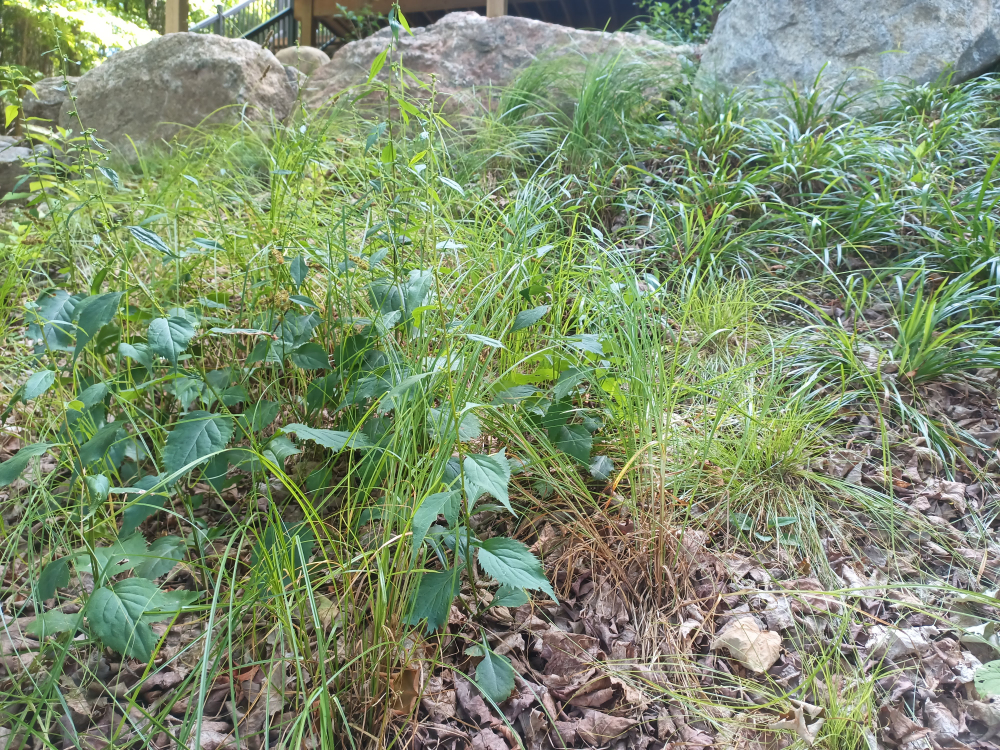
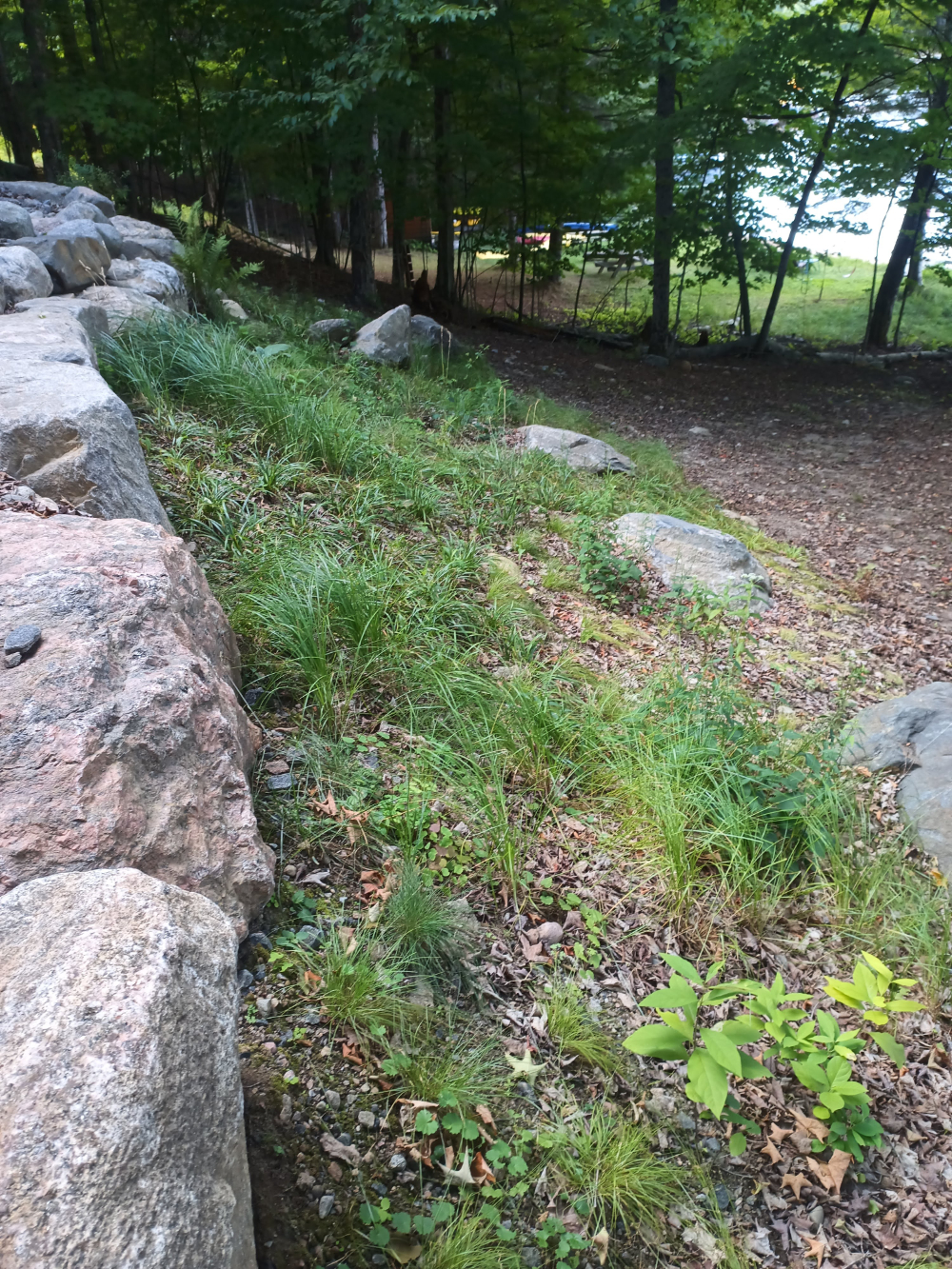
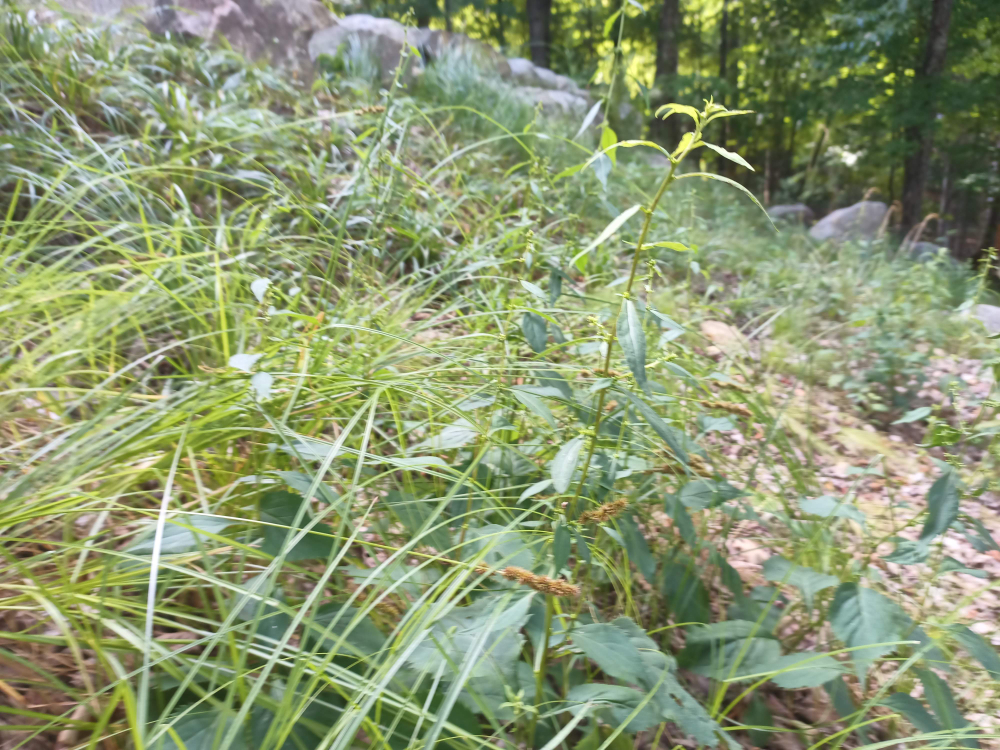
This shaded rocky slope needed erosion control after a new deck was constructed so we created a woodland garden. Installed June 2024.
Plant Selection and Layout Methodology
Project Overview
A north-facing slope behind a cottage after a new deck was constructed required transformation from bare disturbed soil to a functional woodland groundcover. The site presented classic shade garden constraints: less than three hours direct sun, competition from established deciduous canopy, and the visual prominence of a sloped planting bed viewed from the elevated deck and the lake. The design needed to establish quickly, suppress weeds without constant intervention, and provide seasonal interest for cottage residents.
The primary planting area covered approximately 700 square feet, with an additional rock terrace requiring formal shrub treatment. Installation occurred in June 2024.
Site Analysis Summary
Light Conditions
The site sits on a north-facing slope beneath mature deciduous canopy. North aspect combined with tree cover creates deep shade conditions throughout the growing season. This eliminates sun-demanding species from consideration and requires selecting genuine shade specialists—plants that thrive in low light rather than merely tolerating it.
The deciduous canopy creates a brief window of higher light before spring leaf-out, making early-season woodland species viable. By midsummer, however, the site receives 2-3 hours of sun at best.
Topography and Visibility
The sloped terrain creates both challenge and opportunity. Water moves downslope, creating variable moisture conditions—drier near landscaping rocks at one end, wetter elsewhere. More significantly, the slope is viewed from above, meaning the planting reads as a tapestry rather than a vertical arrangement. This influenced the decision to create textural interest across the horizontal plane through groundcover variation.
Existing Conditions
Prior to installation, the site showed disturbed, largely bare soil from construction activity. Some tree saplings had established during the disturbance period. The lack of established weed pressure—a consequence of shade and recent disturbance—provided a window of opportunity for native plant establishment without intensive site preparation.
Wildlife Considerations
Deer, rabbits, and turkeys are present. Rather than treating herbivory as a problem to eliminate, the design accepts some browse pressure as inevitable. Sedges, which form the bulk of the matrix layer, are less attractive to deer than many ornamental plants. The philosophy: plant densely enough that some loss to browsing doesn't compromise the overall planting.
Design Strategy
The Three-Layer Approach
The design uses a layered planting structure common to naturalistic woodland plantings: groundcover, vignette, and structure. Rather than spacing individual specimens, this approach creates a densely planted matrix that mimics natural woodland floor communities.
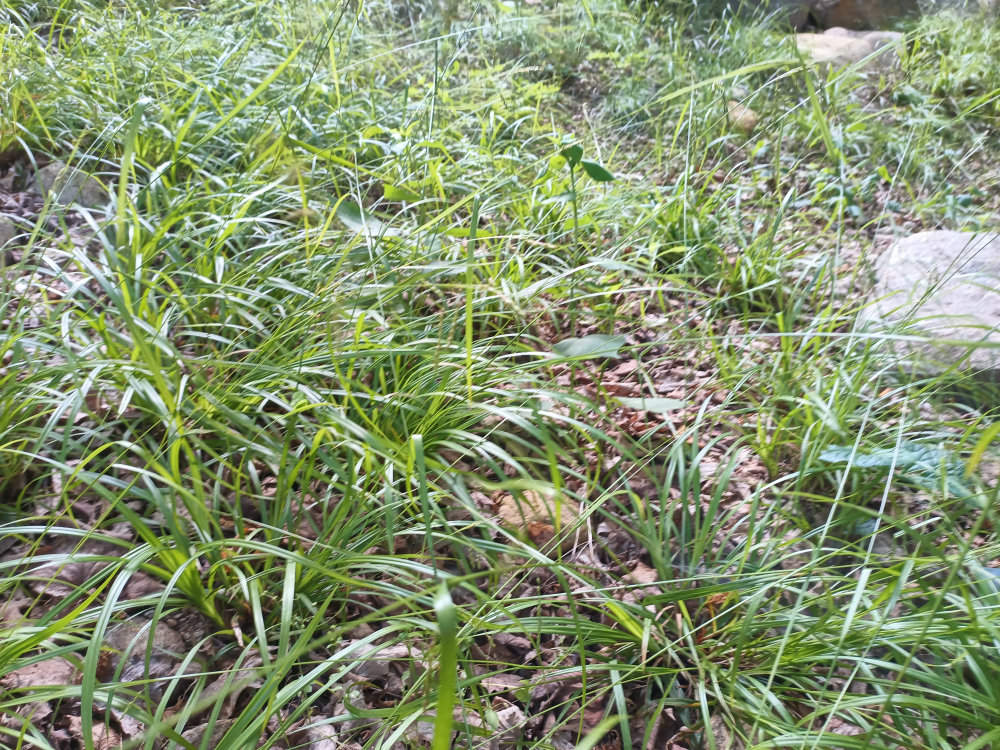
Groundcover layer (600+ plants, 77% of total): Three sedge species create a continuous low matrix that suppresses weeds once established. Sedges were chosen over conventional groundcovers because they grow actively in spring and fall when temperatures favour root establishment, tolerate deep shade, and provide textural interest through their grass-like foliage and seed heads.
Vignette layer (140 plants, 18% of total): Herbaceous perennials planted in groups of five or six, rising through the sedge matrix to provide seasonal flower interest. These species were selected to extend bloom from spring through fall during cottage occupancy.
Structure layer (12 shrubs, plus existing trees): Woody plants providing year-round framework. The main slope received two specimens for visual anchoring; the rock terrace received ten shrubs alternating between species for formal rhythm.
Why Three Sedges Instead of One
A single sedge matrix would create coherence but monotony. Using three sedges—Rosy Sedge, Fox Sedge, and Graceful Sedge—creates visual complexity without requiring different cultural conditions. Each has distinct character: Rosy Sedge with fine leaves and pink-tinted seed heads; Fox Sedge with fox-tail-shaped seed heads; Graceful Sedge with arching leaves and dangling seeds. Used together and planted in blocks, they create a tapestry visible when viewing the slope from above.
Plant Community Structure
Matrix Layer
| Species | Common Name | Quantity | Character |
|---|---|---|---|
| Carex rosea | Rosy/Wood Sedge | 200 | Fine, pink tint |
| Carex vulpinoidea | Fox Sedge | 200 | Fox-tail seeds |
| Carex gracillima | Graceful Sedge | 200 | Arching, bold |
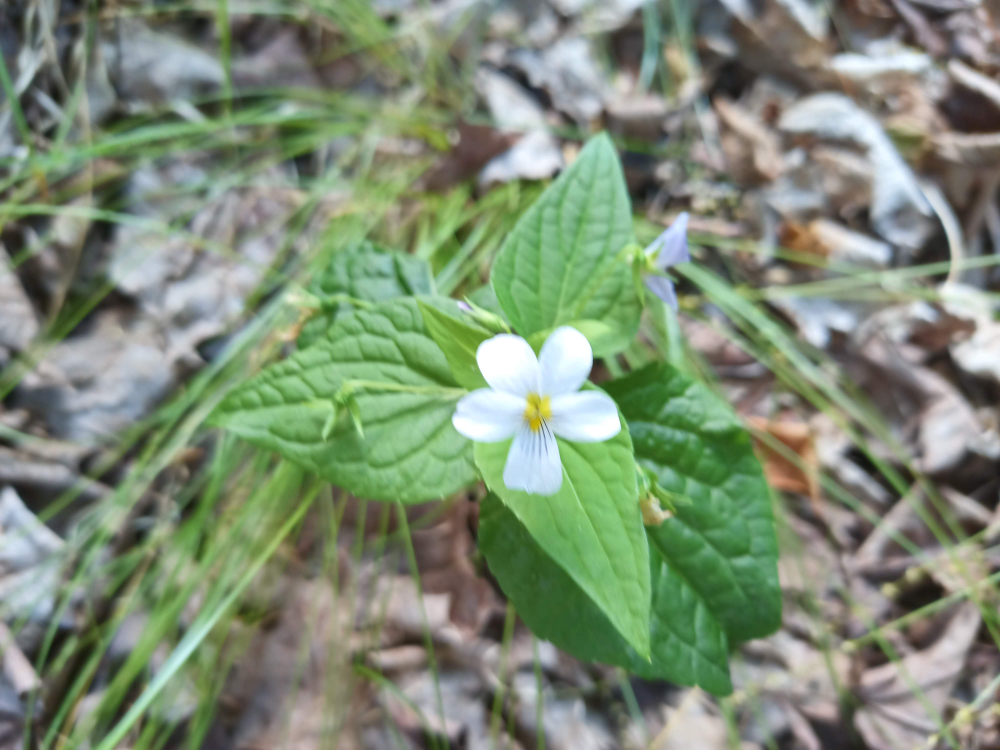
| Viola canadensis | Canada Violet | 10 | White flowers |
| Viola sororia | Common Blue Violet | 20 | Blue, self-seeds |
The violets serve as groundcover connectors, planted in groups of two or three throughout the site. Both species self-seed reliably, meaning initial placement matters less than providing establishment points. Over time, violets should appear in spaces between sedge clumps, creating a more naturalistic distribution than planned placement alone.
Vignette Layer
The vignette layer provides seasonal flower interest rising through the sedge matrix. Species were selected to cover the May-through-October occupancy window:
| Species | Common Name | Qty | Bloom | Role |
|---|---|---|---|---|
| Thalictrum dioicum | Early Meadowrue | 30 | May | Early season |
| Phlox divaricata | Wild Blue Phlox | 30 | May-Jun | Spring colour |
| Asclepias exaltata | Poke Milkweed | 20 | Jun-Jul | Monarch host |
| Solidago flexicaulis | Zigzag Goldenrod | 30 | Aug-Oct | Fall colour |
| Symphyotrichum cordifolium | Heart-leaf Aster | 30 | Aug-Oct | Late pollinators |
Each vignette species was planted in six groups of five or six plants, distributed across the slope. This grouping creates visible impact when blooming while allowing natural expansion over time. The zigzag goldenrod and heart-leaf aster provide critical late-season resources for pollinators preparing for dormancy.
Poke Milkweed deserves particular note. Unlike common milkweed, this species tolerates shade and occurs naturally in forest openings. It serves as a Monarch butterfly host plant, extending habitat value beyond pollinator support. Its distinctive drooping flower clusters provide visual interest when few other shade plants bloom.
Structure Layer
Main slope: Two shrubs provide woody framework within the herbaceous planting. Hobblebush (Viburnum lantanoides) was placed at the forest edge to soften the transition, its open habit and white spring blooms complementing the naturalistic approach. Alternate-leaf Dogwood (Cornus alternifolia) provides year-round interest through its distinctive tiered branching, white spring flowers, and colourful fall foliage.
Rock terrace: The upper terrace required a more formal treatment, with shrubs placed in a visible row against the stone backdrop. Winterberry (Ilex verticillata) and Grey Dogwood (Cornus racemosa) alternate along the terrace—five of each species. This combination provides: spring flowers (dogwood), summer/fall fruits (both), winter interest (winterberry's persistent red berries), and year-round structure. Both tolerate pruning for a more formal appearance if desired.
Spatial Organization
The sloped site naturally created micro-zones based on moisture and position. Rather than imposing rigid boundaries, the planting works with this variation. Sedges were mixed throughout rather than planted in discrete blocks, creating a naturalistic tapestry effect. Vignette groups were distributed to ensure bloom interest across the entire slope rather than concentrated in one area.
The rock terrace operates as a distinct zone—more visible, more formal, requiring species tolerant of the drier, more exposed conditions near the landscaping stones. The alternating shrub pattern provides rhythm and order appropriate to its prominent position.
Textural Strategy
Viewed from above, the slope reads primarily as texture rather than colour. The three sedges create fine-to-medium texture variation across the matrix. Vignette plants punctuate this with medium texture and occasional bold accents (meadowrue's compound leaves, milkweed's broad foliage). The shrubs provide bold structural anchors at key positions.
This textural approach means the planting provides visual interest throughout the season, not just during bloom periods. Even in midsummer when flowering is minimal, the interplay of sedge textures creates a living tapestry.
Trade-offs Accepted
- Deer browse: The design accepts some shrub damage rather than installing fencing or relying entirely on deer-proof species. Dense planting creates acceptable loss tolerance.
- Summer interest: Shade gardens are quietest in summer. The design prioritizes spring and fall bloom when woodland conditions favour flowering, accepting midsummer as a textural rather than floral season.
- Establishment period: Dense matrix planting creates awkward early appearance—visible soil, immature clumps. The design invests in long-term coverage over immediate aesthetic impact.
Expected Development
Years 1-2: Establishment
The sedge matrix needs time to fill. Expect visible soil between clumps, some plant losses requiring monitoring, and peak weed pressure (primarily tree saplings). Watering is critical during establishment, particularly in drier zones near landscaping rocks. The planting will appear sparse—this is normal.
Years 3-4: Filling In
Sedges spread and merge. Violets self-seed into new positions. Vignette plants mature and begin flowering reliably. Ground coverage approaches 85-95%. Weed pressure decreases as the matrix fills. The planting transitions from "installed garden" to "established community."
Year 5+: Mature Community
The planting functions as a stable woodland floor community. Management shifts from establishment support to occasional editing—removing tree saplings, adjusting species balance if any become too dominant. The design accommodates change rather than resisting it; the specific sedge ratio may shift over time, and this is acceptable as long as overall coverage and character remain.
Summary
- Site analysis revealed: North-facing slope, deep shade, variable moisture, deer presence, view from above
- This indicated: Shade-specialist matrix, herbivore-tolerant selections, textural rather than height-based interest
- Constraints filtered to: Sedge-based groundcover, woodland perennials for vignette, native shrubs for structure
- Design challenge was: Creating visual interest within tight constraints, avoiding monotony while maintaining coherence
- Solution was: Three-sedge textural differentiation, distributed vignette groups, formal rhythm on prominent terrace
- Result: A design that works with site conditions, requiring decreasing intervention as it matures
Get updates by email
Fill out the form to get updates about Grounded and native plant gardening.