
Woodland Clearing
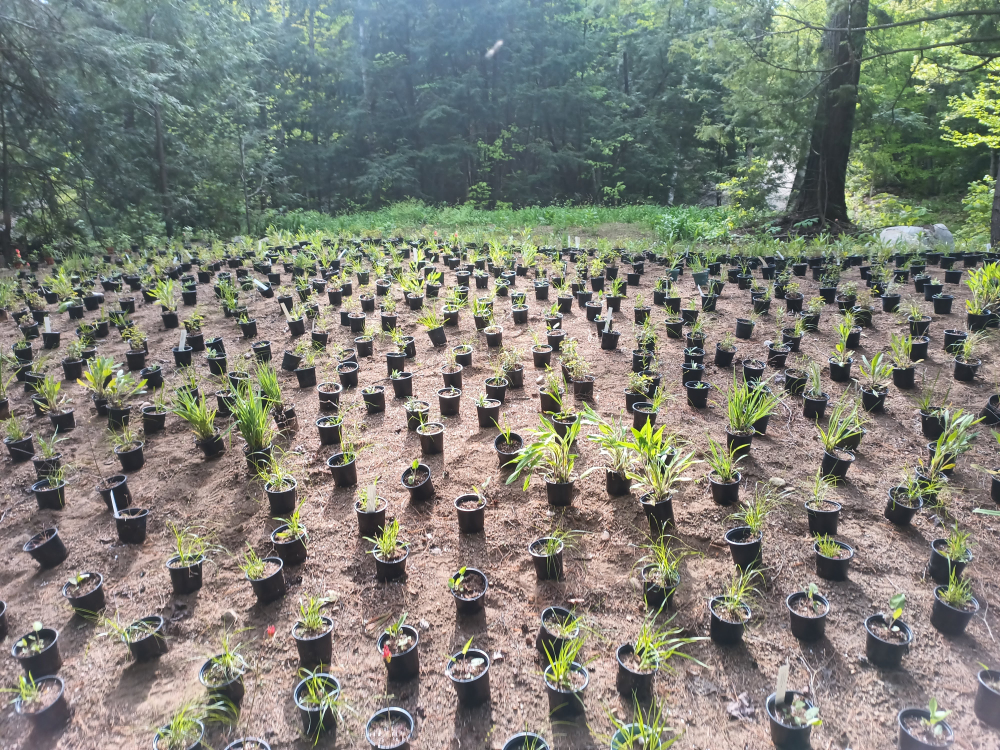
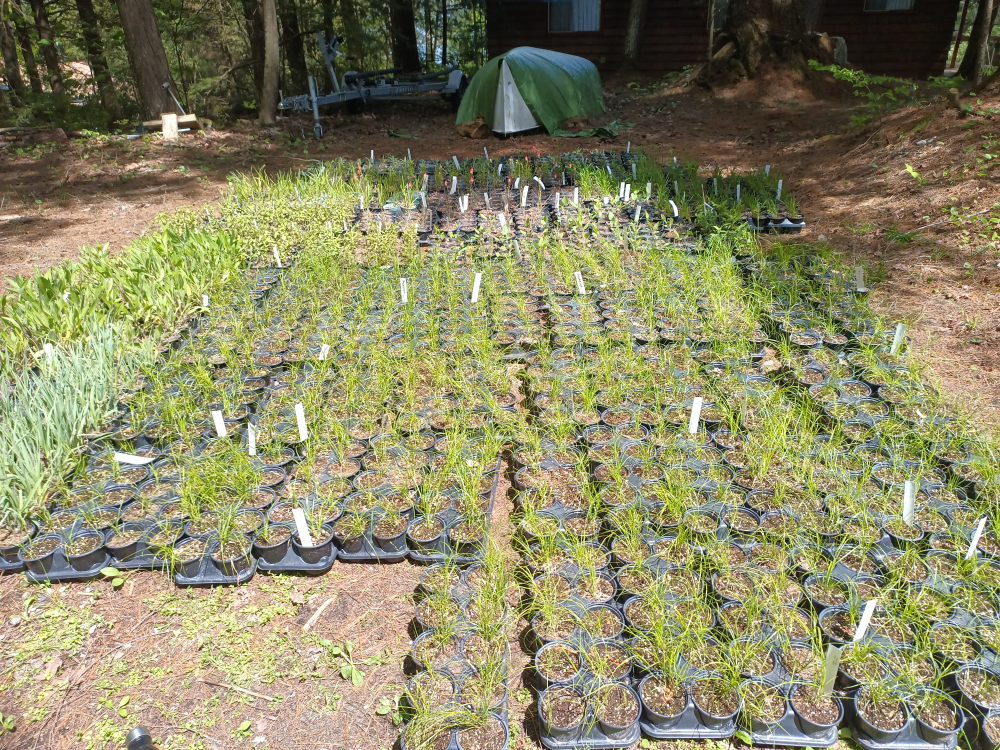
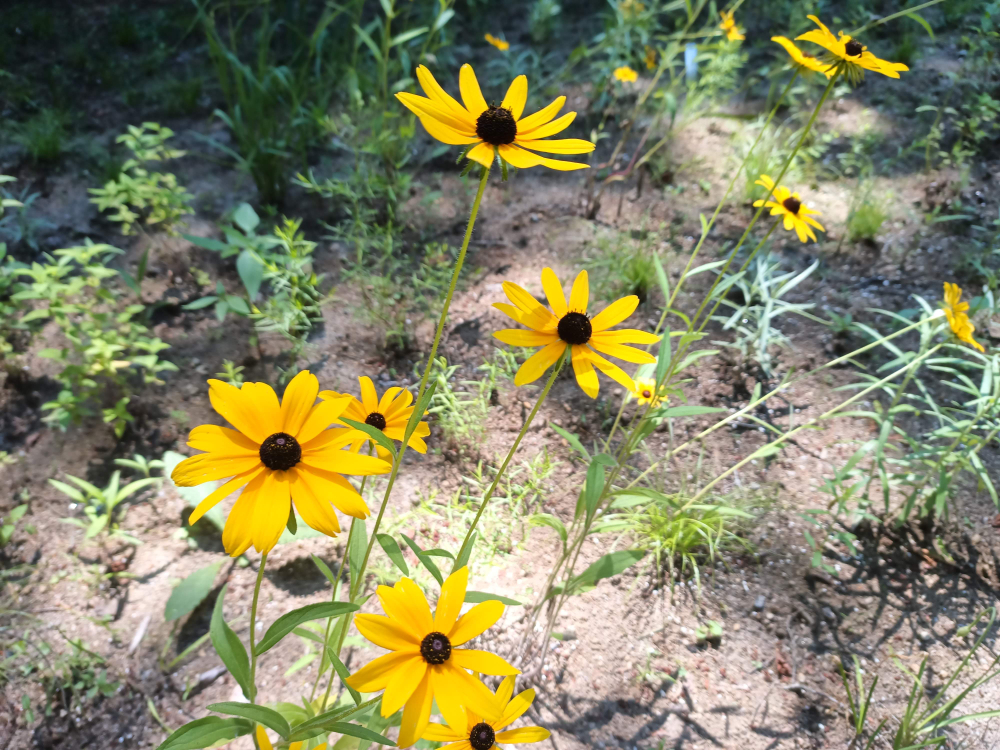
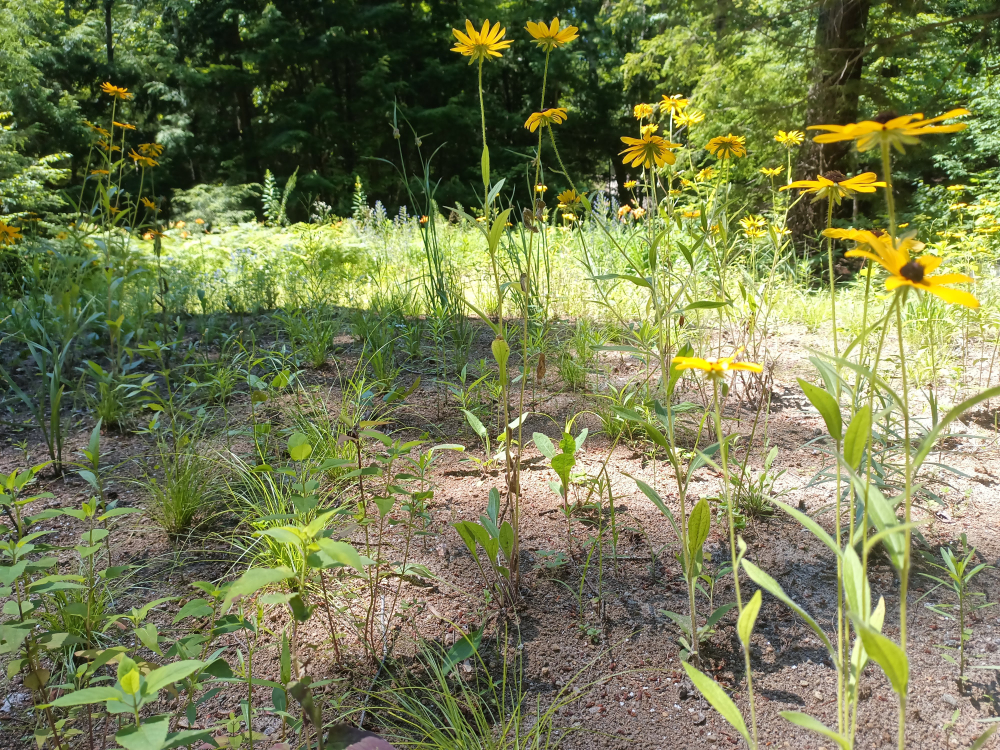
Taking advantage of a new septic leach bed to plant a meadow in a woodland clearing. We used plants to stabilize the bank at the side of the leach bed. Installed July 2025.
Plant Selection and Layout Methodology
Project Overview
A 1,220 sq ft septic leach bed at a Haliburton County cottage required transformation from bare sandy soil to functional native planting. The site presented layered constraints: part-sun conditions with woodland edge character, mandatory shallow-rooted plants over infrastructure, dry sandy substrate, deer presence, and seasonal cottage occupancy limiting the clients' experience to late spring through fall. The design needed to create both wildlife habitat and visual interest while respecting the septic system's requirements—with the added goal of screening boulders at the far end of the leach bed.
Site Analysis Summary
Light Conditions
The site receives part-sun exposure, creating a woodland glade microclimate. This intermediate light condition opens possibilities beyond deep shade specialists while excluding full-sun prairie species that would struggle without consistent direct exposure. The part-sun character influenced selection toward species tolerant of variable light conditions throughout the day and across seasons.
Substrate Conditions
The newly installed septic system was covered in builder's sand with virtually no existing vegetation. Rather than fighting this substrate, the design added topsoil to create a planting medium while maintaining the free-draining character appropriate to septic infrastructure. The sandy, well-drained substrate favours stress-tolerant species that don't require rich soil to thrive.
Site-Specific Constraints
Septic infrastructure imposes the most significant restriction: all plants must have shallow roots that won't infiltrate the leach bed, tolerate dry conditions, and avoid forming dense mats that could impede system function. This eliminates deep-rooted perennials and aggressive rhizomatous spreaders from consideration.
Boulder screening at the far end of the leach bed required taller plants capable of creating visual mass without violating root-depth restrictions.
Deer pressure exists throughout Haliburton County. While not all species needed ironclad resistance, the palette favoured deer-resistant or deer-tolerant selections.
Client Parameters
The clients occupy the property seasonally, meaning design investment needed to prioritize late spring through fall interest rather than early spring ephemerals that would go unseen. They expressed clear goals: groundcover to replace the bare soil, wildlife habitat value, erosion control on the sloping edge of the mound, and screening of the boulders. They wanted a landscape that appeared natural yet intentional—legible as designed rather than random.
Design Strategy
The Naturalistic Inversion
Conventional landscaping would approach a septic bed as a problem—poor soil, root restrictions, limited options. The naturalistic approach inverts this: the constraints become selection criteria that filter toward a coherent plant community. Species adapted to stress conditions (low fertility, dry substrate, restricted growing space) form stable communities with lower maintenance requirements than plants that need ongoing inputs to survive.
CSR Strategy Determination
Without a formal soil test, CSR determination relied on site observation and design intent:
Stress-tolerant (S) dominance suits the dry, sandy conditions. The septic substrate offers limited fertility and moisture retention, selecting for species that have evolved to thrive in lean conditions rather than demanding regular inputs.
Competitor-stress (CS) tolerance allows for some larger, more vigorous species in the screening role, where the need for visual mass justifies careful management of more assertive plants.
Ruderal (R) elements provide first-year colour and gap-filling dynamism. Short-lived species like Black-eyed Susan give immediate visual impact while longer-lived plants establish.
The Woodland Glade Concept
The design creates a pollinator meadow with woodland glade character—neither full prairie nor forest floor but the transitional zone between. This concept suits the part-sun conditions and creates a recognizable landscape type: warm grass scent in summer, buzzing insects, swaying seedheads catching evening light, bronze stems against winter snow.
Plant Community Structure
Matrix Layer: Rosy Sedge
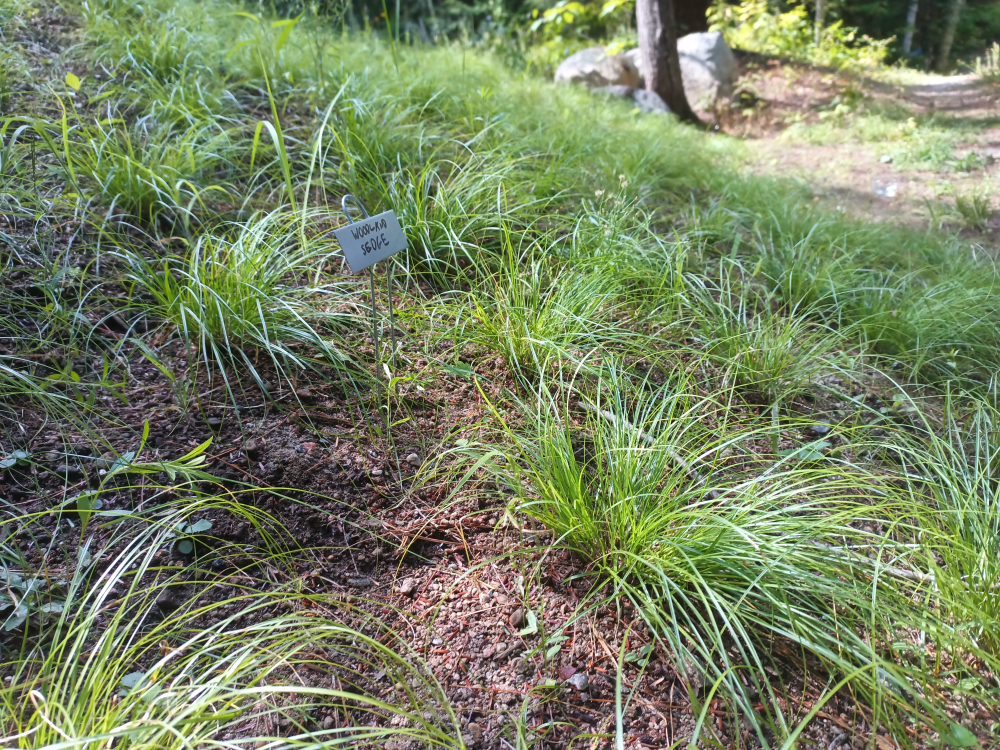
Carex rosea (Rosy Sedge) serves as the foundational matrix, comprising 50% of the total planting. Selection rationale:
- CSR profile: S-strategist adapted to stress conditions
- Root system: Shallow fibrous roots appropriate for septic overlay
- Light tolerance: Thrives in part-sun to shade
- Growth habit: Forms clumps that gradually expand without aggressive rhizomatous spread
- Seasonal interest: Greens up early in spring, flowers subtly in May, grows actively in fall
- Septic compatibility: Does not form dense mats that would impede drainage
The sedge matrix knits the planting together, providing consistent groundcover that allows vignette species to emerge and recede through the seasons. As individual clumps expand, they'll gradually close gaps while maintaining the loose, naturalistic character appropriate to the site.
Vignette Layer: Pollinator Community
The remaining 50% of planting consists of native perennials chosen for varying growth habits, bloom times, colours, and textures. These create seasonal interest from June through fall.
Narrowleaf Mountain Mint (Pycnanthemum tenuifolium) — 10% of planting
- CSR: CS (quick establishing, medium-lived)
- Superior pollinator attraction; one of the most valuable native nectar sources
- Aromatic foliage provides deer resistance
- Forms loose colonies through short rhizomes but not overwhelmingly aggressive
- Placed adjacent to other spreading plants (Pearly Everlasting, Wild Bergamot) where competition contains expansion
Wild Bergamot (Monarda fistulosa) — 10% of planting
- CSR: CS (spreading but manageable)
- Lavender-pink tubular flowers attract bees, butterflies, and hummingbirds
- Aromatic foliage deters deer
- Spreads assertively but contained by equally vigorous neighbours
- Provides mid-to-late summer colour during peak occupancy
Upland White Goldenrod (Solidago ptarmicoides) — 10% of planting
- CSR: S (slower establishing, longer-lived)
- Unusual white-flowered goldenrod providing late-season interest
- Compact, well-behaved clumps that don't spread aggressively
- Flat-topped flower clusters attract butterflies and bees
- Suits the dry, well-drained conditions
Azure Aster (Symphyotrichum oolentangiense) — 10% of planting
- CSR: S (moderate establishment, medium-lived)
- Sky-blue flowers provide critical late-season pollinator nectar
- Well-behaved clumps with clear boundaries
- Blooms September-October, extending the season into fall occupancy
Pearly Everlasting (Anaphalis margaritacea) — 10% of planting
- CSR: CS (dual spreading strategy—rhizomes and self-seeding)
- Silvery-grey foliage provides textural contrast
- Papery white flowers persist into winter
- Larval host for American Lady butterfly
- Placed adjacent to other spreaders for mutual containment
Canadian Columbine (Aquilegia canadensis) — 10% of planting
- CSR: R (classic ruderal—short-lived but self-seeding)
- Red and yellow flowers attract returning hummingbirds
- Scattered distribution allows seeds to naturalize across the landscape
- Individual plants short-lived (2-3 years) but colony persists through self-seeding
- Provides spring-to-early-summer colour
Ohio Spiderwort (Tradescantia ohiensis) — 5% of planting
- CSR: CS (spreads steadily but manageable)
- Blue-purple three-petaled flowers provide early summer colour
- Grass-like foliage complements the sedge matrix
- Scattered placement allows natural expansion
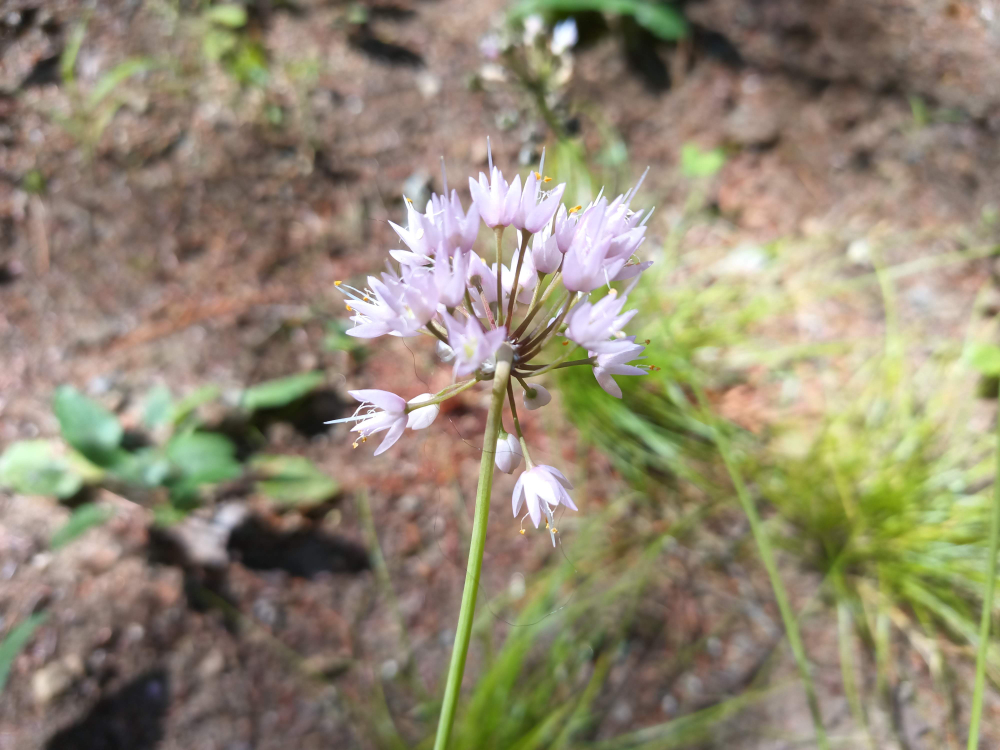
Nodding Onion (Allium cernuum) — 5% of planting
- CSR: S (slow but long-lived)
- Pink nodding flower heads provide mid-summer interest
- Deer and rabbit resistant (onion family)
- Forms small clumps, not aggressive
- Entire plant edible with mild onion flavour
Ruderal Component: Black-eyed Susan
Black-eyed Susan (Rudbeckia hirta) was included not as a percentage of the permanent planting but as an early-succession element. This classic ruderal species lives fast and dies young—providing bold yellow colour in the first two seasons while longer-lived perennials establish, then setting seed and gradually declining as the matrix closes. Its role is temporary gap-filling, not permanent presence.
Screening Layer: Woodland Sunflower
Woodland Sunflower (Helianthus divaricatus) — 2.5% of planting, placed at edges
- CSR: C (vigorous spreader)
- Heights of 90-180 cm provide screening at the far end of the leach bed
- Yellow daisy flowers in mid-to-late summer
- Spreads vigorously through rhizomes—contained by placement at margins and attention
This is the most aggressive plant in the palette, requiring ongoing management. Its inclusion reflects the screening requirement: no other shallow-rooted species achieves the necessary height. Placement at the far end of the leach bed positions it away from more delicate species and allows edge editing.
What Was Excluded
Prairie Smoke (Geum triflorum): Appeared in the initial concept document but wasn't in the final planting. While appropriate for dry conditions and deer resistant, its spring bloom timing occurs before clients typically arrive, reducing value relative to alternatives.
Little Bluestem (Schizachyrium scoparium): The concept document expressed preference for this grass given sufficient sun. The part-sun conditions determined that Rosy Sedge provided a more reliable matrix choice for the light levels present.
Aggressive rhizomatous spreaders beyond Woodland Sunflower were excluded or placed strategically. The design acknowledges that spreading plants can overwhelm a small site. By placing spreaders (Mountain Mint, Pearly Everlasting, Wild Bergamot) adjacent to each other, they compete with equals rather than overwhelming gentler neighbours.
Spatial Organization
Planting Pattern
The perennials are planted in clumps and drifts with repeating patterns, creating what the design describes as "loosely designed"—natural yet intentional. This legibility matters: visitors should recognize the landscape as designed rather than random without it appearing formal or regimented.
Sociability-based grouping influenced placement:
- More sociable plants (those that thrive in groups) were planted in clusters of five
- Less sociable plants (those that prefer individual space) were planted in twos and threes
- Aggressive spreaders were placed adjacent to each other for mutual containment
- Self-seeding plants (Columbine, Spiderwort) were scattered to allow naturalization across the entire landscape
Textural Strategy
The sedge matrix (50%) provides fine-textured groundcover throughout. Against this consistent base, vignette species create textural variety:
- Fine texture: Sedge matrix, Mountain Mint's narrow leaves
- Medium texture: Most flowering perennials
- Bold accents: Woodland Sunflower's large leaves, Wild Bergamot's whorled flowers
Bloom Sequence
The planting calendar ensures continuous interest during occupancy:
| Season | Primary Bloom | Foliage Interest |
|---|---|---|
| Late Spring | Columbine (red/yellow) | Sedge emerging |
| Early Summer | Spiderwort (blue), Nodding Onion (pink) | Full canopy |
| Mid Summer | Mountain Mint (white), Wild Bergamot (lavender) | Peak mass |
| Late Summer | Black-eyed Susan (yellow), Pearly Everlasting (white), Woodland Sunflower (yellow) | Seedheads forming |
| Fall | Azure Aster (blue), Upland White Goldenrod (white) | Bronze sedge |
This sequence ensures something is always happening during the May-October window clients experience.
Expected Development
Year One: Establishment
Plants concentrate energy on root development rather than impressive above-ground growth. Coverage expected to reach 60-70% by fall as sedge clumps expand. Watering required during dry periods of four or more days—deep and infrequent rather than shallow and constant. Weeding minimal given the lack of existing weed pressure in the clean substrate, though tree seedlings should be removed promptly given septic constraints.
Years Two and Three: Community Formation
Sedge matrix closes gaps. Black-eyed Susan reaches peak display then begins declining as perennial community matures. Columbine self-seeds into new locations. Spreading species (Mountain Mint, Wild Bergamot, Pearly Everlasting) begin testing boundaries—some editing required at margins. Woodland Sunflower may need containment at screening location.
Long-Term: Stable Community
By year four, the planting functions as a self-regulating community. The S-dominant matrix creates low competitive pressure from weeds. Annual tasks reduce to:
- Spring cutback of previous year's growth (or leave standing for winter interest and overwintering insects, cutting back in late spring)
- Occasional editing of spreading species at boundaries
- Removal of Woodland Sunflower runners outside designated area
- Enjoying the garden
Summary
- Site constraints identified: septic infrastructure requiring shallow roots, dry sandy substrate, part-sun exposure, deer pressure, seasonal occupancy
- Strategy determined: S-dominant community suited to stress conditions, with CS elements for screening and spreading pollinator plants, R elements for first-year colour
- Constraints filtered palette: shallow-rooted, drought-tolerant, deer-resistant species with bloom timing matching occupancy window
- Design challenge: creating visual interest and wildlife habitat within narrow restrictions
- Solution: sedge matrix (50%) providing consistent groundcover, diverse vignette layer (50%) providing seasonal progression, single screening species at margin
- Result: a "woodland glade pollinator meadow" that works with site conditions rather than fighting them
The methodology prioritizes matching plants to place. The septic bed's restrictions aren't problems but selection criteria. The sandy, lean conditions favour stress-tolerant natives that require no fertility inputs. The outcome should be a landscape that smells like summer, sounds like bees, and looks designed—natural yet intentional.
Get updates by email
Fill out the form to get updates about Grounded and native plant gardening.