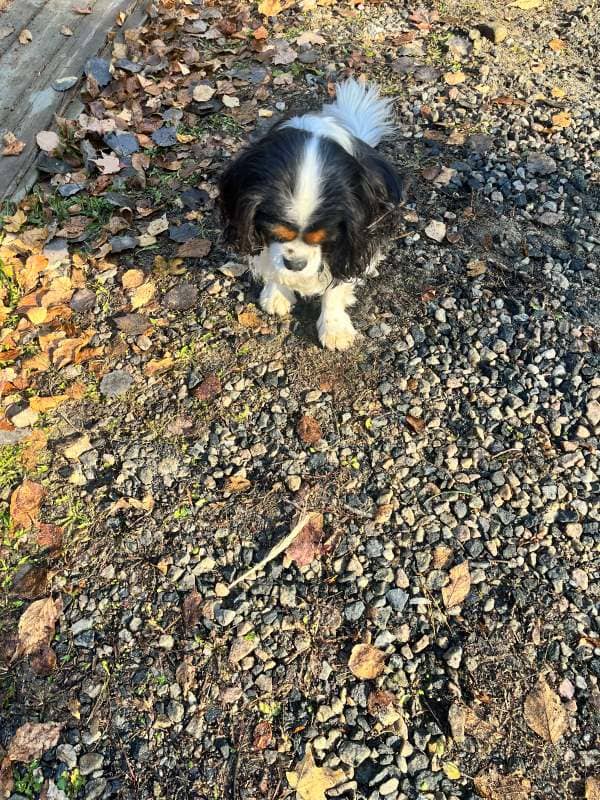
Rufus, who some of you are familiar with because he insists on putting his picture at the bottom of every newsletter, developed an obsession this year.
That obsession was rocks and stones: chasing them, trying to bury them, chewing (!) on them.
And that, as you might have seen if I visited you this year, is a problem. First, in case you hadn’t noticed, we have a lot of rocks and stones in Haliburton County. Second, he gets so excited at the rocks that he emits a series of high-pitch yaps that set my teeth on end. Third, chewing rocks isn’t recommended by his vet.
So Rufus has (reluctantly) gone back to school. I hired a dog trainer the other week. And as anyone who has a dog knows, dog trainers don’t actually train dogs, they train their owners. So now I know how to wean him off his obsession. I hope. We will see next year.
I mention this as an inelegant segue into talking about the obsession some of us have with our landscapes.
If you read the article linked below on “gardening that looks like wandering,” you’ll see that relaxation – going with the flow – is a key part of stewarding our landscapes.
It’s about allowing plants to do their thing and gently steering them in a way that suits you instead of controlling your landscape from the get-go.
It’s about being OK with some weeds and with your landscape not going how you planned, as long as it’s still going in a good direction.
It’s also about being OK with imperfection because, as I like to say, nature is perfectly imperfect. We don’t need to obsess about it being right.
Because it’s very seldom wrong.
Simon
Rufus being a very good boy and using every neuron he has to leave a feather alone. Yes, it’s feathers also.
If you want a Grounded garden…
At some point, the wrong landscape stops being something you’ll put up with.
If you’re ready to replace it with something that feels like here, I’d be glad to talk.
To see some of my recent work, please see this page.
Two edges that matter in a cottage landscape
Cottages have two edges: between the clearing and the forest, and between the clearing and the lake. This is where the work happens. Read more.
How we made a shoreline garden
Here’s the thinking behind a small shoreline planting we did last year. I visited it again this summer. It’s thriving. Read more.
The gardening that looks like wandering
How landscape stewardship starts by spending some pleasant time with your plants. Read more.
Now Available: The Unfinished Cottage Landscape
I’ve written a short book about my way of landscaping.
The Unfinished Cottage Landscape is about what happens when you stop fighting the land and start noticing what it’s already doing.
It’s for anyone who has ever sighed getting out of the car on a Friday evening, looking at what still needs to be done. And for anyone who suspects there might be a different way.
Click the button below to read more and order the book. Price is $15 with free shipping.
The great landscape designer Piet Oudolf chooses plants for fall as well as summer. To him, brown foliage and seed heads are as important as red and yellow flowers. I agree and try to do the same.
The last few warm weeks have given me time to poke around my backyard and Lucas House and notice what the plants are doing as they start to go dormant.
Photographing projects is hard, so this is the best I got.
The project was a big one, replacing suckering sumac and maple on a pretty steep slope. We added over 100 shrubs and hundreds of perennials this past spring. As you might be able to see from this picture taken in early October, it’s filling in quite nicely.
Today’s recommended reading
Start here: A super-useful article from a community newspaper about creating gardens using native plants. Read more.
Seeing the fungus among us: We already know how vast networks of fungi are essential to plant growth. A new technique allows scientists to see that network. Read more.
Good reeding: Great news from the Great Lakes, where once invasive phragmites are removed, native plants come back. Read more. A small step is big enough: Fixing a burning world seems overwhelming. This writer realized that doing something, however small, is the way to cope. It’s one reason I started Grounded. Read more.
Get the free guide
I’ve updated my guide to natural gardens in Haliburton County and surrounding areas.